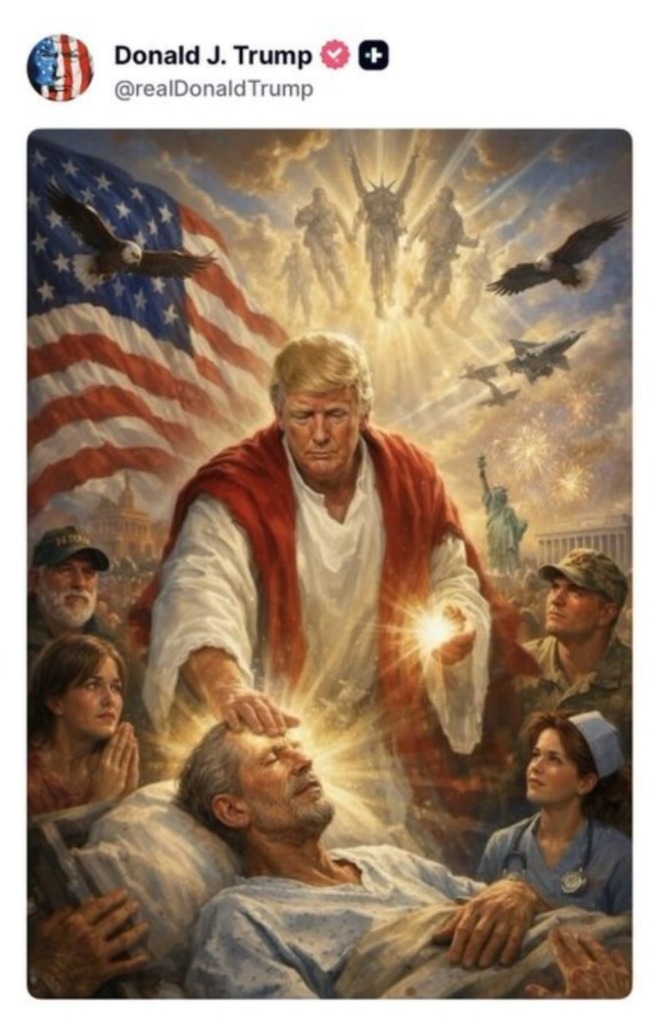
President Donald Trump posted an AI-generated image to Truth Social on Sunday, April 13, 2026, depicting him in white robes performing a healing miracle, a composition styled directly after classical Christian iconography of Jesus Christ laying hands on the sick. The image, posted on Orthodox Easter, showed Trump extending his hand over a man lying in a hospital bed, surrounded by soldiers, eagles, American flags, and a glowing Statue of Liberty.
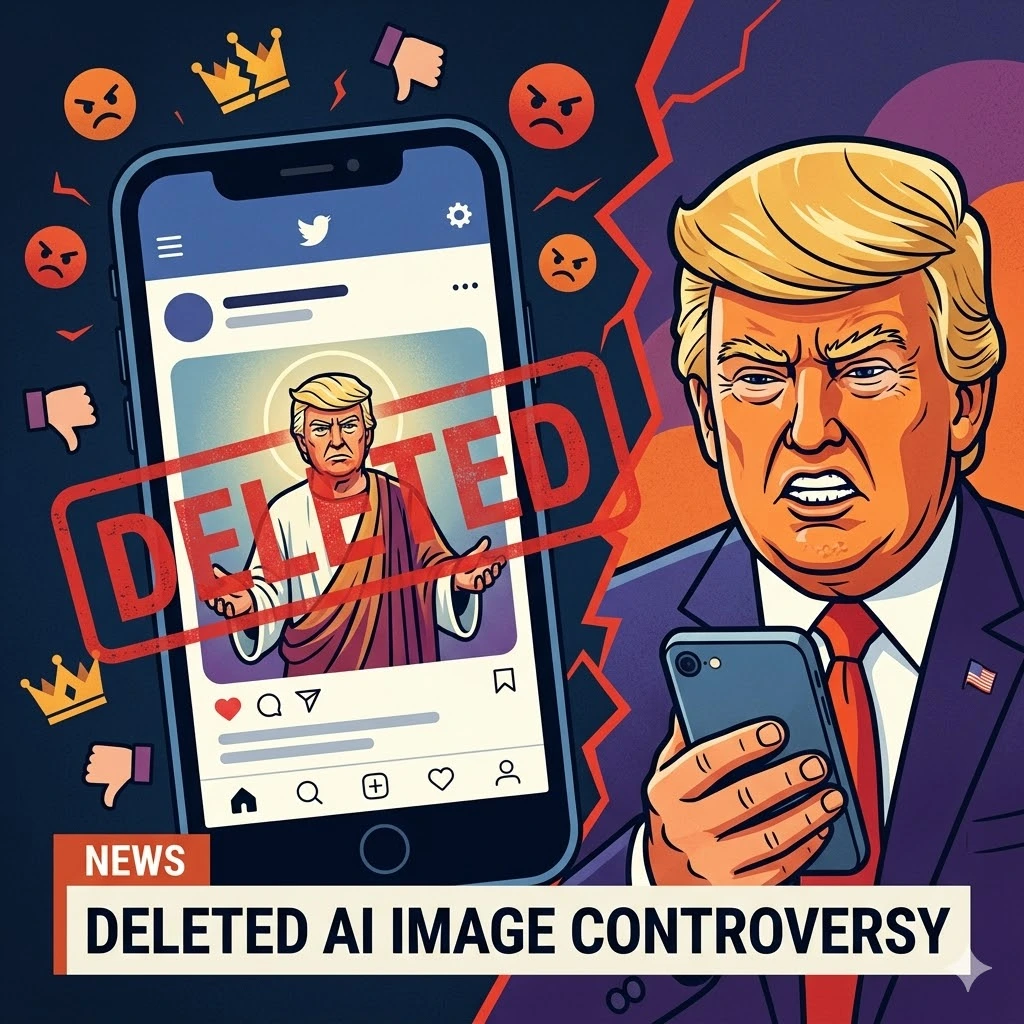
Trump deleted the post on Monday morning after the backlash came not from his political opponents, but from the evangelical Christian and conservative Catholic supporters who helped return him to the White House.
Trump told reporters on Monday that he thought the image showed him as a doctor, not a messianic figure. “It’s supposed to be me as a doctor, making people better. And I do make people better. Make people a lot better,” he said.
What the Image Showed and What It Was Posted Alongside
The AI-generated image posted by Trump on Orthodox Easter depicted him in traditional Christ-like robes with a red and white draping, extending a glowing hand over a man lying in a hospital bed. American military figures, eagles, fireworks, and the Statue of Liberty formed the backdrop. The composition directly mirrors classical Western religious paintings of the healing of the sick, one of the most recognizable visual formats in Christian iconography.
The post did not appear in isolation. On the same day, Trump separately targeted Pope Leo XIV (the first American-born Pope) in a lengthy public statement calling him “weak” and condemning the pontiff’s criticism of Trump’s war with Iran. Pope Leo XIV responded directly, stating he does not “fear” Trump and that his opposition to the war derives from the core teachings of the Gospel, specifically the Christian message of peace and dialogue.
Posting an image depicting oneself as a Christ-like healer on the same day as publicly attacking the leader of the Catholic Church, on Orthodox Easter, represented a convergence of provocations that Trump’s religious base treated as qualitatively different from his prior controversies.
The Reaction That Made Trump Delete the Post

The backlash that moved Trump to delete the image within 24 hours came from figures who had publicly supported him, campaigned for him, and built their platforms around his movement.
Conservative Christian activist and longtime Trump surrogate Sean Feucht called the image unacceptable in any context and demanded it be deleted immediately. Turning Point USA contributor Riley Gaines said a “little humility would serve him well.”
Republican National Committee youth advisory council co-chair Brilyn Hollyhand stated directly: “More deportations less Jesus comparisons.”
Christian influencer Mandy Arthur wrote on X: “God, we might have made a mistake and accidentally elected the Antichrist.”
Former Georgia Representative Marjorie Taylor Greene, who has been one of Trump’s most consistent congressional defenders, issued a comprehensive rebuke connecting the Jesus image to Trump’s broader Easter weekend conduct. “On Orthodox Easter, President Trump attacked the Pope because the Pope is rightly against Trump’s war in Iran, and then he posted this picture of himself as if he is replacing Jesus,” Greene wrote.
He further wrote that “This comes after last week’s post of his evil tirade on Easter, and then threatening to kill an entire civilization. I completely denounce this, and I’m praying against it.“
The cultural and religious firestorm around Trump’s deleted post occurred against the backdrop of the US-Iran ceasefire negotiations that his administration was simultaneously managing.
Faith-based MAGA influencer Steve Deace, slated to speak at Turning Point USA’s upcoming pastors’ summit in Texas, offered a more strategic warning than a moral rebuke: “Trump is absolutely right about this pope, but he should consider that he is walking into a trap. Asking one of the pivotal voting blocs in America to choose any politician over the most venerable office of their religion is a very tough ask.“
The Pope Feud That Preceded the Image
The Trump-Pope Leo XIV conflict that immediately preceded the Jesus image post is the context without which Sunday’s post cannot be fully understood. Pope Leo XIV (born in the United States, making him the first American to hold the office) publicly criticized Trump’s military operations against Iran and the humanitarian consequences of the conflict. Trump responded with a Truth Social statement calling the Pope “weak” and framing the criticism as interference in American foreign policy.
Pope Leo XIV’s response was measured and direct. He stated that he does not fear Trump and that his position on the Iran war is derived from the Gospel’s teachings on peace and dialogue, not political opposition.
The Pope’s statement positioned the disagreement as theological rather than political, a framing that made Trump’s subsequent Jesus image post appear to escalate from attacking the Pope’s authority to claiming the authority the Pope represents.
The strategic miscalculation Deace identified is precise: Trump’s evangelical and conservative Catholic base could absorb criticism of a specific pope’s political positions. They could not absorb an image suggesting the president occupies a role that those same voters treat as sacred.
The Jesus image post arrived during one of the most volatile weeks of Trump’s second term, the same week his administration was managing the fragile US-Iran ceasefire and publicly feuding with Pope Leo XIV over the conflict.
What the Post Reveals About AI-Generated Political Imagery
The image itself was AI-generated. A point several observers noted immediately. The composition is technically sophisticated, blending photorealistic Trump features into a classical religious painting style with a level of detail and symbolic density that would require hours of skilled artistic work to produce manually. AI image generation reduces the production time to minutes and makes this category of politically charged religious imagery trivially easy to create and distribute.
The image circulated widely before deletion. Screenshots captured and reshared across platforms ensured the post’s content remained visible well after Trump removed it. This is the standard dynamic of deleted social media content: the deletion removes the original distribution channel but cannot remove the copies already in circulation.
Trump’s Monday morning deletion removed the post from his Truth Social account. It did not remove the image from public consciousness, news coverage, or the political conversation it had already generated.
Trump’s explanation, that he believed the image depicted him as a doctor performing Red Cross work, was received skeptically across the political spectrum. The image contains no Red Cross symbols, medical equipment, clinical setting indicators, or any visual element that would distinguish it from classical Christian healing iconography. The composition is unambiguous to any viewer familiar with Western religious art.
The Honest Opinion
The post that unified opposition from inside the movement!
Trump’s deletion of the Jesus image is significant precisely because of who compelled it. The evangelical Christian community that forms one of the most reliable components of Trump’s electoral coalition drew a line on Sunday that his attacks on political opponents, mainstream media, and international institutions had not triggered. The line was not drawn over the Iran war, the Pope feud, or the genocidal threat against Iran that preceded both, all of which generated criticism from figures like Greene and Carlson without producing the same coordinated public rebuke.
The contradictory position is the one that Trump’s explanation attempts to occupy. If the image was genuinely misunderstood by its poster as depicting a doctor rather than a messianic figure, the misunderstanding required not recognizing one of the most visually distinctive iconographic formats in Western cultural history. A figure in white robes with glowing hands performing miraculous healing, surrounded by ethereal light, on the day Christians celebrate the resurrection.
Whether Trump genuinely did not recognize the imagery he posted, or recognized it and chose the explanation after the deletion, neither version resolves the underlying question his religious base is now asking publicly:
- What exactly does their support for this president mean?
- What does his conduct mean for them?
Frequently Asked Questions
1. Was this image actually made by Trump himself?
Almost certainly not. AI image generation tools produce compositions like this from simple text prompts. Trump likely received or reposted it, but posting it publicly makes the endorsement his, regardless of who generated it.
2. Didn’t Trump’s own supporters compare him to Jesus first, so why the outrage now?
There is a significant difference between supporters making spiritual comparisons privately and a sitting president officially amplifying that comparison on a national platform. One is devotion. The other is self-deification, and his base recognized the distinction immediately.
3. If he deleted it, doesn’t that mean the damage is already contained?
Deletion removes the original post, not the controversy. Screenshots circulated globally within hours. Every outlet covered it. The deletion actually extended the story’s lifespan by confirming the post was problematic enough to require removal.
4. Is attacking a Pope really that politically dangerous for Trump?
Individually, no. Criticizing a pope’s political position is defensible. But combining a papal attack with a Jesus self-portrait on Orthodox Easter in a single day created a compound provocation even loyalists could not rationalize away simultaneously.
5. Could this genuinely hurt Trump’s approval ratings?
His approval was already declining due to the Iran war. This accelerates existing erosion, specifically among religious conservatives, the demographic most likely to process this imagery as spiritually serious rather than politically theatrical.
Stay Connected, Stay Informed!
Political controversies, AI-generated media, and the cultural conflicts shaping the current US administration are covered at The IT Horizon. Subscribe to our newsletter. We track every development that matters at the intersection of technology, politics, and public discourse.