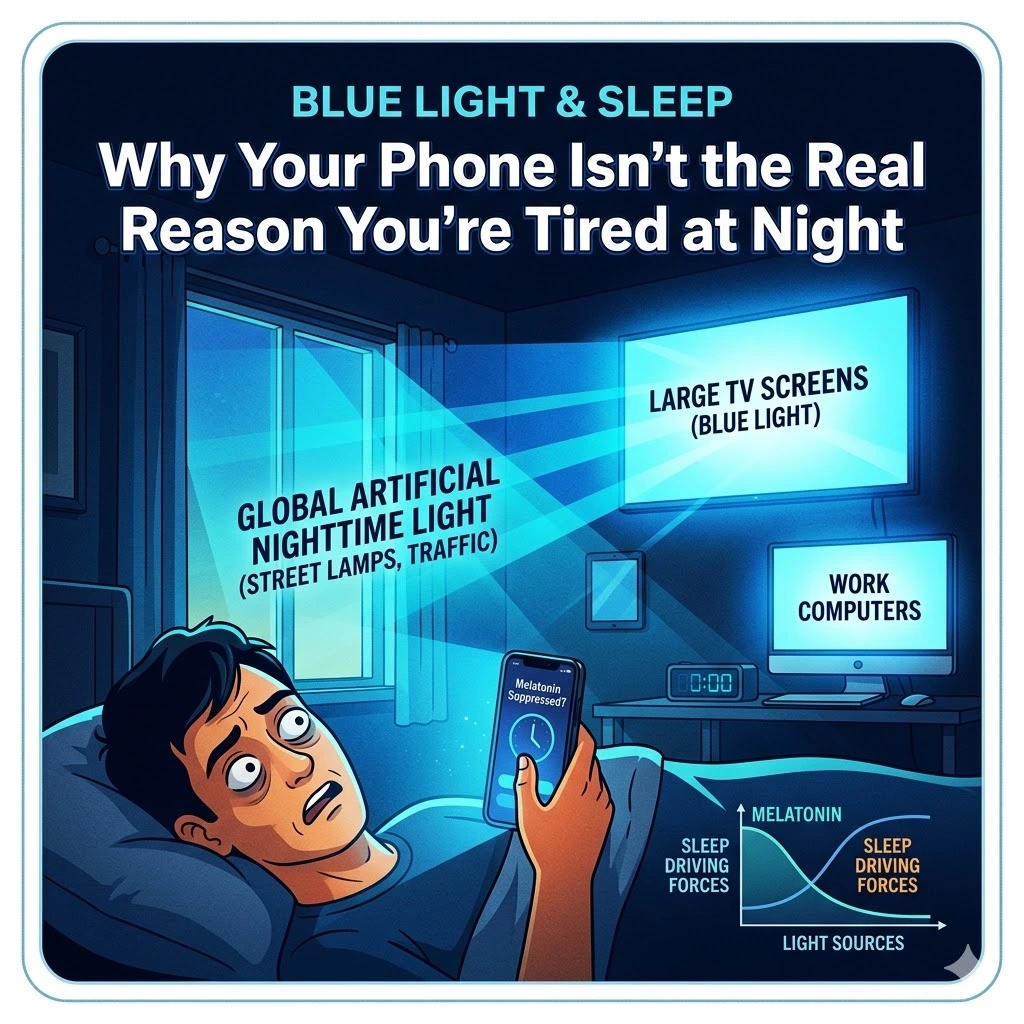
For years, we’ve been told the same story: blue light from phones, laptops, and TVs is destroying our sleep. It’s become one of the most repeated warnings in modern wellness culture. Night mode settings, blue-light glasses, screen filters, and entire industries have grown around the idea.
But newer research and sleep experts are now challenging that belief. The truth is more nuanced: your phone isn’t harmless, but it’s also not the main reason you can’t fall asleep at night.
So what actually is affecting your sleep, and why do we keep blaming screens?
Where the Blue Light Theory Came From
The concern around blue light largely began with early lab studies around 2014. In these experiments, participants who used LED screens before bed took longer to fall asleep and showed reduced melatonin production compared to those reading printed books.
This led to a simple conclusion: blue light from screens disrupts your circadian rhythm.
And while that sounds convincing, experts now argue the interpretation went too far.
Sleep researchers point out that these studies often used unrealistic conditions, dim environments all day, followed by controlled exposure to bright artificial light. That’s not how real life works.
In everyday settings, the amount of light emitted from phones and tablets is significantly lower than natural environmental light exposure.
What Science Now Suggests About Screens
Recent research paints a very different picture.
Studies reviewing multiple experiments suggest that screen use before bed may delay sleep by only a few minutes on average, far less than previously believed. In many cases, the delay is not clinically significant.
Also, the blue light narrative has been particularly influential in parenting discussions, and the same evidence gaps that undermine it apply to broader claims about screen time harming children’s development.
Another surprising finding is intensity. Even extended exposure to digital screens produces far less blue light than natural daylight. In fact, a full day of screen exposure can equal only a minute of outdoor sunlight in terms of light intensity.
This changes the conversation completely. If screens emit relatively low light, why are they still associated with poor sleep?
The Real Sleep Disruptors Aren’t Just Light
Experts now say the issue is not purely biological. It’s behavioural.
Your sleep is influenced by far more than just light wavelengths. Some of the strongest factors include:
- Mental stimulation from content: Scrolling social media, watching videos, or reading stressful news keeps your brain active long after your body should be winding down.
- Irregular sleep schedules: Going to bed at different times confuses your internal body clock more than screen exposure itself.
- Lack of daytime light exposure: Spending most of your day indoors weakens your circadian rhythm, making it harder for your body to recognise nighttime cues.
- Evening habits and routines: Late-night work, gaming, or binge-watching trains your brain to stay alert at the worst possible time.
In short, screens are part of the problem, but not in the way most people think.
Why Morning Light Matters More Than Night Light
One of the most important discoveries in sleep science is that daytime light exposure has a far greater impact on sleep quality than evening screen use.
Natural sunlight helps regulate your circadian rhythm. Getting bright light in the morning signals to your brain that it’s time to be awake. This strengthens your sleep drive later in the evening.
Experts recommend:
- Getting outside within an hour of waking up
- Spending at least 20–30 minutes in natural daylight
- Taking short outdoor breaks during the day
Even on cloudy days, outdoor light is far stronger than indoor lighting.
Without enough daylight exposure, your body becomes less sensitive to nighttime darkness cues, making it harder to feel sleepy at the right time.
Why Blue-Light Glasses and Night Mode Fall Short
Blue-light filtering tools have become extremely popular, but evidence supporting their effectiveness is weak.
Most studies show minimal or no meaningful improvement in sleep quality when using:
- Blue-light blocking glasses
- Night shift modes on phones
- Screen dimming filters
That doesn’t mean they’re useless, but they are not a solution to chronic sleep issues. Sleep disruption is one of the primary health risk indicators in older adults, a concern that connects directly to the growing market for medical alert systems designed to respond when health events occur during nighttime hours.
At best, they may slightly reduce alertness in sensitive individuals. At worst, they create a false sense of security while underlying habits remain unchanged.
The Bigger Problem: Modern Indoor Life
The real shift affecting sleep patterns isn’t screens. It’s a lifestyle.
Modern environments keep people indoors under stable artificial lighting for most of the day. This flattens the natural contrast between day and night that the human body relies on.
Without strong light signals in the morning and darkness at night, your internal clock becomes less precise.
That’s why so many people feel:
- Tired in the morning
- Alert late at night
- Inconsistent sleep schedules
It’s not just what you do at night, it’s how you spend your entire day.
How to Actually Improve Your Sleep
If you want better sleep, the solution is simpler than most people expect:
- Prioritise morning sunlight exposure
- Keep daytime environments bright and active
- Dim lights in the evening (not just screens)
- Avoid stimulating content before bed
- Stick to a consistent sleep schedule
These behavioural changes have a far greater impact than obsessing over screen filters or special glasses.
Conclusion
The idea that blue light alone is ruining your sleep is outdated. While it does play a minor role, it’s not the dominant factor behind poor rest.
Sleep is shaped by your entire environment, light exposure during the day, mental stimulation at night, and the consistency of your daily routine.
In reality, your phone isn’t the villain. Your lifestyle is the bigger story.
Sleep science is evolving just as fast as the technology we use every day. The next frontier in sleep research may involve continuous passive biometric monitoring, including contact lenses capable of tracking eye movement and alertness patterns throughout the day without any active user input. From screen myths to real circadian health factors, there’s a lot more beneath the surface than popular advice suggests.
Stay ahead of the noise with The IT Horizon. Subscribe to our newsletter for clear, research-driven insights into how technology is truly shaping your health, habits, and daily life.