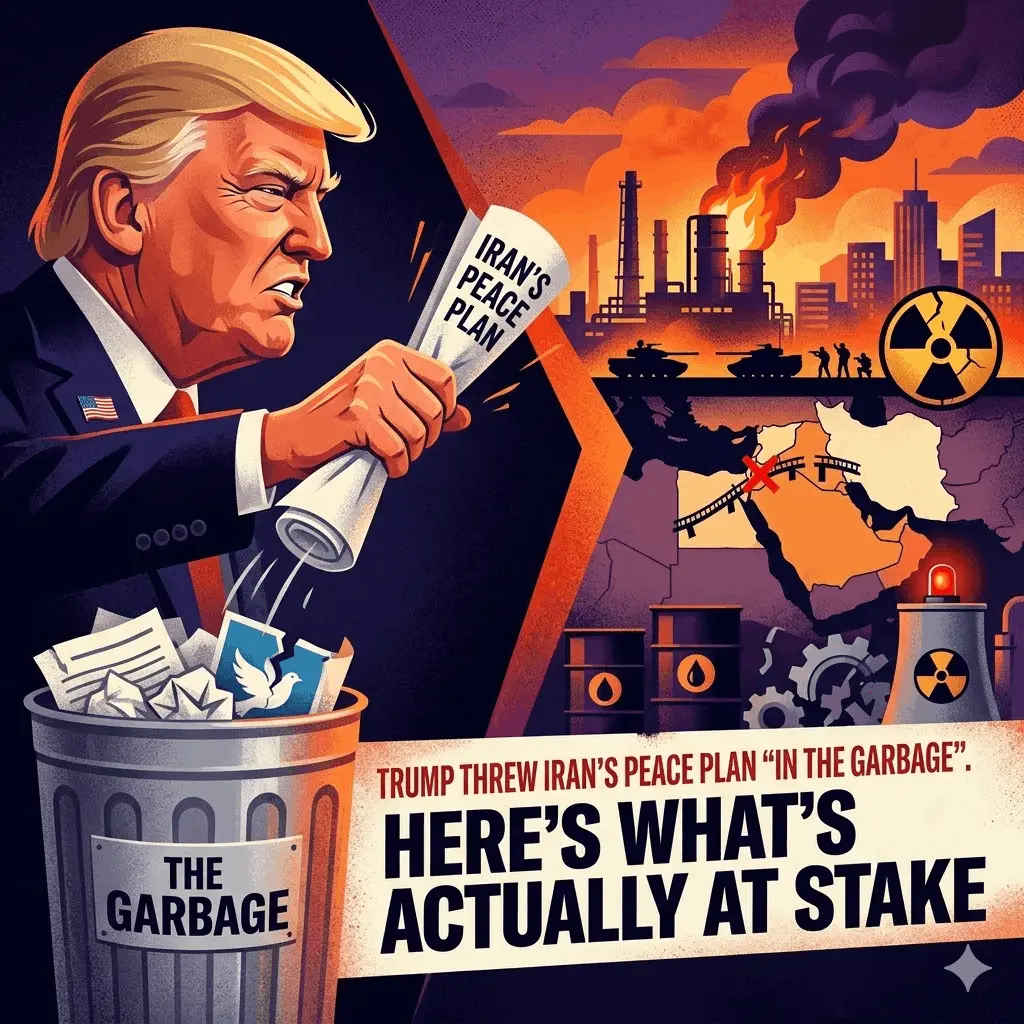
The US-Iran ceasefire negotiation framework collapsed into public contradiction on April 9, 2026, when White House press secretary Karoline Leavitt confirmed that Iran’s original 10-point peace proposal had been rejected outright by President Donald Trump and his negotiating team. The statement arrived after 38 days of active US-Israel military operations against Iran, and just hours after Trump’s own Truth Social post had described Iran’s 10-point proposal as “a workable basis on which to negotiate.”
The internet noticed the gap immediately.
What the White House Actually Said
Leavitt’s official statement on April 9 corrected what she described as widespread media inaccuracy surrounding the negotiations. The statement established 4 firm positions from the Trump administration simultaneously.
Iran’s original 10-point plan was “fundamentally unserious, unacceptable, and completely discarded.” A revised, modified proposal, distinct from the publicly circulated Iranian document, was determined to be “a workable basis on which to negotiate.” Trump’s red lines remain unchanged, specifically the complete end of Iranian uranium enrichment inside Iran. The ceasefire framework holds only as long as the Strait of Hormuz remains fully open with no limitations, tolls, or delays.
The US delegation leading the first round of negotiations, scheduled for Islamabad, Pakistan, on Saturday, comprises Vice President JD Vance, special envoy Steve Witkoff, and Jared Kushner. Pakistan’s role as host emerged directly from conversations between Trump and Prime Minister Shehbaz Sharif and Field Marshal Asim Munir, both of whom reportedly requested the US suspend military operations as a precondition for Iran’s agreement to open the Strait of Hormuz.
The Contradiction That Broke X
The public confusion surrounding the White House statement traces directly to Trump’s own Truth Social post announcing the ceasefire. The post stated: “We received a 10-point proposal from Iran, and believe it is a workable basis on which to negotiate. Almost all of the various points of past contention have been agreed to between the United States and Iran.”
Leavitt’s statement, 24 hours later, declared that the same 10-point proposal is “literally thrown in the garbage.”
The contradiction generated 2.1 million views on a single BRICS News post within hours. X users identified the discrepancy immediately. One user quoted Trump’s original statement verbatim alongside Leavitt’s and asked: “Then what did he agree to yesterday? Was it a blank sheet?” Another noted that Iran had published its 10-point terms publicly the moment the ceasefire was announced, while the US refused to disclose its own 15-point counter-proposal, creating an information asymmetry that fed the confusion directly.
JD Vance addressed the contradiction from Budapest, Hungary, stating the first Iranian proposal “was probably written by” parties other than Iran’s primary negotiating team, effectively arguing 2 separate Iranian proposals existed, only 1 of which the US considered legitimate. The public and media had access to only 1 of them.
The 4 Unresolved Issues Threatening the Two-Week Ceasefire
The US-Iran ceasefire agreement, reached after 38 days of conflict, suspends active military operations for a 2-week period. The suspension rests on Iran maintaining complete, immediate, and safe opening of the Strait of Hormuz. Beyond that single operational condition, 4 fundamental disputes remain entirely unresolved entering the Islamabad talks.
| Dispute | US Position | Iran’s Position |
| Uranium Enrichment | Complete end to all enrichment inside Iran | Recognition of Iran’s right to enrich uranium |
| Strait of Hormuz | Zero tolls, zero limitations, unrestricted passage | Formalized tolls of up to $1 per barrel on transiting oil shipments |
| Sanctions Relief | Not disclosed publicly | Permanent sanctions removal as part of any agreement |
| Lebanon and Hezbollah | The ceasefire does not extend to Lebanese territory | Lebanon was explicitly included in the ceasefire agreement |
The Strait of Hormuz dispute carries immediate economic consequences beyond the negotiating table. Iran has been charging ships a toll of up to $1 per barrel for oil transported through the strait. The largest supertankers carry up to 3 million barrels of crude per voyage, making the per-ship toll exposure as high as $3 million per transit. Only 11 vessels passed through the strait on April 9, consistent with the suppressed traffic levels recorded across recent days. Global oil markets are absorbing the supply disruption in real time.
Lebanon: The Ceasefire That Isn’t a Ceasefire
The Lebanon dimension of the US-Iran ceasefire agreement represents the sharpest factual disagreement between the 2 parties entering Islamabad. Iranian Foreign Minister Abbas Araghchi stated explicitly that Lebanon was included within the ceasefire framework. Both Israeli Prime Minister Benjamin Netanyahu and President Trump stated with equal explicitness that the ceasefire does not extend to Lebanese territory.
Israel intensified its offensive against Hezbollah in Lebanon on April 9. Strikes hit both commercial and residential areas in Beirut. At least 182 people were reported killed on Wednesday, the deadliest single day of the ongoing Lebanon conflict. The strikes continued under active ceasefire conditions, according to the US and Israeli interpretation of those conditions.
The practical consequence is a ceasefire agreement where 1 party considers active military operations in a neighboring country a violation of the agreement’s scope, and the other party considers those same operations entirely outside the agreement’s scope. Both claim the ceasefire is intact. Both are describing different ceasefires.
Iran’s Nuclear Programme: The Red Line That Has Not Moved
Iran’s nuclear programme is the central unresolved issue in every US-Iran negotiation framework attempted since 2003, and the Trump administration’s position entering Islamabad is structurally identical to its position before 38 days of military operations. Complete dismantlement of Iran’s domestic uranium enrichment capability remains the non-negotiable American demand. Iran’s original proposal reportedly sought US recognition of Iran’s right to enrich uranium alongside permanent sanctions relief and a guaranteed halt to future attacks.
These 2 positions are not close. They are not variations of the same framework awaiting technical refinement. Iranian enrichment either continues inside Iran or it does not, and both governments have stated their respective positions publicly, firmly, and without qualification, entering a 2-week negotiating window.
The nuclear stalemate has produced 1 consistent historical pattern across 4 previous US administrations: negotiated agreements that reduce enrichment activity without eliminating enrichment infrastructure, followed by Iranian reconstitution of that infrastructure after agreement terms expire or US administrations change.
The 2015 JCPOA, which Iran signed, the US joined under Obama, Trump exited in 2018, and Biden partially restored, followed this exact trajectory. The Trump administration’s 2026 red line reflects its 2018 position: enrichment infrastructure elimination, not enrichment reduction.
What X Got Right and Wrong Simultaneously
Public reaction to the White House statement on X divided sharply along 3 distinct interpretive lines, each capturing a real element of the situation.
The contradiction observers were correct on the factual gap. Trump’s Truth Social statement and Leavitt’s press briefing described the same Iranian proposal in irreconcilable terms within 24 hours. The explanation offered by Vance, that 2 separate Iranian proposals existed, is plausible but was never clarified in real time, producing entirely reasonable public confusion from a communication failure, not a media fabrication.
The skeptics of the ceasefire’s durability were correct on the structural substance. A 2-week suspension of hostilities with 4 fundamental disputes unresolved, a disputed geographic scope, and a nuclear red line separating the parties by the width of the entire Iranian weapons programme is not a peace framework. It is a pause.
The observers dismissing the negotiations entirely were wrong on one point. Islamabad represents the first direct high-level US-Iran negotiating contact of the Trump second term, brokered through Pakistan’s military and civilian leadership. The diplomatic channel now exists in a form it did not 2 weeks ago. Whether that channel produces anything depends entirely on whether either party moves on positions; neither has publicly indicated any willingness to move on.
Conclusion
The ceasefire was built on 4 unresolved contradictions.
The US-Iran ceasefire agreement of April 2026 is real in 1 specific sense: active military strikes between American-backed forces and Iranian territory have paused for 2 weeks. Every other element of the agreement is either disputed, undisclosed, or directly contradicted by one party’s public statements.
Iran published its terms. The US refused to publish its counter-proposal. Both sides claimed victory. The Lebanon question split the parties before Islamabad began. The nuclear red line has not moved on either side after 38 days of military operations that both governments describe as successful. And the Strait of Hormuz, the single operational condition on which the entire ceasefire rests, remains a live economic dispute with $3 million per supertanker in Iranian toll revenue at stake per transit.
The Islamabad talks beginning Saturday carry the weight of all 4 unresolved contradictions simultaneously. Diplomatic processes have resolved harder starting positions before. They have also collapsed under lighter contradictions. The 2-week window is not long enough to resolve a nuclear dispute that has resisted resolution for 23 years. It may be long enough to establish whether resolution is possible at all under the current leadership on both sides.
That is a meaningful outcome. It is also a considerably smaller one than either government’s victory declaration suggests.
The US-Iran situation is developing faster than daily news cycles can track. Subscribe to The IT Horizon newsletter. We cut through the noise on the geopolitical events reshaping technology, security, and the global digital infrastructure, so you stay informed on what actually matters.