
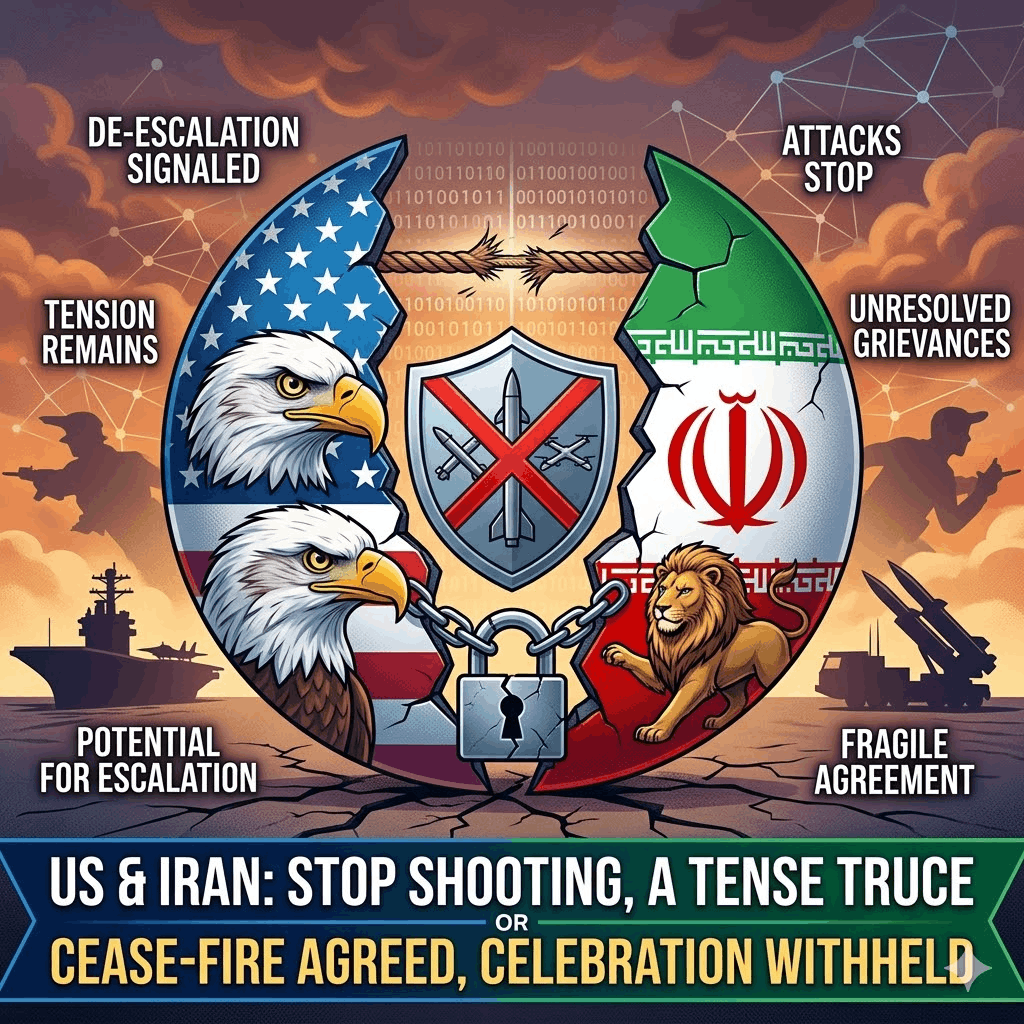
At 6:32 PM Washington time on Tuesday, April 7, 2026, roughly 90 minutes before a self-imposed deadline that carried the implicit threat of civilisational annihilation, Donald Trump posted on Truth Social that the United States and Iran had agreed to a two-week ceasefire. As a result of the ceasefire, oil prices immediately plummeted below $100 a barrel for the first time in days. US stock futures soared. In Tehran, people poured onto the streets. In Washington, relief was palpable in markets, if not in the public statements of every official involved.
The war that had consumed 40 days, killed 13 American service members, devastated Iran’s military infrastructure, and choked the world’s most critical oil shipping lane (Strait of Hormuz) had paused. Not ended, not resolved, not settled. Paused.
That distinction matters more than any headline suggests.
How Close It Actually Came
To understand why the ceasefire feels less like victory and more like a narrow escape, it helps to understand what Tuesday looked like before 6:32 PM.
Trump had set an 8 PM Eastern deadline: open the Strait of Hormuz or face strikes on Iranian power plants and bridges that he promised would be “devastating.” Two days earlier, in language that diplomats and historians struggled to categorise, he had written that Iran’s “whole civilisation will die tonight.” Whether that was negotiating leverage, a genuine threat, or the kind of statement that would be discussed in security studies classrooms for decades was genuinely unclear.
Republican Senator Ron Johnson, usually a Trump loyalist, said it would be a “huge mistake” to follow through. Texas Congressman Nathaniel Moran wrote that the destruction of a “whole civilisation” was “not who we are.”
Austin Scott, a senior Republican member of the House Armed Services Committee, told the BBC that the president’s comments were “counter-productive.” Even within Trump’s own coalition, something was straining.
On the other side, Iran’s Revolutionary Guards had been operating with increasing autonomy as the conflict progressed. Iran had attacked Saudi Arabia. Iranian drones had struck Kuwait, causing “significant material damage” to oil facilities, power stations, and water desalination plants. UAE air defences were engaging Iranian missiles. The escalation architecture was in place for something considerably worse than what had already happened.
That is the context in which the ceasefire was agreed. Not a planned diplomatic conclusion, a last-minute off-ramp that both sides needed for different reasons, arrived at via a country that neither side expected to be the one holding the door open.
The Country That Actually Stopped the War
Pakistan is not a superpower. It is not a permanent member of the UN Security Council. It does not have the economic leverage of China or the institutional credibility of the European Union in international mediation. What it has is a shared border with Iran, a historically “brotherly” relationship with Tehran, a Field Marshal that Donald Trump has publicly called his “favourite,” and a Prime Minister who was willing to operate as an intermediary in a conflict where almost everyone else with influence had an obvious stake in the outcome.
Pakistan’s Prime Minister Shehbaz Sharif had been passing messages between Washington and Tehran for weeks, operating through what a Pakistani source described to the BBC as “a very small circle” in a mood that was “sombre and serious but still hopeful.” Field Marshal Asim Munir was even more openly critical of Iran’s behaviour as the deadline approached, calling Iran’s attack on Saudi Arabia an action that “spoils sincere efforts to resolve the conflict through peaceful means.” That was some of the strongest public language Pakistan had directed at Tehran since the war began.
Whether that criticism added to the pressure on Iran to negotiate is debated. What is not debated is what happened at midnight in Islamabad: Sharif posted that diplomatic efforts were “progressing steadily, strongly and powerfully,” asked Trump to extend his deadline by 2 weeks, and asked Iran to open the Strait of Hormuz for the same period. Iran’s ambassador to Pakistan posted at 3 AM local time that there had been “a step forward from a critical, sensitive stage.” At just before 5 AM, Sharif announced that a ceasefire had been agreed and invited both sides to Islamabad on Friday for further talks.
The Rawalpindi Chamber of Commerce and Industry, in a joint statement from president Usman Shaukat and group leader Sohail Altaf, captured the national sentiment directly: “At a time when regional tensions had escalated to dangerous levels, Pakistan’s timely diplomatic efforts played a pivotal role in de-escalation. This achievement reflects Pakistan’s emerging role as a responsible and influential country on the global stage.”
Pakistan’s role was not incidental. It was structural. The only country with trust relationships on both sides that was willing to operate at this pace, at this hour, under this pressure.
What the Ceasefire Actually Contains and What It Does Not
Both sides have declared victory. Both sides have claims on which to base that declaration. Neither side has what it actually wanted.
The US position: Defense Secretary Pete Hegseth, at a Pentagon briefing on Wednesday, described Operation Epic Fury as “a historic and overwhelming victory on the battlefield.” Chairman of the Joint Chiefs of Staff General Dan Caine stated that US forces struck more than 13,000 targets in Iran, destroyed 80% of Iran’s air defence systems, more than 90% of Iran’s conventional navy fleet, and 90% of Iran’s weapons factories. “It will take years for Iran to rebuild any major surface combatants,” he said. Trump declared on Truth Social that the US had “met and exceeded” all its military objectives.
The harder question is whether the military objectives were the actual objectives. Iran’s enriched uranium, the foundation of its nuclear programme, remains unaccounted for. The Islamic Republic’s government, while battered, is still in power. The Revolutionary Guards, while degraded, are not disbanded. Caine himself acknowledged the ceasefire was “only a pause” and that US forces remained ready “if ordered or called upon to resume combat operations.” Hegseth acknowledged that Iran “can still shoot.”
The Iranian position: President Masoud Pezeshkian said the “general principles desired by Iran were accepted in the ceasefire deal,” attributing the ceasefire to the sacrifice of former Supreme Leader Ali Khamenei, killed in US-Israeli strikes on the first day of the war, and the resistance of the Iranian people. Iran’s 10-point plan, submitted to the White House via Pakistani intermediaries, includes the lifting of all primary and secondary sanctions on Iran, continued Iranian control over the Strait of Hormuz, US military withdrawal from the Middle East, the release of frozen Iranian assets, and a UN Security Council resolution making any deal binding.
It is difficult to imagine Trump accepting any of those conditions. Even Democratic Senator Chris Murphy said on CNN that if the agreement gives Iran the right to control the Strait of Hormuz, “that is cataclysmic for the world.”
The Revolutionary Guards said they would honour the truce but warned that their “finger was on the trigger.”
This is not a peace agreement. This is 2 sides exhausted from fighting, with legitimate reasons to stop for now, using a ceasefire to buy time for negotiations that will be, in the BBC’s Anthony Zurcher’s framing, “treacherous.”
The Strait of Hormuz: Open, But Not Normal
The single most economically consequential element of the ceasefire is the agreement that Iran would allow safe transit of vessels through the Strait of Hormuz. Through that 21-mile-wide waterway passes approximately 20% of the world’s oil supply, roughly 130 vessels per day, before the war began.
As of Wednesday morning, 2 vessels had transited the strait. About 1,000 ships remained stranded, including 426 tankers, 34 liquefied petroleum gas carriers, and 19 liquefied natural gas vessels.
Shipping experts moved quickly to dampen expectations of a rapid normalisation. Richard Meade, Editor-in-Chief of maritime publication Lloyd’s List, told CNN that shippers did not have the logistical details from Iran and that the system of intense screening in place before midnight had not changed despite the ceasefire announcement. That screening includes checking ownership, management, insurance, financing, and charter history of each vessel for any affiliation with the US or Israel.
Trade risk analyst Ana Subasic of Kpler estimated that only 10 to 15 ships are likely to pass through the strait each day under the current framework. At that pace, only 150 to 210 ships would transit during the entire 2-week ceasefire, leaving the bulk of the backlog in place when the deal expires.
Peter Sand, chief analyst at freight analysis firm Xeneta, framed the carrier’s dilemma directly: “The limited timeframe and fragile ceasefire raise the risk for any carrier returning ships into the Gulf that they could become trapped once again if there is another deterioration in the security situation.”
The Strait of Hormuz is technically open. Whether it functions is a different question entirely.
The Contradictions That Nobody Is Resolving
Iran is weaker and stronger at once. The US military campaign degraded Iran’s conventional military capabilities dramatically. But the same war that killed Khamenei and destroyed much of Iran’s physical military infrastructure may have consolidated the Revolutionary Guards’ internal power and hardened public sentiment behind the regime. One woman in Tehran told CNN: “This war has given the government the win of all wins, they are stronger than ever.” A 45-year-old man told CNN that those who had protested in January against the regime now felt “there is no way forward.”
The stated US objective was regime change. Trump explicitly told Iranians in February to “take over your government.” The actual outcome appears to be a regime that has more control, not less, over the Iranian population, which it was supposed to inspire to revolt.
Trump declared a historic victory over a country that still has missiles. Hegseth said US forces had achieved “every single objective on plan, on schedule.” He also said, “They can still shoot.” US intelligence, reported by CNN a week before the ceasefire, had assessed that roughly half of Iran’s missile launchers were still intact and thousands of one-way attack drones remained in Iran’s arsenal.
Israel is continuing to fight. The ceasefire between the US and Iran does not include Lebanon. Netanyahu’s office stated this explicitly. Within 10 minutes of the ceasefire taking effect, the Israeli Defence Forces completed what they described as the largest coordinated strike against Hezbollah in Lebanon since the war began, targeting more than 100 command centres and military sites simultaneously across Beirut, the Bekaa Valley, and southern Lebanon. At least 1,530 people have been killed in Lebanon since Israel’s bombardment began.
Pakistan’s role secured a ceasefire between 2 of the two parties. The third party has explicitly said it is not part of that ceasefire.
What Comes Next
On Friday, April 10, delegations from Iran and the United States are expected to meet in Islamabad for talks on a permanent settlement. The US delegation is expected to include Trump’s special envoy Steve Witkoff, his son-in-law Jared Kushner, and Vice President JD Vance. Iran has confirmed its participation, with parliament speaker Mohammad Bagher Ghalibaf likely to lead the Iranian delegation.
The gap between the 2 sides’ positions is vast. Iran’s 10-point plan and America’s stated objectives are not just different. They are structurally incompatible on several points. Iran wants to retain control of the Strait of Hormuz. The US explicitly does not want that. Iran wants sanctions lifted comprehensively. The US wants enrichment stopped and uranium removed first. Iran wants the US military withdrawal from the region. The US is discussing a “joint venture” to secure the Strait.
China, which is Iran’s largest trade partner and encouraged Tehran toward the ceasefire, according to multiple sources who spoke to AP, will be watching Islamabad closely without sitting at the table. China’s influence over Iran’s economic calculus is significant, and Beijing’s interest in a stable Strait of Hormuz is at least as large as Washington’s.
European leaders and Canadian Prime Minister Mark Carney issued a joint statement calling for “quick progress towards a substantive negotiated settlement.” UK Prime Minister Keir Starmer announced he would visit the Middle East following the ceasefire announcement. NATO Secretary General Mark Rutte was scheduled to meet Trump at the White House on Wednesday, a meeting whose tone would have been dramatically different 24
hours earlier.
The Cost That Has Not Yet Been Tallied
The ceasefire gives Trump a political off-ramp from what was becoming an increasingly exposed position. Approval ratings at their lowest ever. Republican senators breaking from the party. The economy is under pressure from oil prices above $100 a barrel. An 8 PM deadline with no good options on either side of it.
The ceasefire also gives him something to point to: 13,000 targets struck. 80% of Iran’s air defences destroyed. The Strait reopening. A 15-point plan framework is being negotiated. By the metrics Trump has chosen, it looks like a victory.
Whether the broader cost, to the international order, to America’s standing among allies, to the regional stability of the Middle East, to the 13 American service members who were killed, to the hundreds of Iranians who died in strikes, and to the 1,530 people killed in Lebanon, constitutes a price that justifies what was achieved is not a question that will be answered this week, or in the next 2 weeks of talks.
The BBC’s Anthony Zurcher put it most clearly: “The ceasefire is a reprieve, not a permanent settlement. The long-term cost of the president’s words and actions, and of the war overall, has yet to be fully assessed.”
Final Takeaway
Two weeks is a short time. Iran’s 10-point plan and America’s objectives are separated by conditions that neither side can easily concede. The Strait of Hormuz has 1,000 ships waiting and a coordination framework that has not yet been tested. Israel is still bombing Lebanon. The Revolutionary Guards have their finger on the trigger.
What exists right now is a pause, bought by a Pakistani prime minister operating in the middle of the night, extended by a US president who needed an off-ramp before a deadline he had set himself, and accepted by an Iranian regime that needed time to rebuild what it had lost. The world should be relieved. It should not be mistaken about what it is relieved about.
The war won’t end overnight, and neither will our coverage. Geopolitical developments, global security, and the decisions reshaping the world order, The IT Horizon covers every story worth knowing about, from the first shot to the final deal. Subscribe and stay informed.