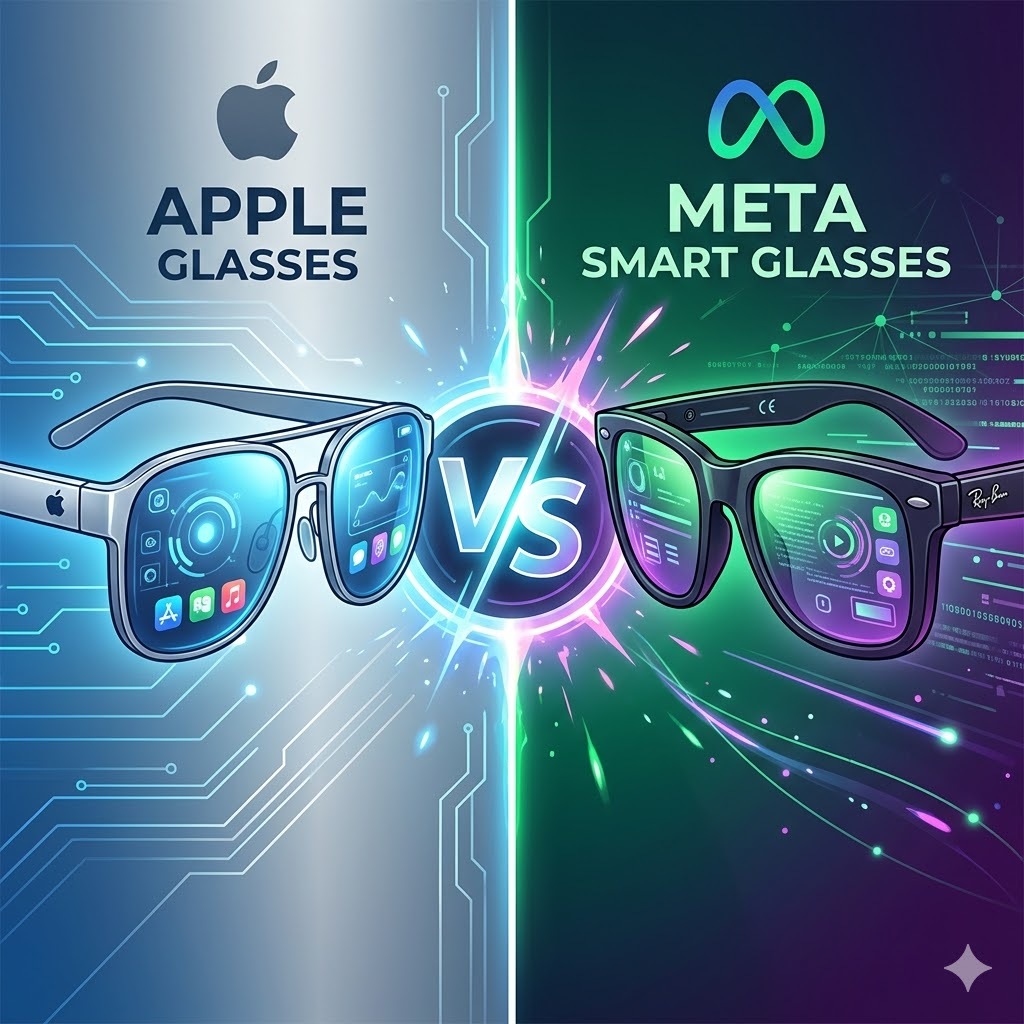
Apple’s smart glasses development is now confirmed as one of the company’s next major product categories. The project, internally code-named N50, is targeting a reveal at the end of 2026 or early 2027, with an actual consumer release planned for 2027. The glasses are display-free, no augmented reality overlay, and are designed to handle everyday tasks through camera capture, audio, and a significantly upgraded Siri powered by Apple Intelligence.
Apple did not add smart glasses to its product roadmap until around 2022, when Meta’s camera-equipped Ray-Ban collaboration demonstrated that consumer demand for the category was real. A product whose commercial success and documented social friction Apple has spent 3 years studying before entering the market.
What Apple Is Actually Building
Apple’s smart glasses development centers on 4 design variants currently in testing, with the company planning to launch some or all of them alongside multiple color options. The frames are constructed from acetate, a higher-end material known for durability and a premium feel compared to the standard plastic used by most competitors.
The 4 frame designs under consideration are:
1. Large rectangular frame: Reminiscent of Ray-Ban Wayfarers in proportion and style.
2. Slim rectangular frame: Similar to the glasses worn by Apple CEO Tim Cook in public appearances.
3. Larger oval or circular frames: A bolder, rounder silhouette distinct from the rectangular options.
4. Smaller refined oval or circular option: A more understated version of the oval design.
Color options in testing include black, ocean blue, and light brown. The camera system under consideration uses vertically oriented oval lenses with indicator lights surrounding them. A deliberate departure from the circular camera design Meta uses in its Ray-Ban products. Apple refers to the goal of creating an immediately recognizable design as the “icon” internally.
How It Fits Apple’s Broader AI Wearables Strategy
Apple smart glasses are 1 component of a 3-device AI wearables strategy Apple is developing simultaneously. The other 2 devices are new AI-capable AirPods and a camera-equipped pendant. All 3 devices are designed to use computer vision to interpret the user’s surroundings and feed contextual awareness into Siri and Apple Intelligence, enabling features including improved turn-by-turn navigation, visual reminders, real-time translation, and object identification.
The glasses will require a paired iPhone and will work with a significantly upgraded version of Siri arriving in iOS 27. Apple’s competitive positioning relies on 4 structural advantages over Meta and Google: its brand recognition, in-house silicon design, retail presence across 500+ global stores, and deep iPhone ecosystem integration that neither Meta nor Google can replicate on Apple’s platform.
While Google and Samsung are building their smart glasses in partnership with Warby Parker for frames, Apple is designing its hardware entirely in-house, consistent with the company’s historical approach to product differentiation through controlled design.
The Privacy and Camera Question the Industry Hasn’t Resolved
Smart glasses with cameras generate a documented social friction that predates Apple’s involvement in the category. Google Glass established this in 2013. Its camera indicator light and visible form factor made wearers identifiable, led to bans in restaurants, bars, and workplaces in San Francisco and beyond, and resulted in users having their glasses physically removed. Meta’s Ray-Ban glasses have replicated the same friction pattern on a smaller scale.
The specific concern is not that cameras exist, smartphones have carried cameras for 20 years, but that glasses cameras are wearable, always-positioned, and not obviously active to people being potentially recorded. Healthcare environments, schools, corporate workplaces with data loss prevention policies, and private social settings all represent environments where camera-equipped glasses create legal and interpersonal complications.
At least 1 healthcare organization implemented a same-day ban on Meta glasses after an IT department flagged child protection concerns about a staff member’s pair.
Apple’s MacBook camera hardware is hardwired to its indicator light. The light cannot be disabled in software without also disabling the camera. Whether Apple applies equivalent hardware-enforced transparency to its glasses cameras is unknown. Multiple users have documented that Meta’s privacy light has been bypassed, meaning software or physical modification can enable recording without the indicator activating.
True AR glasses, which would require cameras for environmental mapping and hand gesture detection regardless of photography capability, remain years away. Apple’s own internal timeline confirms this breakthrough is closer to the end of the decade.
The wearable camera anxiety Apple is navigating extends into an adjacent product category, arriving even sooner. Passive eye-tracking contact lenses that harvest continuous gaze data through any external camera raise the same unresolved questions about biometric data collection, consent, and surveillance in an even less visible form factor than smart glasses.
John Giannandrea’s Exit and What It Means for Siri
The glasses’ entire value proposition depends on a functional AI assistant. This makes the timing of Apple’s former AI chief John Giannandrea’s departure, confirmed for the week of April 15, 2026, directly relevant to the product’s trajectory.
Giannandrea, known internally as JG, joined Apple from Google in 2018 to lead machine learning and AI strategy. His tenure ended as a documented failure: Apple Intelligence launched to widespread disappointment, Siri improvements were repeatedly delayed, and the company was broadly assessed as having been caught off-guard by the generative AI wave.
In March 2025, Cook stripped Giannandrea of his oversight of Siri, robotics, and most AI teams. His remaining responsibilities, foundation models, and AI testing were distributed across software chief Craig Federighi, services head Eddy Cue, and operating chief Sabih Khan.
Gurman’s assessment of why Giannandrea failed is direct: Apple’s executive structure functions like a small family business with a narrow inner circle, and outside hires who are not part of that circle are not empowered to drive real change, regardless of their technical capability. The Siri that will power Apple’s smart glasses will be built by the people who replaced him.
Competitive Landscape: Where Apple Enters
| Product | Company | Camera | AI Assistant | Display | Release |
| Ray-Ban Meta Gen 2 | Meta + EssilorLuxottica | Yes | Meta AI | No | 2025 |
| Android Glasses | Google + Samsung + Warby Parker | Yes | Gemini | TBD | TBD |
| Apple Glasses (N50) | Apple | Yes | Siri (iOS 27) | No | 2027 |
| True AR Glasses | Apple (future) | Yes | Apple Intelligence | Yes | ~2030 |
Apple’s entry into the smart glasses market follows the same pattern as the Apple Watch: not first to market, not pioneering the category, but entering with tighter ecosystem integration and higher build quality than existing options, and ultimately reaching mainstream adoption that earlier category entrants did not.
Frequently Asked Questions
What are Apple smart glasses?
Apple smart glasses are display-free AI-powered eyewear that capture photos and videos, handle phone calls, play audio, deliver notifications, and enable hands-free Siri interaction through a camera and microphone system built into the frame.
When will Apple smart glasses be available?
Apple plans to reveal the glasses at the end of 2026 or early 2027, with consumer availability in 2027.
What is the internal code name for Apple’s smart glasses?
Apple’s smart glasses project is internally code-named N50.
How many frame styles is Apple testing?
Apple is testing at least 4 frame styles: 2 rectangular options and 2 oval or circular options, and will launch some or all of them at release.
Do Apple smart glasses have a display?
No. The N50 glasses are display-free. True AR glasses with a heads-up display remain years away, but Apple’s internal timeline places that product closer to the end of the decade.
Will Apple smart glasses require an iPhone?
Yes. The glasses are designed to sync with an iPhone and will require a paired iPhone for full functionality, including content editing and sharing.
What AI assistant powers Apple smart glasses?
A significantly upgraded version of Siri arriving with iOS 27 will power the glasses, integrated with Apple Intelligence for computer vision and contextual awareness features.
How do Apple glasses differ from Meta Ray-Bans?
Apple is designing frames entirely in-house using acetate rather than relying on a frame manufacturer partner. The camera design uses vertically oriented oval lenses rather than Meta’s circular design. The ecosystem integration runs through iPhone and Apple Intelligence rather than Meta’s platform.
Conclusion
Apple’s smart glasses’ competitive positioning is structurally strong; brand trust, hardware quality, and iPhone integration represent genuine advantages over Meta’s and Google’s offerings. The form factor, the acetate construction, and the multiple style options all suggest a product designed to be worn by people who care about how they look, not just what their glasses can do.
The contradictory position is the one Apple’s own track record makes unavoidable. Apple Intelligence launched to widespread disappointment. Siri has been reliably outperformed by Google Assistant and ChatGPT for years. The AI chief responsible for both failures just left the building. Smart glasses without a functional AI assistant are expensive earbuds with a camera attached, and Apple’s 2027 glasses will live or die on an upgraded Siri built by the team that inherited a damaged AI program, racing against Meta’s hardware iteration head start and Google’s Gemini integration advantage, with no confirmed evidence yet that the Siri problem has been solved.
Consumer frustration with AI tools that underdeliver on their promises is not limited to Apple’s ecosystem. The generation that will determine whether smart glasses reach mainstream adoption is already developing a documented skepticism toward AI products, with Gen Z reporting rising anxiety and anger toward AI tools even as their daily usage of those tools continues to grow.
Apple product developments, AI wearables, and the platform competition reshaping consumer technology are covered at The IT Horizon. Subscribe to our newsletter. We track every product reveal, design leak, and competitive shift in the tech industry before the launch event.