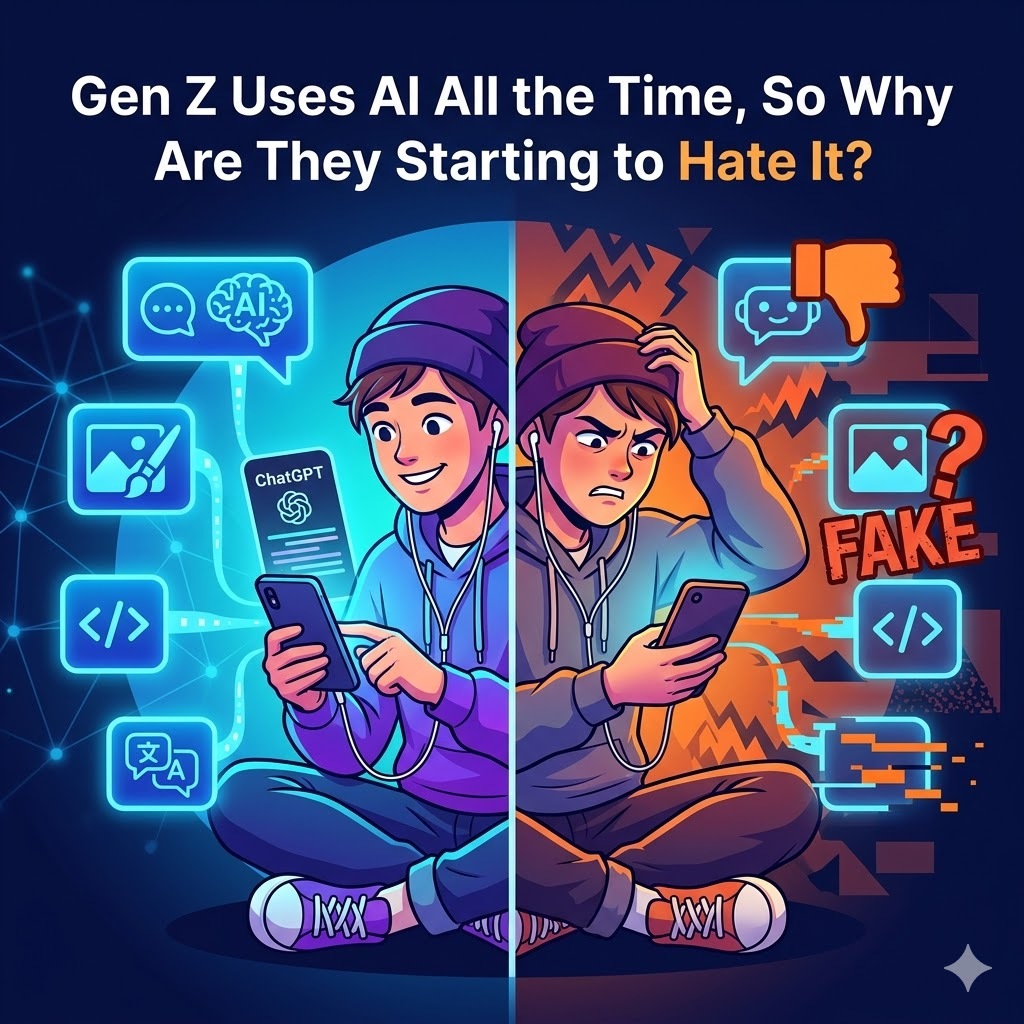
Artificial intelligence is no longer a futuristic concept for Gen Z. It’s part of their daily routine. From writing assignments and generating ideas to coding assistance and creative tools, AI has quietly embedded itself into how young people learn, work, and communicate.
But here’s the contradiction: the more Gen Z uses AI, the less emotionally comfortable they seem with it.
Recent survey data from 2025–2026 shows a clear paradox. AI adoption is steady or increasing, while trust, excitement, and optimism are declining sharply. Gen Z isn’t abandoning AI. Instead, they’re entering a complicated psychological relationship with it: dependence mixed with resistance.
The Usage Reality: AI Is Now a Daily Habit
According to recent survey data, AI usage among Gen Z is not slowing down. It is stabilizing at a high level.
- Daily use increased from 19% in 2025 to 22% in 2026
- Weekly use rose slightly from 28% to 29%
- Monthly usage declined from 13% to 11%
- The number of people who never use AI dropped from 21% to 19%
At first glance, this looks like normal technology adoption: more users, more frequency, and fewer non-users. Gen Z is clearly integrating AI into everyday workflows rather than treating it as an occasional tool.
But usage alone doesn’t tell the full story.
Because alongside rising adoption, emotional responses are shifting in the opposite direction.
The Emotional Breakdown: A Generation Split on AI
The same dataset reveals something far more interesting: Gen Z is emotionally conflicted about AI.
Curious (dominant but not dominant enough)
Nearly half of respondents (around 49%) say AI makes them curious. This shows that interest still exists, but it is no longer enthusiastic curiosity. It is cautious curiosity.
Anxious (42%)
Anxiety is one of the strongest emotional responses. Many young users feel AI is changing learning, work, and cognitive habits in ways they cannot fully control.
Angry (31%)
A significant portion of Gen Z reports anger toward AI. This is not common for most technologies at scale and suggests frustration with dependency, job uncertainty, and perceived overreach.
Excited (22%)
Excitement has dropped significantly compared to earlier optimism cycles around AI. This indicates the “hype phase” is fading.
Hopeful (18%)
Hopefulness is the weakest emotional response. Despite heavy usage, Gen Z is not convinced AI will improve their long-term future.
The pattern is clear: AI is being used more, but liked less.
The AI Paradox: More Usage, Less Trust
This contradiction has been widely discussed in multiple studies, including Gallup-based surveys of Gen Z attitudes in the US. One consistent finding is that even heavy users are becoming more skeptical over time.
Three major psychological shifts explain this trend:
1. AI is becoming invisible infrastructure
AI is no longer something users “try.” It is embedded in:
- search engines
- social media algorithms
- writing tools
- education platforms
- workplace software
When technology becomes unavoidable, emotional resistance often increases.
2. The “learning fear” effect
A major concern among Gen Z users is that AI may be weakening their ability to think independently.
A large portion of respondents believe AI:
- reduces deep learning ability
- weakens creativity
- encourages dependency on shortcuts
This creates internal conflict:
“AI helps me work faster, but is it making me less capable over time?”
This concern is not anecdotal. Research into how AI chatbots influence creative output suggests that heavy reliance on AI tools is quietly homogenizing the range of ideas users generate, narrowing the creative bandwidth of people who use them most frequently.
3. Job insecurity and identity anxiety
Unlike previous generations, Gen Z is entering a workforce already reshaped by automation.
Many fear:
- Entry-level jobs being replaced
- Internships becoming AI-assisted
- Creative roles being partially automated
This creates a deeper emotional layer: AI is not just a tool. It is a competitor in some contexts.
Why Usage Keeps Rising Despite Negative Sentiment
One of the most interesting findings is that negative emotions do not reduce usage.
Even as anxiety and anger rise, AI usage continues to grow.
This happens due to three key forces:
1. Academic pressure
Students are increasingly expected to use AI for productivity. Not using it can actually put them at a disadvantage.
2. Workplace expectation
Many companies now assume basic AI fluency, making it difficult for young professionals to avoid it. The workplace pressure Gen Z is absorbing goes beyond fluency expectations. AI agents are being deployed to autonomously complete tasks that previously defined entry-level roles, compressing the on-ramp that younger workers have historically used to build professional experience
3. Productivity dependency
Even skeptical users admit AI saves time, especially for:
- writing
- summarising
- brainstorming
- coding assistance
So even reluctant users continue using it.
The Cognitive Conflict: “I Don’t Trust It, But I Need It”
This is the core emotional state of Gen Z in 2026.
They are:
- aware of AI’s limitations
- concerned about long-term effects
- dependent on its efficiency
- uncertain about replacing it
This creates a psychological loop of dependence without confidence. That dependence without confidence has a structural parallel in institutional AI deployment. The absence of formal frameworks for investigating AI errors means that the same systems Gen Z relies on daily are operating without the incident accountability mechanisms applied to every other high-stakes technology.
Unlike past technologies that inspired excitement first and concerns later, AI is doing both simultaneously.
Real-World Reflection: Why This Matters Beyond Surveys
This emotional shift is not just cultural. It has real implications:
Education systems
Schools are struggling to balance AI-assisted learning with independent thinking skills.
Workplace transformation
Employers benefit from AI efficiency, but younger workers are increasingly unsure about long-term career stability.
Creativity and confidence
Many Gen Z users report second-guessing their own abilities after relying on AI tools. This self-doubt is reshaping how creative work is presented publicly. The cultural pressure to disclose whether a piece of work was made without AI assistance reflects exactly the identity anxiety Gen Z is navigating, where the value of human-made output is being actively renegotiated.
This suggests a deeper transformation: AI is not just changing output. It is changing self-perception.
The Bigger Picture: A Generation Growing Up With AI Doubt
Historically, new technologies follow a pattern:
- Excitement
- Adoption
- Normalisation
- Dependence
But AI is introducing something new: Emotional resistance during adoption, not after it.
Gen Z is the first generation to grow up inside this cycle in real time. They are not rejecting AI, but they are no longer blindly trusting it either. The same ambivalence shaping Gen Z’s relationship with AI tools extends into healthcare. AI systems are being deployed to manage diagnosis, treatment planning, and patient communication at a pace that outstrips the regulatory frameworks and patient trust mechanisms designed to govern them.
Instead, they are forming a hybrid relationship: Use it heavily, question it constantly.
Conclusion:
The age of AI skepticism has already begun! The data makes one thing clear: Gen Z is not turning away from AI. In fact, they are more dependent on it than ever.
But emotionally, something has changed.
AI is no longer seen as a breakthrough innovation alone. It is now also seen as:
- a cognitive risk
- a job disruptor
- a learning challenge
- and a psychological burden
This is the beginning of a new phase in the AI era. Not adoption, but adjustment under uncertainty.
The technology is advancing quickly. Human trust is not.
And that gap is where the real story of AI in 2026 is unfolding.
FAQs
1. Why is Gen Z using AI more but trusting it less?
Because AI is becoming embedded in school and work systems, usage is unavoidable. However, concerns about learning ability, job security, and creativity loss are reducing trust.
2. What emotions do Gen Z feel about AI the most?
The strongest emotions are curiosity (49%) and anxiety (42%), followed by anger (31%). Excitement and hope are significantly lower.
3. Is AI making Gen Z less confident in their skills?
Many users believe AI reduces independent thinking and creativity, which can lower confidence in personal ability over time.
4. Will Gen Z stop using AI in the future?
Unlikely. Even skeptical users rely on AI for productivity. Usage is expected to grow even if emotional resistance continues.
5. What is the biggest concern Gen Z has about AI?
The top concerns are its impact on learning ability, job security, and long-term cognitive development.
Stay Ahead of the AI Shift
AI is no longer just a tool. It’s becoming a daily dependency that reshapes how people think, work, and learn.
Subscribe to The IT Horizon for deep insights into AI trends, human behaviour shifts, and the technologies redefining the future of intelligence.