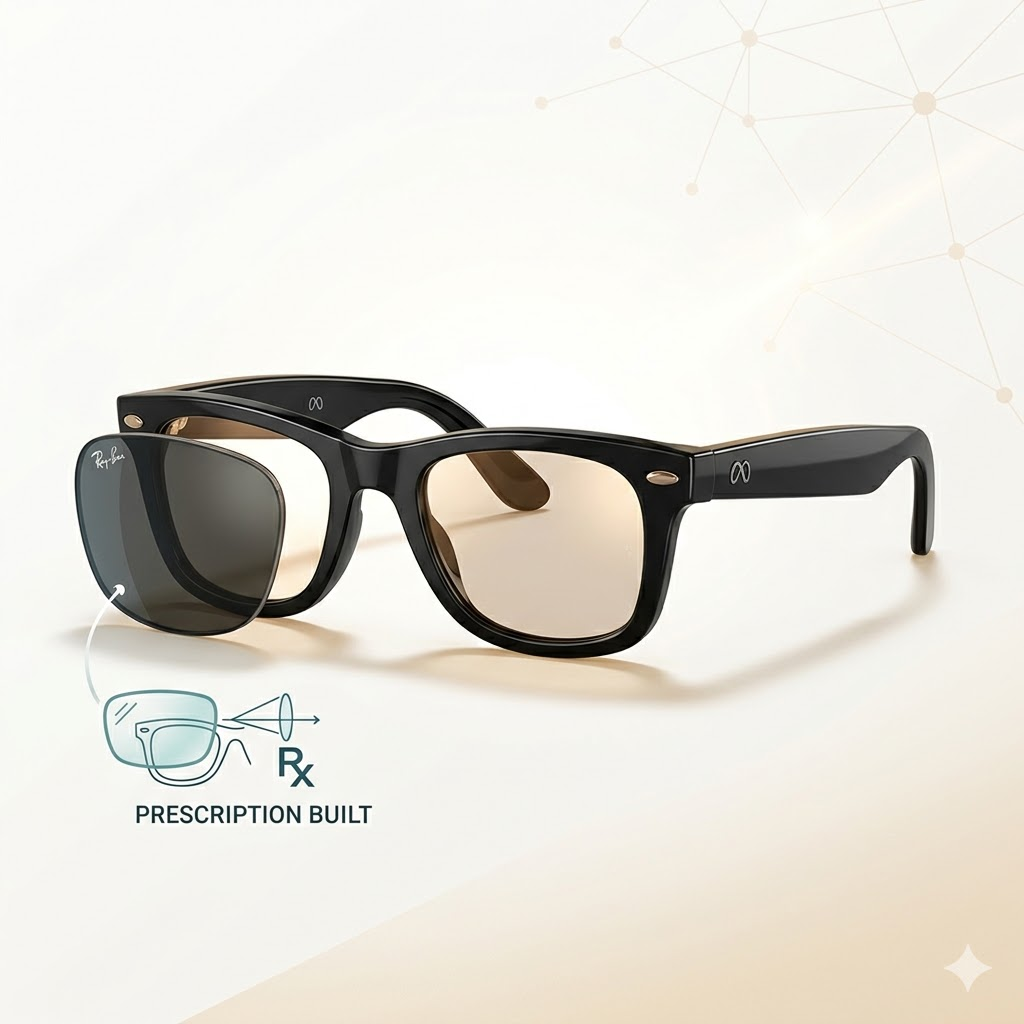
Since 2019, Meta has been working with EssilorLuxottica (the parent company of Ray-Ban) on smart glasses. The first-ever Meta Ray-Ban smart glasses came out in September 2021. It was Ray-Ban Stories.
This time, Meta launches 2 prescription-optimized Ray-Ban smart glasses on March 31, 2026:
- The Ray-Ban Meta Blayzer Optics Gen 2
- The Ray-Ban Meta Scriber Optics Gen 2
The Problem With Previous Ray-Ban Smart Glasses
Previous Ray-Ban Meta glasses were built for people with standard vision, or those with mild prescriptions. The frame design applied fixed, uniform pressure across the lens, which worked fine for lightweight standard lenses. Prescription lenses are heavier and thicker, so the same fixed frame became uncomfortable after a few hours of wear. On top of that, the prescription range was capped at ±6 on the standard model and an even tighter ±4 on the Display version, meaning anyone with a stronger prescription simply could not use them at all.
Why Meta Built Glasses Specifically for Prescription Wearers
Because a large portion of the people who would actually want AI smart glasses wear prescription eyewear every single day. Approximately 2.2 billion people globally require vision correction. For them, smart glasses are only useful if they can replace, or work alongside, their existing prescription frames. Meta built the Optics Styles to solve both problems at once: a frame comfortable enough for all-day prescription wear, and a prescription range wide enough to include almost everyone.
What “Prescription Wearer” Actually Means
A prescription wearer is simply someone whose eyes do not see clearly on their own, either distant objects appear blurry, close objects appear blurry, or both. An eye doctor measures this and writes a prescription, expressed as a number like −3.5 or +5.0. The further that number is from zero, the stronger the lens needed. Previously, if your number exceeded ±6, Ray-Ban Meta glasses could not accommodate your lenses at all. The Optics Styles removes that ceiling entirely at optical retailers.
This new range targets the approximately 2.2 billion people globally who require vision correction, and the 75% of US adults who wear glasses or contact lenses daily. Both styles start at $499, open for preorder from March 31, and reach optical retailers across the US and select international markets on April 14, 2026.
So, there are 2 new frame designs, the prescription ordering process across 2 channels, the 3 hardware upgrades enabling prescription compatibility, and the 5 incoming AI features rolling out across Meta’s glasses lineup this spring.
What the 2 New Optics Styles Are
Ray-Ban Meta Optics Styles prescription smart glasses arrive in 2 distinct frame designs, each built for a different face shape preference.
1. Blayzer
Blayzer is a rectangular frame available in 2 sizes: Standard and Large, making it the only Optics Style offering a size variation for broader face fits. Frame colors include matte black, transparent black, dark olive, ice gray, and stone beige, with a dark brown carrying case included.
2. Scriber
Scriber is a rounded, circular frame available in 1 size, designed for users who prefer a softer frame geometry. Scriber shares the same color range and all 3 hardware fit adjustment features as the Blayzer, including overextension hinges, interchangeable nose pads, and optician-adjustable temple tips.
How to Order with a Prescription:
Prescription ordering for Ray-Ban Meta Optics Styles follows 2 separate channels, and the channel determines the prescription range available to the buyer.
Channel 1: Meta.com and Ray-Ban.com
Ordering directly through Meta’s website or Ray-Ban.com restricts prescription lenses to a maximum range of ±6. Previous Ray-Ban Meta glasses carried the same ±6 ceiling, while the Display glasses were further restricted to ±4. The ±6 limit covers the majority of prescription wearers but excludes those with stronger corrections.
Channel 2: Optical Retailers (LensCrafters and equivalent)
Carrying the Optics Styles frames to an optical retailer removes the prescription ceiling entirely. Meta spokesperson Albert Aydin confirmed to The Verge that “the prescription range for Blayzer and Scriber is unrestricted” at retail opticians. Buyers with prescriptions above ±6 must use this channel. Online ordering will not fulfill high-prescription orders. Visit an optical retailer if your prescription exceeds ±6 in either eye.
3 Hardware Upgrades That Make These Glasses Prescription-Ready
Standard smart glasses frames apply uniform lateral pressure across the frame — a fit designed for lightweight standard lenses. Prescription lenses are heavier and thicker than standard lenses, shifting the frame’s weight distribution and requiring adjustable hardware to maintain all-day comfort. Ray-Ban Meta Optics Styles addresses this with 3 specific hardware upgrades absent from the standard Ray-Ban Meta lineup.
- Overextension hinges: Flexible hinges that accommodate the additional lateral adjustment prescription lens wearers require, previously available only on the Meta Ray-Ban Display glasses.
- Interchangeable nose pads: Removable and replaceable nose pads that distribute the increased lens weight across the nose bridge more evenly than fixed pad designs
- Optician-adjustable temple tips: Temple arms with adjustment points that opticians modify to match the user’s specific head width and ear placement for a tailored fit
All 3 hardware features work together to support all-day wear comfort that standard Ray-Ban Meta frames, built for lighter non-prescription lenses, do not deliver at equivalent prescription weights.
New Colors for Ray-Ban Meta Gen 2 and Oakley Meta
Ray-Ban Meta Gen 2 frames expand with 3 new colors and lens combinations for spring 2026, each pairing Transitions adaptive lenses with new frame finishes. Oakley Meta Vanguard and HSTN expand with 5 new Prizm lens configurations, including the first Prizm Transitions option for Vanguard, adaptive lenses designed for outdoor light condition changes.
| Frame | Color | Lens |
| Ray-Ban Meta Skyler | Shiny Transparent Peach | Transitions Brown |
| Ray-Ban Meta Headliner | Matte Transparent Peach | Transitions Grey |
| Ray-Ban Meta Wayfarer | Shiny Transparent Grey | Transitions Sapphire |
| Oakley Meta Vanguard | Black | Prizm Black |
| Oakley Meta Vanguard | White | Prizm Rose Gold |
| Oakley Meta Vanguard | Black | Prizm Transitions Ember (spring 2026) |
| Oakley Meta HSTN | Black | Prizm Dark Golf |
| Oakley Meta HSTN | Light Curry | Clear to Brown Transitions |
5 AI Features Coming to Meta Glasses This Spring
Meta’s spring 2026 software update delivers 5 new AI capabilities across the Ray-Ban Meta, Oakley Meta, and Meta Ray-Ban Display lineup. The following table organises all 5 by current availability status.
| AI Feature | Function | Availability |
| Hands-Free Nutrition Tracking | Voice or photo logs meals; Meta AI extracts nutrition data and builds a personal food log | Rolling out soon, US users 18+, Ray-Ban Meta and Oakley Meta |
| WhatsApp Summaries and Recall | “Hey Meta, catch me up on my messages” delivers group chat summaries; processed on-device with end-to-end encryption | Early Access Program (EAP), coming soon |
| Neural Handwriting | Finger-writing on any surface sends messages across Instagram, WhatsApp, Messenger, Android, iOS, and iMessage | Rolling out to all users in the coming weeks |
| Pedestrian Navigation | Turn-by-turn directions in-lens, head-up, phone-free | Expanding to every US city, May 2026 |
| Display Recording | Combines in-lens display interactions, world camera view, and audio into a single shareable video | Coming soon |
Nutrition tracking via photo activates the glasses’ camera to capture food imagery, and by extension, captures visual data of the user’s surroundings each time it fires. Meta has faced significant privacy scrutiny over the Ray-Ban camera’s always-available capture capability. Nutrition tracking adds a new recurring camera trigger that activates in domestic and social settings where users may not expect the camera to be in use.
Where Ray-Ban Meta Optics Styles Stand Against Smart Glasses Competitors
Ray-Ban Meta Optics Styles occupies a competitive position; no other smart glasses product currently matches across 3 simultaneous capabilities.
Amazon Echo Frames supports prescription lenses but carries no camera or AI vision features.
Snap Spectacles offers camera capability but provides no prescription lens support.
Xreal Air 2 supports prescriptions but requires a tethered smartphone or computing device to function. It is not a standalone wearable.
Ray-Ban Meta Optics Styles delivers unrestricted prescription support, an integrated camera, and on-device AI in a single self-contained frame, a 3-feature combination no competitor currently replicates at any price point.
Final Words
Ray-Ban Meta Optics Styles removes the last practical barrier that kept high-prescription wearers out of AI smart glasses. The inability to get strong enough lenses in a frame worth wearing all day. At $499 with unrestricted prescription support at optical retailers, 3 dedicated fit features, and 5 AI capabilities rolling out this spring, the Optics Styles are the most complete prescription smart glasses available today.
Are you ready to experience these amazingly new Meta smart glasses?
Preorder opens March 31. Retail availability begins April 14.
If news like this matters to you, the deals reshaping industries, the technology changing everyday life, and the decisions made behind closed doors, our newsletter covers all of it, every week. Subscribe and stay ahead.