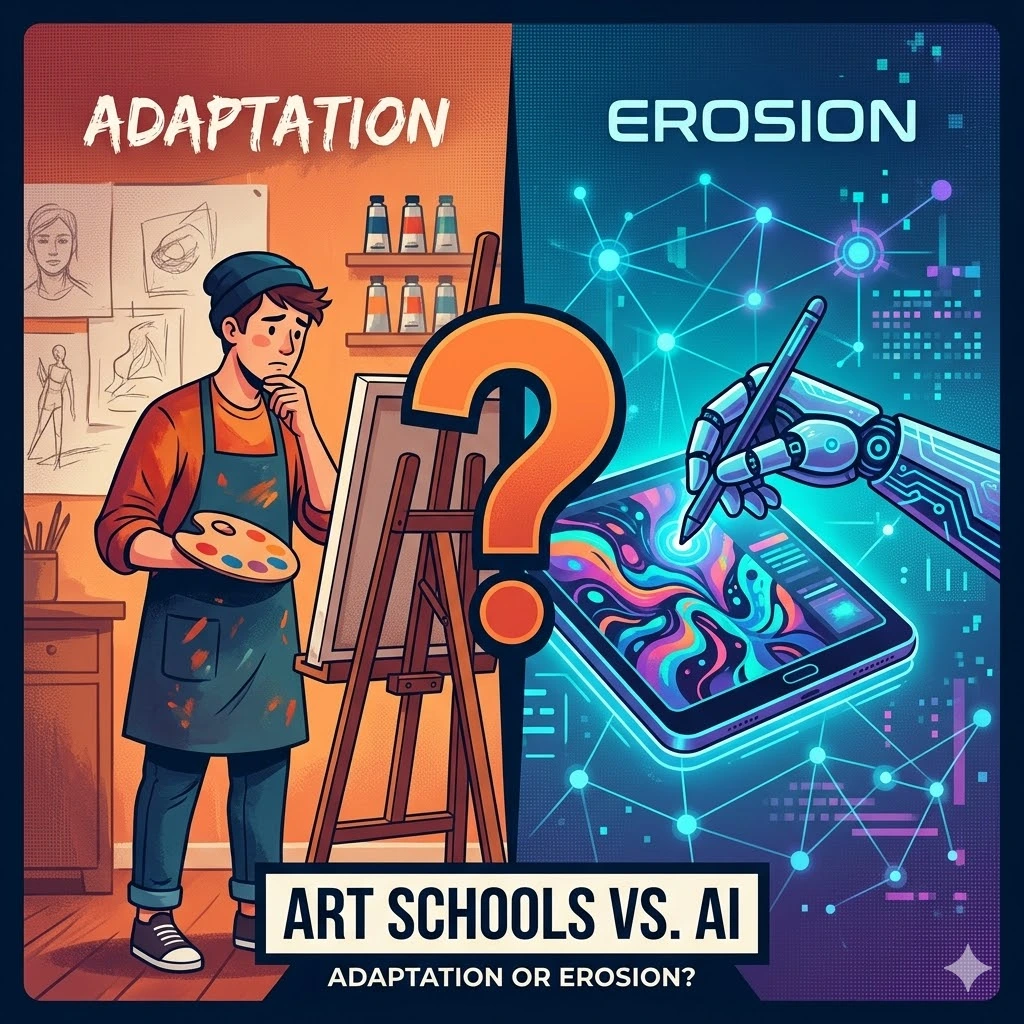
Art schools aren’t quietly updating their syllabi. They’re being pulled in two directions at once.
On one side: institutional pressure to prepare students for an AI-shaped job market.
On the other: deep resistance from the very creatives they’re meant to train.
And right now, both forces are colliding inside classrooms.
The authenticity question extends beyond classrooms. The cultural debate over whether disclosing AI use in creative work should become standard practice is already reshaping how creators present their output.
The shift is already happening
Leading institutions like the California Institute of the Arts, the Royal College of Art, and Massachusetts College of Art and Design are actively integrating AI into their teaching.
Not as a replacement for core skills, but as a required literacy.
Officials across these institutions consistently frame it the same way:
- Students must understand AI tools
- They must question them
- And they must be able to use them responsibly
The logic is blunt: ignore AI now, and you risk irrelevance later.
At the same time, beyond the creative question, institutions adopting AI tools carry security exposure that most art school administrators have not yet evaluated. AI systems used for student feedback, grading assistance, or portfolio review introduce data risks that accompany every organizational AI deployment.
What they’re actually teaching
This isn’t about turning artists into prompt engineers (at least not officially).
The curriculum focus is more nuanced:
- Ideation support
Using AI to generate early concepts, mood boards, rough visual directions - Technical awareness
Understanding how tools like Midjourney or Sora work, and where they fail - Ethics & copyright
Training data, ownership, consent, and legal grey areas - Critical thinking
When to use AI, and when not to
Some institutions are even partnering with companies like Adobe and Google to give students direct exposure to emerging tools.
The message isn’t “use AI for everything.”
It’s “understand it deeply enough to stay in control.”
But students aren’t buying it
Art students sit at the center of a generational rejection of AI tools that extends far beyond campus; younger users across industries are developing a documented hostility toward AI that complicates the ’embrace it or fall behind’ argument.
Across campuses, the pushback is loud and emotional.
Reports from multiple institutions highlight:
- Protest materials altered with anti-AI messaging
- Student work is being challenged or rejected if AI is involved
- Open frustration about being forced to engage with tools they don’t trust
Internal surveys (including those conducted by major art colleges) show a clear pattern:
A majority of students feel negative about AI in creative education.
Why?
Because from their perspective, AI threatens three core things:
1. Skill value
If output becomes easy, what happens to mastery?
2. Job security
If companies can generate design instantly, why hire juniors?
3. Artistic identity
If a model generates the work, who is the artist?
These aren’t abstract concerns. They’re career-level fears.
The uncomfortable reality institutions are responding to
Creative industries are already shifting.
Tools like:
- Udio
- Suno
- Advanced video and image generators
…are lowering the barrier to entry across almost every medium.
At the same time, companies are under pressure to:
- Move faster
- Reduce costs
- Produce more content
That combination makes AI hard to ignore, even for institutions built on traditional craft.
Officials at universities and policy bodies are increasingly aligning on one idea:
AI is not an optional exposure anymore. It’s baseline knowledge.
So what’s the real goal here?
Art schools aren’t trying to replace creativity.
They’re trying to redefine where human value sits.
The emerging approach looks like this:
- Let AI handle speed and variation
- Train humans to lead on taste, direction, and originality
In theory, that keeps creatives essential.
In practice, it’s still messy.
Because if AI keeps improving, that boundary keeps moving.
Where is this heading?
There’s no clean resolution yet, but a few trends are clear:
- AI literacy will become mandatory in creative education
- Purely manual workflows will become niche, not standard
- Hybrid creatives (artist + technologist) will have the edge
And perhaps most importantly:
The debate won’t be about whether AI belongs in art schools.
It will be about how much of it is too much.
Art schools aren’t being “destroyed” by AI because AI chatbots are quietly homogenizing creative output, adding institutional weight to what art schools are observing anecdotally in student work. They’re being forced to evolve faster than their culture is comfortable with. That tension, between preserving craft and embracing automation, isn’t going away. If anything, it’s just getting started.
Ready to stay relevant in an AI-shaped creative world?
You don’t need to pick a side. You need to get sharper. Subscribe to The IT Horizon’s newsletter and always stay informed with facts like AI isn’t replacing creativity. It’s exposing weak creativity. The people who win here aren’t the ones resisting tools or blindly using them. They’re the ones who understand where human input actually matters.
If you’re building a creative career right now, focus on:
- Taste over templates
- Direction over execution
- Thinking over output
That’s what won’t get automated. The tools will keep changing. Your edge shouldn’t.
What creatives actually want to know right now
Is AI going to replace creative jobs completely?
Not completely. But it will reshape them fast. Execution-heavy roles are already under pressure. What’s growing is demand for people who can think, direct, and refine. If your value is only in producing output, you’re exposed. If it’s in shaping ideas, you’re safer. However, the disruption art schools are navigating mirrors what every professional field dependent on specialized human judgment is confronting, from healthcare to legal practice; AI is reshaping the value of trained expertise.
Should art students learn AI or avoid it?
Avoiding it is risky. Blindly relying on it is worse. The smart move is controlled exposure. Understand what it can do, where it fails, and how to guide it. That way, you stay in control instead of becoming dependent on it.
Does using AI make someone less of an artist?
Not automatically. It depends on how it’s used. If AI replaces your thinking, yes, it weakens your role. If it supports your process, like ideation or iteration, it can actually strengthen your creative output. Intent still matters more than the tool.
Why are art schools pushing AI despite student resistance?
Because industry pressure is real. Employers are already expecting AI awareness. Institutions are reacting to that shift, not creating it. Their responsibility is to prepare students for what’s coming, even if it’s uncomfortable in the short term.
What skills will matter most for creatives going forward?
Creative direction, storytelling, taste, and critical thinking. Tools can generate options. They can’t decide what’s good, what works, or what connects emotionally. The more you focus on those human layers, the more future-proof your skillset becomes.