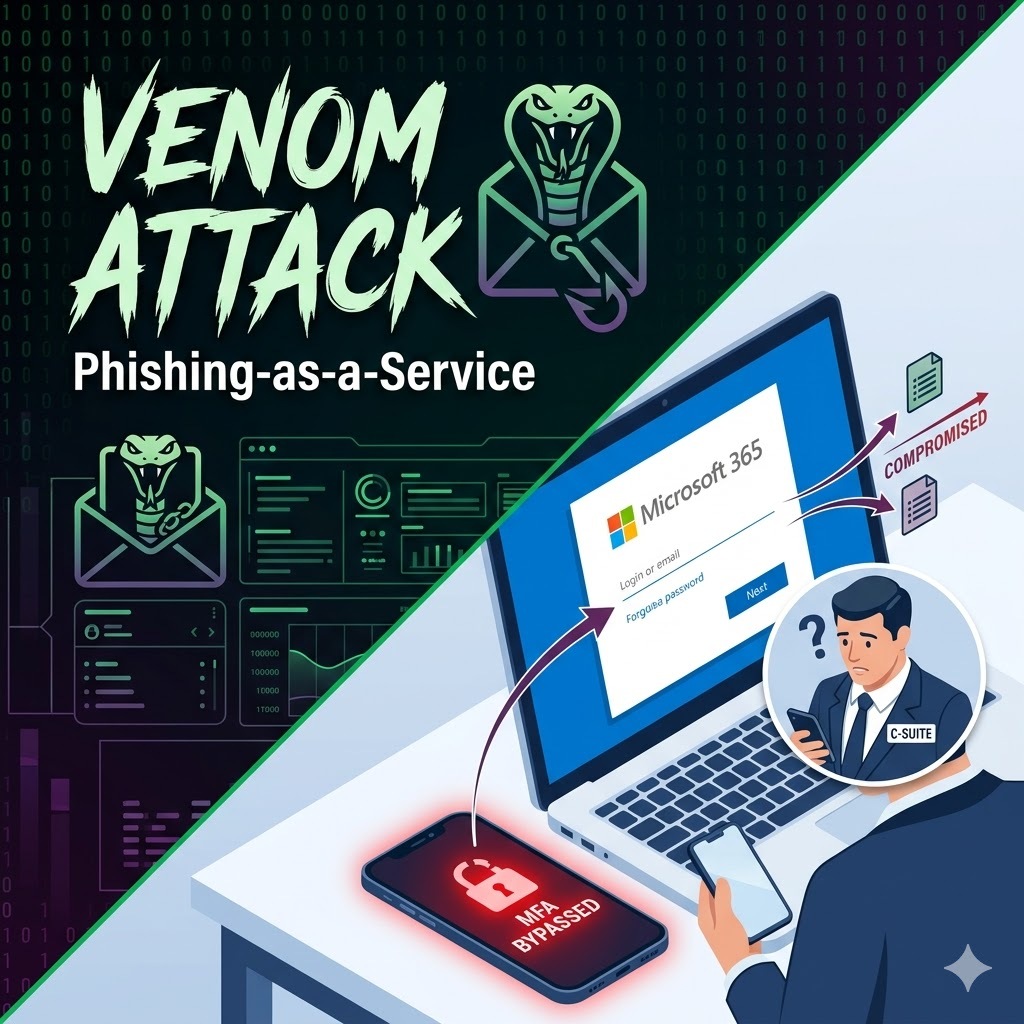
A new cybersecurity threat is putting top-level corporate leaders directly in the crosshairs. A sophisticated phishing-as-a-service campaign known as “Venom” is reportedly targeting C-suite executives across multiple industries, exploiting Microsoft ecosystem tools and bypassing traditional security defenses, including multi-factor authentication (MFA).
The campaign has raised serious concerns across the cybersecurity community due to its precision targeting, advanced evasion methods, and ability to maintain persistent access inside compromised corporate accounts.
A Targeted Attack on Corporate Leadership
Security researchers have identified a previously undocumented phishing platform called Venom that specifically targets executives such as CEOs, CFOs, and vice presidents. Rather than launching broad, random attacks, Venom focuses on high-value individuals with privileged access to sensitive corporate systems.
The phishing campaign impersonates trusted internal communications, especially document-sharing alerts linked to Microsoft SharePoint. Victims receive highly personalized emails that appear to originate from within their own organization.
The Federal Bureau of Investigation has previously warned that targeted phishing campaigns are increasingly designed to bypass technical defenses by exploiting human trust rather than system vulnerabilities.
Federal cybersecurity agencies are tracking this threat pattern across every critical sector simultaneously. CISA’s joint advisory confirming active Iranian exploitation of industrial control systems at US water and energy providers was issued by 7 federal agencies on the same day, underscoring how coordinated and multi-front the threat landscape has become.
How the Venom Phishing Platform Works
Venom operates as a phishing-as-a-service (PhaaS) platform, meaning it is packaged and distributed to cybercriminal customers who use it to launch attacks. Unlike older phishing kits sold openly on underground forums, Venom appears to be distributed through closed, highly controlled channels, making it harder to detect and disrupt.
According to threat intelligence analysis, the campaign uses a multi-stage attack chain designed for stealth and persistence.
1. Highly Personalized Emails
Each phishing attempt begins with a carefully crafted email impersonating Microsoft SharePoint notifications. These messages are not generic. They are tailored to the target, addressing executives by name and referencing realistic business scenarios such as financial reports or internal document reviews.
Attackers also inject randomized HTML elements into emails to evade signature-based detection systems. This ensures that no two phishing emails appear identical to security tools, making automated filtering significantly less effective.
2. QR Code-Based Phishing (Quishing)
Instead of traditional malicious links, Venom uses QR codes embedded in emails. These QR codes redirect users to credential-harvesting pages when scanned, pushing victims to use their mobile devices.
This approach helps attackers bypass email security scanners that typically analyze URLs, not encoded QR content. It also shifts the attack surface away from corporate systems and into less-protected personal mobile environments.
On both iPhone and Android devices, this technique is particularly effective if users trust the visual legitimacy of the message.
3. Anti-Detection and Filtering Layer
Before a victim even reaches the phishing page, Venom performs verification checks to filter out bots, security researchers, and automated scanning tools. Only targeted individuals are allowed to proceed.
Non-targets are redirected to legitimate websites, which helps the campaign remain undetected for longer periods and reduces the chance of early takedown.
4. Credential Theft and MFA Bypass
One of the most dangerous aspects of Venom is its ability to bypass MFA protections using adversary-in-the-middle (AiTM) techniques. In this method, attackers act as a real-time proxy between the victim and Microsoft authentication servers.
This allows them to:
- Capture login credentials
- Intercept MFA codes
- Steal active session tokens
In some cases, attackers register rogue authentication devices during the login process, enabling long-term access even if the password is changed.
Security analysts warn that once session tokens are stolen, MFA becomes effectively irrelevant because the attacker is already authenticated within the system.
5. Device Code Phishing: A Silent Entry Point
Venom also abuses Microsoft’s device code authentication flow. Victims are tricked into approving a login request that appears legitimate but actually grants attackers access tokens instead of passwords.
This method is particularly dangerous because:
- No traditional login form is displayed
- The authentication happens directly through the trusted Microsoft infrastructure
- Tokens remain valid even after password resets
This creates a persistent access channel that is difficult to detect using conventional security tools.
Why C-Suite Executives Are the Primary Target
C-level executives are high-value targets because they hold access to sensitive financial data, strategic planning documents, and internal communication channels.
A successful compromise leads to:
- Business email compromise (BEC) fraud
- Unauthorized financial transfers
- Internal phishing expansion
- Long-term corporate espionage
Researchers note that Venom has been active since late 2025 and has targeted executives across more than 20 industry sectors, making it a widespread enterprise-level threat.
Venom sits within a documented pattern of escalating attack sophistication that spans nearly two decades. The global record of significant cyberattacks confirms that no sector, no seniority level, and no security posture has proven reliably immune to state-sponsored and criminal actors operating with sufficient resources and patience.
Why MFA Alone Is No Longer Enough
For years, multi-factor authentication has been considered a strong defense against account compromise. However, Venom demonstrates a critical shift in attacker capability.
Instead of bypassing MFA directly, attackers now exploit:
- Session token theft
- Real-time authentication proxying
- Device registration manipulation
This means attackers do not need to “break” MFA. They simply operate within its framework. The erosion of MFA as a reliable defense layer is happening in parallel with a longer-horizon threat; quantum computing advances are on track to render the underlying cryptographic standards that authentication systems depend on equally obsolete within the decade.
As cybersecurity experts emphasize, security must now focus on continuous validation, short-lived sessions, and real-time behavioral monitoring rather than relying solely on authentication checkpoints.
How Organizations Can Defend Against Venom
Security analysts recommend a layered defense strategy, especially for leadership accounts.
Key protections include:
- Enforcing FIDO2 or passkey-based authentication
- Disabling unnecessary device code authentication flows
- Monitoring new device registrations in Microsoft Entra ID
- Blocking QR-based phishing attempts at the email gateway level
- Using behavioral analytics to detect unusual sign-in patterns
Executives should also be trained to recognize QR-based phishing emails, especially those impersonating SharePoint or internal document-sharing systems.
Final Takeaway
The Venom phishing campaign marks a major evolution in cyberattacks targeting enterprises. By combining social engineering, QR-based delivery, and advanced authentication abuse, attackers are no longer breaking systems. They are simply logging in through trusted pathways.
For organizations, the threat is no longer limited to weak passwords or outdated security policies. It now extends to how identity systems, session management, and user behavior interact in real time.
In today’s environment, the question is not whether executives will be targeted, but whether organizations are prepared to detect and respond when it happens.
Stay ahead of evolving cyber threats like Venom, MFA bypass attacks, and executive-targeted phishing campaigns. Subscribe to The IT Horizon newsletter for clear, expert-driven cybersecurity insights that help you understand real-world digital risks before they escalate.