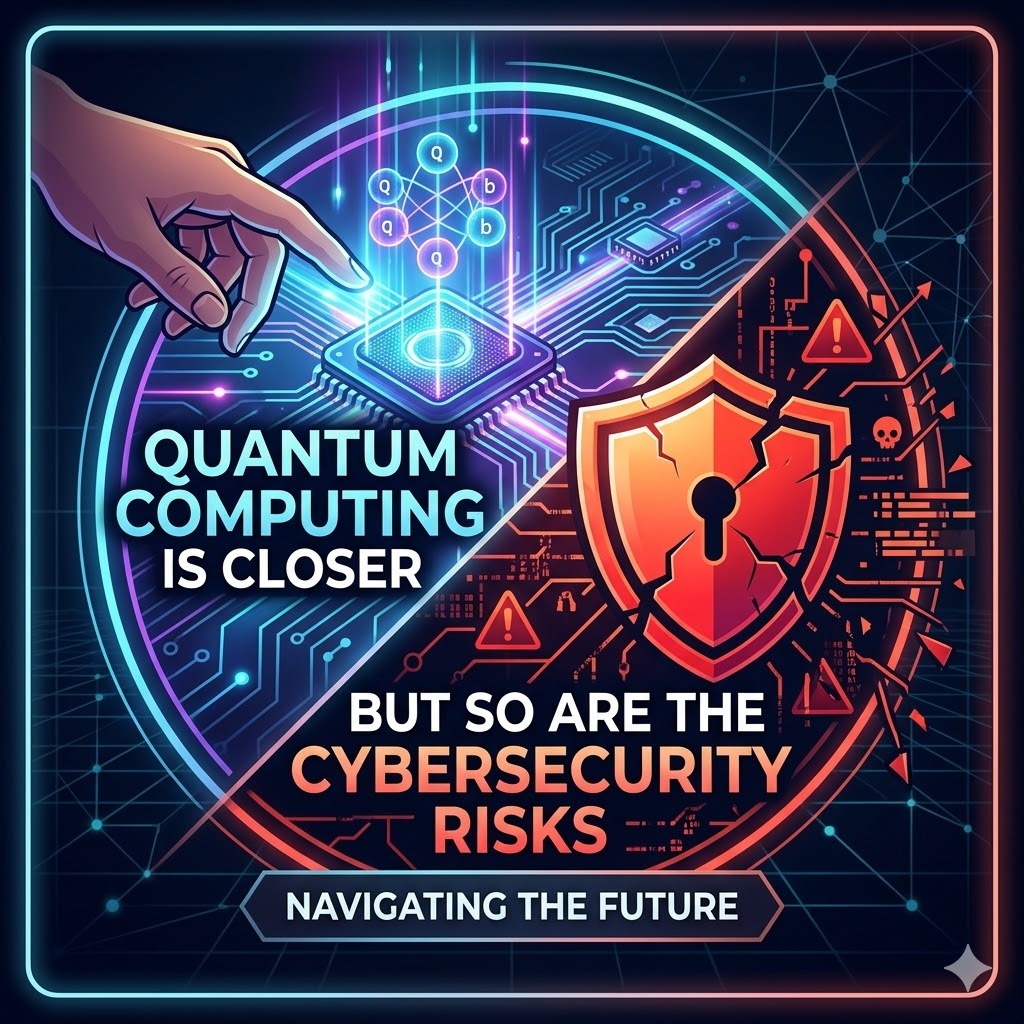
Quantum computing is no longer a distant scientific concept confined to research labs and theoretical physics. It is rapidly evolving into a real-world technology backed by major players like IBM, Microsoft, and Google.
While the breakthroughs are exciting for industries like healthcare, energy, and artificial intelligence, cybersecurity experts are warning that the risks may arrive just as fast as the benefits.
At the center of the concern is one uncomfortable truth: once quantum computing reaches scale, much of today’s encryption infrastructure could become obsolete.
Quantum Computing Is Moving Faster Than Expected
For years, quantum computing was described as “10 years away.” That timeline is now being questioned.
Tech giants such as IBM, Microsoft, and Google have made measurable progress in stabilizing qubits. The fundamental building blocks of quantum systems. Unlike classical bits that represent either 0 or 1, qubits can exist in multiple states simultaneously due to quantum superposition, enabling massively parallel computation.
However, qubits are extremely fragile. Even small environmental disturbances can introduce errors. In many systems, multiple unstable qubits are required just to produce one reliable, error-corrected qubit.
Despite this challenge, researchers estimate that practical quantum applications could emerge within the next five years in fields such as:
- Drug discovery
- Financial modeling
- Material science
- Optimization problems
But as computing power grows, so does the security concern.
Why Today’s Encryption Is at Risk
Modern digital security relies heavily on encryption systems such as RSA and elliptic curve cryptography (ECC). These systems work because classical computers would take impractically long times to break them.
Quantum computers change that equation completely.
Using algorithms like Shor’s algorithm, a sufficiently powerful quantum machine could factor large numbers exponentially faster than classical computers. This would allow attackers to break widely used encryption methods protecting:
- Banking systems
- Government communications
- Cloud data
- Personal identities
- Medical records
The risk is not speculative. Documented state-sponsored cyberattacks have been targeting this exact infrastructure for years, establishing that the organizations most exposed to quantum decryption are the same ones already absorbing the highest volume of conventional attacks.
In response, organizations like NIST (National Institute of Standards and Technology) are actively developing post-quantum cryptography (PQC) standards designed to resist quantum attacks.
These include:
- Lattice-based encryption
- Hash-based signatures
- Multivariate cryptographic systems
However, transitioning global infrastructure to these new standards will take years, not months.
The Hidden Danger: “Harvest Now, Decrypt Later”
One of the most overlooked risks in quantum cybersecurity is a strategy known as “store now, decrypt later.”
In this scenario, attackers do not need quantum computers today. Instead, they:
- Steal encrypted data now
- Store it securely
- Wait for future quantum capabilities to mature
- Decrypt the data later when technology allows
This approach is especially dangerous for long-life data, such as:
- Government archives
- Financial records
- Intellectual property
- Healthcare data
- National security communications
Critical infrastructure systems are among the highest-value harvest targets, a fact underlined by confirmed Iranian state-sponsored attacks on US water and power systems, where the operational data collected today carries long-term strategic value regardless of when it can be decrypted.
Even if data is secure today, it may not remain secure in the future.
State-level actors are already operating on this logic. Documented Chinese cyber operations targeting European government networks represent exactly the kind of long-horizon intelligence collection that becomes exponentially more valuable once quantum decryption capability arrives
The Industry Is Already Preparing, but Not Fast Enough
Experts agree that quantum readiness is becoming a global priority, but many organizations are still behind.
According to cybersecurity leaders, most companies do not yet have a clear understanding of:
- Where encryption is used across their systems
- Which vendors rely on vulnerable cryptographic standards
- How long must sensitive data remain protected
Meanwhile, companies like Google have already outlined timelines to migrate toward post-quantum cryptography by the end of the decade, signaling urgency across the industry.
Governments across the United States, the United Kingdom, Germany, and other nations are also pushing for quantum-safe infrastructure planning.
Why Quantum Computers Are So Powerful
At the core of quantum computing is the qubit. Unlike traditional binary systems, qubits can exist in multiple states simultaneously. This allows quantum systems to explore many possible solutions at once.
But power comes with instability.
To build a functional quantum system, engineers must overcome:
- Decoherence (loss of quantum state)
- Error correction challenges
- Hardware instability
- Environmental interference
This is why scaling quantum systems remains difficult—but not impossible.
Experts believe we are now entering the phase where improvements in qubit stability and system architecture are accelerating rapidly.
New Security Risks Are Emerging Before Full Quantum Adoption
Even before large-scale quantum computers exist, cybersecurity risks are already evolving.
One major concern is that attackers are preparing early by:
- Collecting encrypted data today
- Exploiting weak cryptographic systems
- Testing post-quantum vulnerabilities
- Targeting organizations with long-term data value
This means the quantum threat is not just a future problem. It is already influencing current cyber strategy.
The tactics evolving in parallel with quantum preparation demonstrate how aggressively attackers are already bypassing conventional defenses. Phishing-as-a-service platforms are now capable of defeating multi-factor authentication entirely, without waiting for quantum capability.
Security experts warn that industries holding sensitive long-term data must assume their information is already being collected for future decryption.
Post-Quantum Cryptography: The Race to Replace RSA
To prepare for quantum threats, researchers are developing new encryption systems that cannot be easily broken by quantum algorithms.
Post-quantum cryptography (PQC) is designed to replace vulnerable systems like RSA and ECC. However, these new methods often require:
- More processing power
- Larger key sizes
- System-wide infrastructure changes
This means businesses must update both hardware and software systems to support PQC at scale.
The transition is not optional. It is a necessity for long-term digital security.
Quantum Randomness: A New Layer of Protection
One emerging defense technology is Quantum Random Number Generation (QRNG). Unlike traditional systems that use algorithmic randomness, QRNG generates true randomness based on quantum physical processes.
This makes encryption keys significantly harder to predict or replicate, strengthening cryptographic systems even before full quantum adoption becomes mainstream.
Final Thoughts
The quantum era has already started!
Quantum computing is no longer a question of “if,” but “when.” And according to industry leaders, that “when” may be closer than most organizations realize.
While the technology promises breakthroughs in science, medicine, and computing, it also introduces a fundamental challenge to global cybersecurity infrastructure.
The biggest risk is not just future decryption. It is today’s unpreparedness.
Organizations that begin preparing now, by auditing encryption, upgrading cryptographic systems, and planning for post-quantum standards, will be far better positioned to survive the transition.
Because in the quantum era, security will not be about breaking encryption. It will be about replacing it before it breaks.
Quantum computing is reshaping the future of security faster than most businesses realize. Stay ahead of encryption shifts, cyber risks, and emerging tech disruptions by subscribing to The IT Horizon newsletter for expert insights delivered in plain, actionable language.