
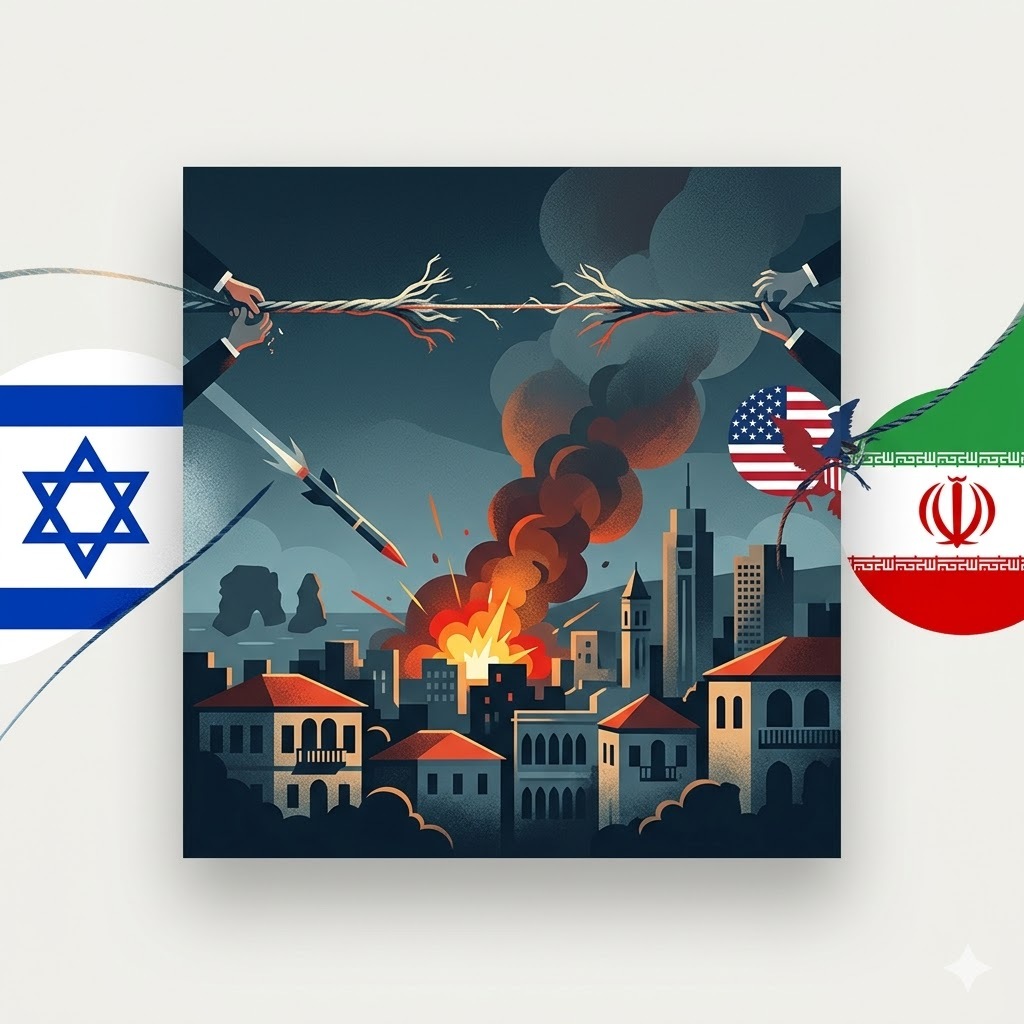
Israel launched its largest coordinated assault on Lebanon since the war began, just hours after a US-Iran ceasefire took effect, killing at least 303 people and threatening to collapse two weeks of hard-won diplomacy before negotiations even started.
The strikes, codenamed “Operation Eternal Darkness,” have exposed the single most dangerous fault line in the ceasefire: whether Lebanon is covered by the deal. With Vice President JD Vance set to lead the US delegation to Islamabad this Saturday for the highest-level US-Iran talks since 1979, the answer to that question may determine whether the region slides back into open war.
303 dead in strikes Israel says targeted Hezbollah
On the morning of April 8, 50 Israeli fighter jets dropped approximately 160 munitions on more than 100 targets across Lebanon in under 10 minutes. Lebanon’s Health Ministry confirmed at least 303 killed and over 1,150 wounded by April 9, with rescue workers still pulling bodies from rubble. UNICEF reported 33 children killed on April 8 alone, bringing the cumulative total to 600 children killed or injured since the broader conflict began on March 2.
The IDF said it struck Hezbollah command centres, intelligence sites, missile infrastructure, and facilities linked to the Radwan Force. Defence Minister Israel Katz called it “the largest concentrated blow Hezbollah has suffered since Operation Beepers,” referring to the 2024 pager attack. The IDF confirmed killing Ali Yusuf Harshi, described as Hezbollah leader Naim Qassem’s personal secretary and nephew.
But journalists on the ground painted a starkly different picture. AP reporters at the Corniche al-Mazraa intersection, one of Beirut’s busiest commercial corridors, described charred bodies in vehicles struck without warning during morning rush hour. At least five densely populated neighbourhoods were hit.
Dr Salah Zeineldine, chief of the American University of Beirut Hospital, said “all the patients we got were civilians“ and described the strikes as “very random,” with victims including “lots of children, women, men, elderly people.” Since March 2, Israeli strikes have killed at least 1,784 people and displaced 1.2 million, nearly one-sixth of Lebanon’s population.
The Lebanon question that could break the ceasefire
The two-week ceasefire, brokered by Pakistan after 38 days of US-Israeli strikes on Iran beginning February 28, was announced by President Trump on Truth Social roughly 90 minutes before a deadline to launch massive infrastructure strikes on Iranian territory. Pakistan’s Prime Minister Shehbaz Sharif explicitly stated the deal covered “everywhere, including Lebanon.”
Israel and the United States disagree. Prime Minister Benjamin Netanyahu declared in a video message on April 9: “I want to tell you: there is no ceasefire in Lebanon. We are continuing to strike Hezbollah with force, and we will not stop until we restore your security.” White House Press Secretary Karoline Leavitt was equally blunt: “Lebanon is not part of the ceasefire. It has been relayed to all parties.”
Iran sees this as a deal-breaker. Foreign Minister Abbas Araghchi responded directly: “The Iran–U.S. ceasefire terms are clear and explicit: the U.S. must choose, ceasefire or continued war via Israel. It cannot have both.” Iran’s 10-point proposal was the same framework the White House had already effectively rejected before the Islamabad talks began.
Trump initially called it “a workable basis on which to negotiate,” explicitly includes as its final clause the “cessation of war on all fronts, including against the heroic Islamic Resistance of Lebanon.” The IRGC issued a blunt warning on state television: “If the aggression against beloved Lebanon does not cease immediately, we will fulfil our duty and deliver a response.”
Parliamentary Speaker Mohammad Bagher Ghalibaf accused Washington of violating three clauses before talks even began, continued strikes on Lebanon, a drone entering Iranian airspace, and denial of Iran’s enrichment rights, concluding that “a bilateral ceasefire or negotiations is unreasonable.”
Islamabad talks face nuclear-sized obstacles
Against this backdrop, Vice President JD Vance is set to lead the US delegation alongside envoy Steve Witkoff and Jared Kushner to the Serena Hotel in Islamabad for Saturday’s opening session, the first face-to-face US-Iran engagement since the 1979 revolution. Iran’s delegation is expected to be led by Ghalibaf and Araghchi, though Tehran’s participation remains uncertain. Iran’s ambassador to Pakistan posted, then deleted, confirmation that the delegation would arrive for “serious talks based on the 10 points proposed by Iran.”
Three issues dominate the negotiating agenda. Nuclear enrichment is the hardest. Trump stated flatly: “There will be no enrichment of uranium.” Leavitt called it “a red line that the President is not going to back away from.” Iran’s atomic energy chief Mohammad Eslami responded that any attempt to limit enrichment “would fail.”
The Strait of Hormuz remains the most immediate flashpoint. Trump’s ceasefire condition demanded its “complete, immediate, and safe opening.” Iran reopened it briefly, allowing roughly 22 ships through in two days, versus the normal 100–120 daily, before halting all tanker traffic in response to the Beirut strikes. Reports that Iran plans to charge $1 per barrel in cryptocurrency as a transit toll drew a sharp Trump rebuke: “They better not be.” Leavitt confirmed the strait must reopen “without limitation, including tolls.”
And Lebanon, the dispute that overshadows everything. Vance, speaking in Budapest before departing for Islamabad, acknowledged a “legitimate misunderstanding“ about Lebanon’s inclusion and warned that if Iran walks away over the issue, “that would be dumb, but that’s their choice.” Trump separately told NBC he asked Netanyahu to be “a little more low-key” in Lebanon, a request the 303 dead suggest went unheeded.
A ceasefire expiring on borrowed time
The two-week window closes on April 22. Iran’s new Supreme Leader, Mojtaba Khamenei, the son of Ayatollah Ali Khamenei, who was killed in the war’s opening hours, declared on April 9 that Iran is the “definite victor” and vowed to bring Strait of Hormuz management “into a new phase.” Trump countered that all US military assets would remain in position and warned: “If for any reason it is not complied with… then the ‘Shootin’ Starts.'”
Pakistani diplomatic intervention reportedly prevented an Iranian retaliatory strike overnight on April 8–9. But with the Strait still closed, Lebanon still burning, and both sides claiming victory in a war that killed thousands, the Islamabad talks face a fundamental question: whether a ceasefire that neither side interprets the same way can survive long enough to become a peace.