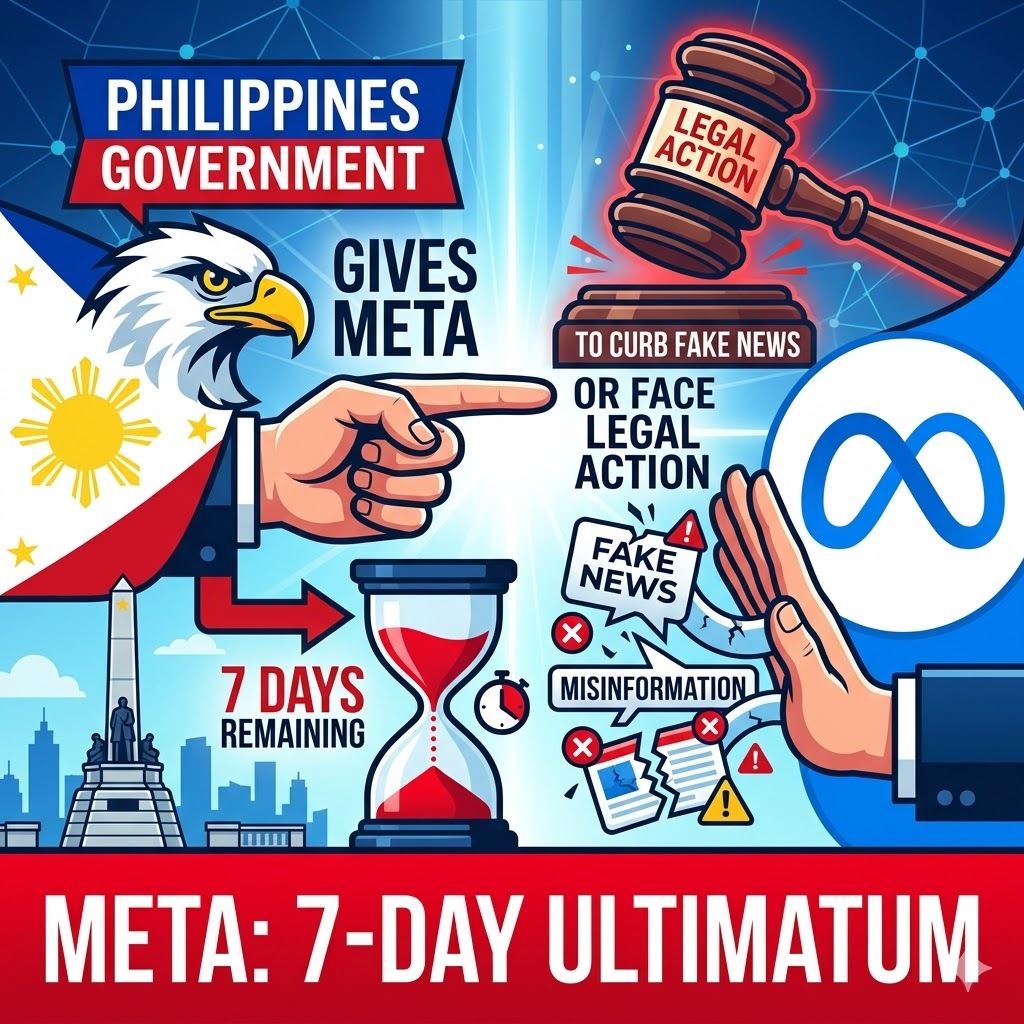
The Philippine government issued a formal ultimatum to Meta Platforms Inc. on April 10, 2026, demanding that Facebook’s parent company implement immediate, verifiable measures to suppress disinformation on its platforms, or face regulatory and legal consequences under Philippine law.
The joint communication, signed by Department of Information and Communications Technology Secretary Henry Aguda and Presidential Communications Office Acting Secretary Dave Gomez, was addressed directly to Meta CEO Mark Zuckerberg and gave the company 48 hours to confirm receipt and 7 calendar days to submit a detailed implementation plan.
The letter is publicly available through the Office of the President of the Philippines, Presidential Communications Office at pco.gov.ph.
What the Philippine Government Is Demanding
The DICT-PCO joint letter to Zuckerberg identifies 6 specific categories of harmful content currently circulating on Meta’s platforms that the Philippine government requires immediate action against.
1. Fabricated medical status content: Documents or announcements falsely alleging illness, incapacitation, or death of senior government officials, specifically including President Ferdinand Marcos Jr.
2. False economic advisories: Misleading posts about exaggerated oil price increases, alleged energy supply disruptions, or lockdowns capable of inducing public panic and economic disorder.
3. Financial institution disinformation: Content targeting banks and payment systems in ways that could undermine public trust and trigger financial instability.
4. Fabricated law enforcement or military statements: misleading or false pronouncements relating to police and military operations.
5. Anti-government compliance narratives: Dontent encouraging citizens to disregard lawful government directives based on false premises.
6. Coordinated inauthentic behavior: Organized manipulation campaigns targeting the government and its officials.
Beyond content removal, the government demands Meta establish a senior-level 24/7 coordination focal point for real-time government engagement, expedited takedown protocols for high-priority content, enforceable response timelines for high-risk categories, and regular transparency reporting on enforcement actions affecting the Philippines.
The Legal Framework Behind the Threat
The Philippine government’s ultimatum invokes 4 specific legal instruments to establish that disinformation on Meta’s platforms may constitute criminal liability under Philippine law.
1. Article 154 of the Revised Penal Code:
The Philippine criminal code provision prohibits the publication or circulation of false news that may endanger public order or cause damage to the interests of the state. This is the foundational criminal law basis for the government’s position that disinformation is not merely a policy concern but a prosecutable offense.
2. Republic Act No. 10175 (Cybercrime Prevention Act of 2012):
The primary Philippine digital law, which extends the Revised Penal Code’s provisions to online conduct and specifically covers content distributed or amplified through digital platforms. The letter explicitly states that criminal acts committed “through digital platforms or involving aiding or abetting cyber-related offenses” fall within this law’s scope, a framing that potentially extends liability to platforms that fail to act on flagged content.
3. Republic Act No. 7581 (The Price Act):
A less commonly cited legal instrument in a content moderation context, but one that the government deploys specifically against economic disinformation. The Price Act prohibits hoarding, profiteering, and market manipulation. The government argues that false content inducing panic buying or artificial price distortions contributes to illegal price manipulation, creating a legal chain connecting Facebook posts to economic crime statutes.
4. National Telecommunications Commission authority:
The NTC holds the regulatory power to block platforms or revoke operating permissions for communications services in the Philippines. The government’s explicit mention of NTC coordination in its threat of “appropriate regulatory and legal measures” signals that platform blocking, the most severe enforcement option, remains on the table if Meta does not comply.
Why the Oil Crisis Context Matters
The Philippine government’s letter frames the disinformation threat specifically within the context of the ongoing global oil crisis triggered by the US-Iran conflict and the Strait of Hormuz blockade.
The DICT and PCO letter states directly: “Rising fuel costs and increasing prices of essential goods have materially heightened public sensitivity to information related to economic stability and government response. In this environment, the rapid proliferation of false, misleading, and panic-inducing content, particularly that relating to oil prices, economic disruptions, and government actions, poses a direct and escalating threat to public order, economic confidence, and national security.”
The geopolitical trigger behind that economic stress is the same US-Iran standoff that collapsed Iran’s own peace framework. The failure of Iran’s proposed diplomatic resolution left the Strait of Hormuz blockade in place, directly sustaining the fuel supply disruption that the Philippine government identifies as the crisis context for its disinformation ultimatum.
The Philippines imports approximately 97% of its oil requirements. Strait of Hormuz disruption directly affects Philippine fuel supply chains, pricing, and inflationary pressure on basic goods. In this environment, false posts claiming energy supply cutoffs or extreme price increases carry measurable real-world impact, potentially triggering panic buying, supply hoarding, and genuine market disruption that compounds an already stressed supply environment.
The Enforcement Question Meta Faces
Meta’s response timeline under the Philippine ultimatum requires delivering a detailed implementation plan by approximately April 17, 2026, 7 days from the letter’s April 10 date. The enforcement pathway the Philippine government has available involves 3 escalating mechanisms if Meta’s response is deemed insufficient.
Regulatory action through the National Telecommunications Commission, including potential platform access restrictions, represents the most immediate lever available without judicial process. Criminal referral to the Department of Justice for prosecution of individuals involved in specific disinformation campaigns represents a secondary pathway.
Civil legal action against Meta for platform-level failures to suppress content identified as violating Philippine law represents a third option, though its jurisdictional enforceability against a US-headquartered corporation remains legally complex.
Jurisdictional complexity has not prevented successful legal action against Meta in other contexts. A California jury found Meta and Google liable for deliberately addicting a child user, establishing that platform-level design and enforcement failures can translate into civil damages in courts outside the EU’s regulatory framework.
The Philippine government does not hold the same regulatory infrastructure over Meta that the European Union holds through the Digital Services Act, which mandates transparency reporting, risk assessments, and content moderation standards backed by fines of up to 6% of global annual revenue.
The Philippines’ enforcement leverage is primarily domestic criminal and regulatory law applied to a platform operating in a jurisdiction where it has significant commercial presence but no mandatory compliance framework equivalent to the DSA.
The Philippines is not alone in reaching for domestic law to fill the gap left by the absence of a DSA-equivalent framework. Greece moved to ban social media access entirely for users under 15, a blunter instrument than content-specific suppression orders but one that requires no cooperation from Meta to enforce.
Conclusion
The Philippine government’s concern about disinformation during an active global economic crisis is legitimate. False content about oil prices, energy supply, and government capacity to respond carries documented real-world consequences in a highly import-dependent economy already absorbing external supply shocks. The legal framework the government cites, the Cybercrime Prevention Act and the Revised Penal Code, represents genuine statutory authority, not manufactured legal justification.
The contradictory position is the one that the government’s own critics raise, and it is not easily dismissed. A government demanding that Meta suppress content falsely alleging a senior official’s illness or death, while simultaneously defining what constitutes false information about government actions, occupies a position where the line between legitimate disinformation enforcement and political speech suppression is determined by the same authority that benefits from favorable enforcement outcomes. The 6 content categories the government identifies for suppression are not value-neutral technical classifications. They include content critical of government directives, content about officials’ health, and content framed as challenging government legitimacy, categories where the distinction between disinformation and protected political dissent depends entirely on whose definition of “false” governs the takedown process.
Platform regulation, government demands on social media companies, and the legal frameworks shaping online speech globally are covered at The IT Horizon. Subscribe to our newsletter. We track every ultimatum, enforcement action, and policy decision that affects how information flows on the platforms billions of people use daily.