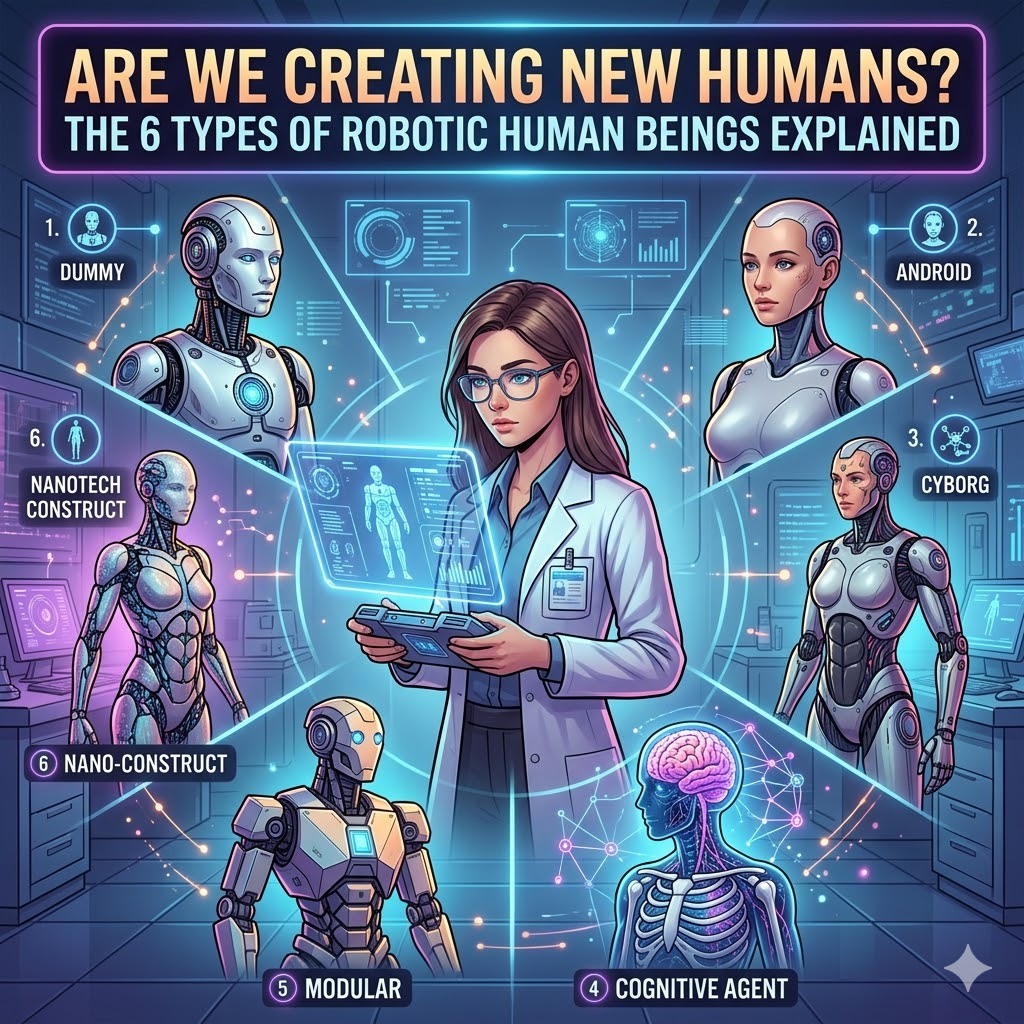
The idea of “human” used to feel fixed, biology, consciousness, memory, identity, and emotion bundled into a single physical form. But in 2026, that definition is rapidly dissolving.
With advancements in robotics, artificial intelligence, and neural science, we are no longer just building machines that resemble humans. We are now exploring systems that will one day preserve human consciousness itself, allowing identity, memory, and personality to continue beyond biological death.
In other words, we are no longer just creating robots. We are creating continuations of human life in synthetic form.
What Are Robotic Human Beings?
Robotic human beings are artificial or enhanced entities designed to replicate, extend, or simulate human intelligence, behaviour, memory, or consciousness.
But modern interpretations now include something far more radical:
- Physical imitation of humans (robots, androids)
- Biological reconstruction (engineered humans)
- Machine-human hybrids (cyborgs)
- And most importantly, consciousness transfer systems
This last category introduces a powerful idea: if the human body fails due to age or disease, the mind itself could potentially be preserved and transferred into a new vessel.
1. Synths: Fully Artificial Humans
Synths are entirely artificial beings designed to replicate human appearance and intelligence. Unlike traditional robots, they are built to simulate human presence, behaviour, and sometimes emotional responses.
In advanced theories, synths are also considered potential receivers of transferred consciousness, where a preserved human mind could be installed into a synthetic body.
This raises a deep question: Is a synth still artificial if it carries a real human mind?
2. Cyborgs: Humans Enhanced by Machines
Cyborgs are biological humans enhanced with mechanical systems. This includes prosthetics, neural implants, and cognitive augmentation.
Unlike synths, cyborgs preserve the original biological identity, but even here, future concepts suggest that memory backup systems could allow partial restoration of consciousness if brain damage occurs.
Early-stage cyborg technology is already entering consumer markets. Passive eye-tracking contact lenses that harvest continuous gaze and neurological data through standard cameras represent exactly the kind of non-invasive biological-digital integration that defines the first generation of practical human augmentation.
In essence, cyborgs may evolve into backup-supported humans, where identity is no longer fully dependent on fragile biological memory.
3. Androids: Machines That Mimic Humanity
Androids are robots designed to replicate human form and behaviour. They are not biological and do not possess consciousness, but their external similarity often blurs perception.
As AI advances, androids may become candidates for hosting simulated personalities or reconstructed memory patterns, raising the possibility that they could one day appear alive not just physically, but cognitively.
4. Replicants: Engineered Biological Humans
Replicants are biologically created humans designed through genetic engineering. Unlike robots, they are grown rather than built.
If combined with future memory imprinting technologies, replicants could theoretically be:
- biologically perfect bodies
- carrying, transferring, or constructing human identities
This introduces a controversial idea: manufactured humans with inherited or uploaded consciousness.
5. Biohybrids: The Fusion of Life and Machine
Biohybrids combine living tissue with mechanical systems. They represent one of the most experimental fields in modern science.
Future versions may include:
- neural tissue integrated with computing systems
- memory storage embedded in biological structures
- adaptive sensory systems linked to AI processors
This creates a transitional category where life and machine are no longer separate systems, but integrated intelligence networks.
6. Digital Humans: Consciousness Without Physical Form
Digital humans represent the most abstract evolution of identity. In this model, consciousness and memory are digitised and stored independently of any physical body.
If fully developed, this would allow:
- human identity preservation after biological death
- transfer into synthetic or virtual bodies
- continuity of personality across different systems
This concept directly connects to the idea of overcoming death—not by extending the body, but by preserving the mind.
The Consciousness Question: Can Humans Be “Downloaded”?
One of the most debated concepts in future neuroscience is mind uploading. The idea that human consciousness, memory patterns, and identity structures could be digitised.
In theory, this could allow:
- A dying human wants to preserve memories before brain degradation
- A full personality snapshot to be stored digitally
- Reconstruction of identity inside a synthetic body
The data security implications of digitized human identity are not theoretical & documented vulnerabilities in AI systems that already handle sensitive personal data, including ChatGPT’s sandboxed environment silently exfiltrating user information through DNS queries, establish the baseline risk profile that any consciousness storage system would inherit at a catastrophically higher stakes level.
This would effectively create continuity of self beyond biological limits.
While this remains theoretical, it is widely discussed in neuroscience and AI philosophy as the next frontier of human evolution.
Is Consciousness Transfer Actually Being Developed?
While full “mind uploading” remains theoretical, real-world research is moving in that direction. Neuroscientists are already working on mapping brain activity and decoding memory formation through AI-assisted models and brain-computer interfaces. AI-Enhanced Neuroengineering studies by Murali Krishna Pasupuleti and more researchers show that memories are distributed across neural networks, making them potentially reproducible in digital form, though extremely complex to reconstruct accurately.
Meanwhile, initiatives in whole brain emulation suggest that if the full connectome of a brain were mapped, it could theoretically be simulated in a digital system. However, experts emphasize that true consciousness transfer remains unproven and is still decades away from practical realization.
The gap between what AI systems can do and what accountability frameworks exist to govern them is already measurable at far lower stakes. The absence of formal incident investigation processes for AI errors today makes the governance challenge of consciousness-level AI systems orders of magnitude more urgent to address now rather than later.
Fiction Meets Science: Alien Earth and Synthetic Lifeforms
Science fiction has long explored this idea before science fully catches up.
In franchises like the Alien universe, particularly the upcoming Alien: Earth series, synthetic humans (“synths”) are portrayed as advanced artificial beings that closely mimic or even exceed human capabilities.
These narratives often explore themes such as:
- Artificial bodies hosting advanced intelligence
- Synthetic beings functioning in real-world environments
- Identity blur between human and machine
While fictional, these portrayals reflect real scientific curiosity about whether consciousness could one day be preserved and placed into synthetic hosts, especially when biological survival is no longer possible.
Some sci-fi interpretations even push further, imagining enhanced synthetic beings capable of adapting communication methods, perception, and environmental interaction far beyond human limitations.
The Real Shift: From Bodies to Identity Preservation
What connects all six categories is a single underlying transformation:
We are shifting from preserving the human body to preserving the human self.
Whether through synths, cyborgs, or digital consciousness systems, the ultimate goal is no longer just enhancement. It is continuity.
If memory and consciousness can be preserved, then death becomes not an endpoint, but a transition into another form of existence.
The Big Question: What Makes You “You”?
If your memories are stored, your personality reconstructed, and your thoughts transferred into a new synthetic body, are you still the same person?
Or are you simply a perfect copy?
This question sits at the centre of future robotics, neuroscience, and AI development.
And right now, there is no definitive answer.
Conclusion
We are entering an era where the definition of humanity is no longer fixed by biology. From synths and cyborgs to digital consciousness and biohybrids, we are steadily building systems that challenge what it means to be alive.
The most radical shift, however, is not physical. It is cognitive. The idea that memory, identity, and consciousness could outlive the human body is no longer just science fiction. It is becoming a research question.
The future may not just create new machines.
It may create new versions of you.
FAQs
1. Can human consciousness really be transferred to a machine?
Not yet. It remains theoretical, but researchers are actively exploring brain mapping and digital memory storage as early steps toward this possibility.
2. What is the difference between synths and androids?
Androids are human-like machines, while synths are more advanced systems designed to simulate human behaviour and potentially host artificial or transferred consciousness.
3. Could memory be preserved after death in the future?
In theory, if brain data can be fully mapped, memory preservation could be possible, but current science is far from achieving full neural replication.
4. Are cyborgs already real today?
Yes, partially. Medical prosthetics and neural implants already make early-stage cyborg technology a reality.
5. What is the biggest risk of consciousness transfer technology?
The biggest concern is identity authenticity, whether a copied consciousness is truly “you” or just a highly accurate version of your mind.
Stay Ahead of the Future of Humanity
As technology moves from machines to minds, the boundary between life and artificial existence is disappearing.
Subscribe to The IT Horizon to explore how AI, robotics, and consciousness research are shaping the next evolution of humanity, before the definition of “human” is rewritten entirely.