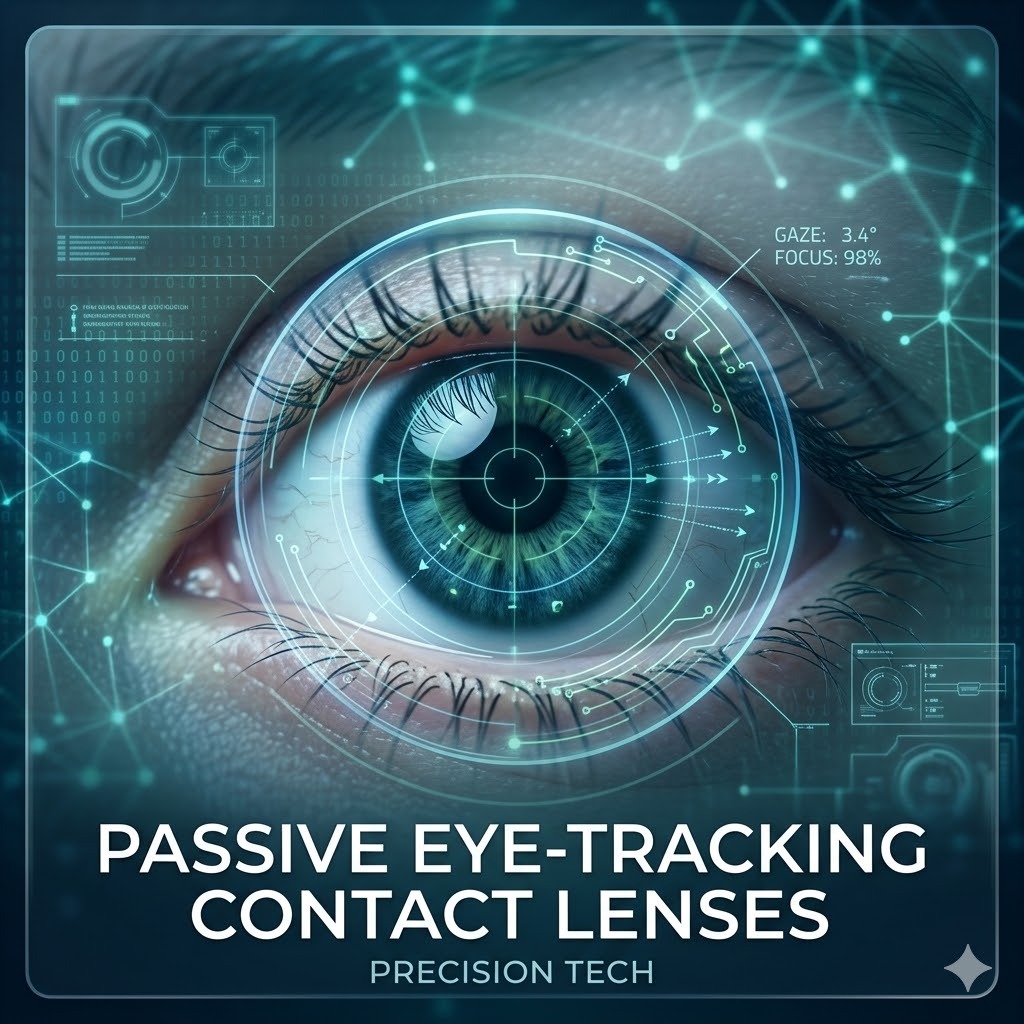
A new passive contact lens developed by deep-tech startup Xpanceo promises to make eye-tracking more accurate and ubiquitous. By embedding microscopic optical patterns in a conventional contact lens, the system allows any camera-equipped device (phones, laptops, VR headsets, even vehicle dashboards) to precisely follow your gaze without bulky sensors or power‐hungry infrared illumination. In practical terms, this means real-time gaze tracking with about 0.3° precision. The key innovation is a pair of ultra-thin gratings printed on the lens: as your eye rotates, their overlapping “moiré” pattern shifts in a measurable way that standard cameras can detect and interpret.
Unlike conventional eye-trackers that shine infrared light on the eye and analyse reflections (glints) from the cornea or pupil, Xpanceo’s lens is fully passive. No battery or active electronics are needed in the lens itself. Any camera simply sees the shifting moiré fringes and computes gaze direction through geometry. This simplifies the hardware dramatically – no IR LEDs, less calibration, and little impact from ambient light conditions. Because it uses existing imaging systems, the tracking can be continuous and “always-on” without draining device batteries.
What Is the Eye-Tracking Contact Lens?
The new contact lens is a passive eye-tracking device, meaning it doesn’t require batteries or active electronics inside the lens itself. Instead, it works in combination with external devices like smartphones or cameras.
The lens uses microscopic optical structures that generate shifting patterns as the eye moves. These patterns are then read by a camera system and translated into precise eye movement data.
In simple terms:
- Your eye moves
- The lens creates optical patterns
- Devices read those patterns
- Software interprets your gaze direction
This allows ultra-precise tracking without heavy hardware or high power consumption.
How the Smart Lens Works
The core of the technology is the microscopic moiré pattern: two transparent gratings (each a tiny stripe pattern a few microns apart) are stacked on the lens. When perfectly aligned, they form a constant pattern. But as the eye rotates, the relative angle between the gratings changes, creating a larger-scale interference pattern (moiré fringes) that shifts predictably. By measuring the phase shift of these fringes, algorithms can infer the gaze angle very precisely. In lab tests, the system achieved 0.28°–0.3° accuracy across a ±15° range, surpassing many current commercial trackers. Importantly, it reaches this precision without any special illumination, even a normal camera flash or room light can do.
The entire patterned module on the lens is only about 2.5×2.5 mm and is encapsulated in biocompatible silicone, compatible with regular lens manufacturing. In other words, the result is a near-normal contact lens that looks and feels like any other. Any camera that can focus on your eye (smartphone selfie camera, AR glasses sensor, etc.) could now double as an eye-tracker.
Advantages and Applications
One of the most important applications of this technology is in healthcare.
Researchers suggest that precise eye-tracking data could help detect early neurological changes associated with conditions like:
- Alzheimer’s disease
- Parkinson’s disease
- cognitive decline disorders
Patterns of eye movement can reveal early signs of diseases like Parkinson’s and Alzheimer’s. In fact, the Xpanceo team points out that their system’s 0.3° precision “makes it a promising solution” for detecting subtle eye-movement changes linked to these disorders.
Because eye movement is closely linked to brain function, subtle irregularities in gaze patterns can act as early warning signals. The relationship between visual behavior and neurological development is already at the center of a separate debate. Research into screen time effects on children is producing conflicting findings about whether extended device use alters attention patterns in ways that could complicate the diagnostic baselines eye-tracking systems depend on.
If combined with consumer devices, this technology could allow:
- Continuous at-home monitoring
- Early diagnosis without hospital equipment
- Long-term neurological tracking
Passive eye-tracking sits within a broader transformation of consumer devices into diagnostic tools. AI systems are already being deployed across healthcare to detect disease patterns, personalize treatment recommendations, and monitor chronic conditions through data streams that previously required clinical settings to generate.
In theory, this could transform preventative healthcare by turning everyday devices into diagnostic tools.
The major advantages of Xpanceo’s approach are accuracy, convenience, and versatility. Because it leverages existing cameras, it can be used “passively” in many contexts: from hands-free computing to medical monitoring. Phones and computers with no special hardware upgrades could offer gaze-based interaction or accessibility features.
For example, a laptop’s webcam could detect which part of the screen you’re looking at without requiring you to wear a head-mounted tracker. The article by T3 notes that this could make eye-tracking far more practical in everyday devices.
Beyond health, the tech could enhance AR/VR and wearable computing. Since the lens is small and passive, it could be integrated into future augmented-reality contact lenses or heads-up displays, providing precise gaze input for user interfaces. It also has potential in industrial and automotive settings: for example, drivers or pilots wearing helmet cameras could have their eye fatigue or alertness monitored continuously.
The EurekAlert release notes that helmet-mounted systems and vehicle dashboards are prime targets, where detecting “central nervous system fatigue, cognitive impairment, or intoxication” in real time could improve safety.
Disadvantages and Concerns of Eye-Tracking Contact Lens
1. Privacy and Surveillance Risks
This technology can capture extremely sensitive biometric data, including attention patterns and subconscious focus. Such information could be exploited for behavioural profiling, targeted advertising, or even surveillance, raising serious concerns about who controls and benefits from this data.
2. Data Security and Misuse
Since the system relies on continuous tracking and external device integration, it introduces new attack surfaces. If hacked, eye-movement data could be used maliciously to infer user intent, habits, or even cognitive conditions.
3. Ethical and Consent Issues
Continuous passive tracking blurs the line between voluntary and involuntary data collection. Users may not fully understand what is being recorded or how often, making informed consent difficult in real-world usage.
4. Health and Comfort Concerns
As a wearable medical-grade contact lens, long-term usage may raise concerns about eye strain, irritation, or compatibility with different users’ eye conditions, especially in continuous tracking environments.
How It Compares to Existing Eye-Tracking Tech
Traditional eye-tracking systems rely on:
- Infrared cameras
- External sensors
- Machine learning calibration systems
These systems are:
- Power-intensive
- Hardware-heavy
- Limited in mobility
In contrast, the contact lens approach is:
- Lightweight
- Passive
- Potentially continuous
This shift from external tracking systems to in-eye data generation represents a major leap in wearable computing.
Privacy and Ethical Considerations
On the flip side, a ubiquitous eye-tracking lens raises serious privacy concerns. Gaze data is extremely personal. How long you look at something, and what you look at, can reveal intimate information: your interests, attention, even health and emotional state. Civil liberties advocates warn that advanced eye-tracking could be used for intrusive profiling or surveillance. For example, ACLU analysts note that gaze behavior indicates medical conditions (autism, ADHD, Alzheimer’s, etc.) or cognitive states, and could even be mined for targeted advertising based on what draws your focus.
Imagine public cameras or advertising displays tracking oncoming pedestrians’ eye movements in real time – such technology could infer which products grab someone’s attention or how they react to images. The prospect of a device literally “seeing into your mind” can be unsettling. The T3 article itself acknowledges this tension: “Machines seeing us more easily and in more detail can be scary,” even as it praises the health benefits.
Regulatory issues are still catching up. Eye-tracking data could easily count as biometric or health-related data under laws like the GDPR or HIPAA, requiring stringent consent and protections.
Currently, no comprehensive framework exists for passive gaze data captured outside of research settings. As one analyst puts it, continuous monitoring of gaze requires oversight “commensurate with that of financial records or health data”.
For now, Xpanceo’s lenses are experimental research – but should they reach mass use, we’ll need clear rules on data ownership, opt-in consent, and limits on how eye data is stored and shared.
Future Outlook
The Xpanceo contact lens is still in development – the company has published its findings in the journal Advanced Functional Materials, but a consumer product is not yet available. Nonetheless, it exemplifies a broader trend toward invisible wearables. By making the lens itself an input sensor, Xpanceo aims to create a “vision-native” platform for computing (as per their site vision) that could outcompete glasses or wrist-worn devices.
If successful, we will soon see a world where eyes become touchscreens, controlling interfaces just by looking, and where everyday devices “know” your state of attention. This tech bridges eyewear, AI, and biometrics in a novel way. But as with any powerful sensing tech, society will have to balance innovation with privacy. In the words of Xpanceo’s founder, this moiré approach opens applications without adding complexity, yet it will also require us to add complexity to legal and ethical safeguards.
Eye-tracking contact lenses represent one technology thread in a much wider reconfiguration of what human capability means. Biotechnology, neural interfaces, and augmentation systems are converging toward entirely new categories of human experience that challenge existing legal, ethical, and biological definitions.
If this technology matures, it could become part of a broader ecosystem of human-integrated computing, where devices no longer require explicit input.
Instead of typing or touching screens:
- Your gaze becomes input
- Your attention becomes data
- Your vision becomes interaction
This could redefine how humans interact with machines entirely.
But it also pushes us toward a future where even unconscious behaviour is measurable, trackable, and analysable.
Conclusion
The eye-tracking contact lens developed by Xpanceo represents a major step forward in wearable technology. It combines optical physics, AI interpretation, and human-computer interaction into a single passive system.
Its potential applications in healthcare, accessibility, and computing are enormous. However, its implications for privacy and surveillance are equally significant.
This is not just a new gadget. It is a glimpse into a future where the human eye itself becomes part of the digital interface.
FAQs
1. What is the Xpanceo eye-tracking contact lens?
It is a passive wearable lens that tracks eye movement using optical patterns and external cameras, enabling precise gaze detection without embedded electronics.
2. How does it track eye movement?
It uses moiré interference patterns that shift as the eye rotates. Cameras detect these shifts and convert them into eye-tracking data.
3. What are the medical uses of this technology?
It helps in the early detection of neurological conditions like Alzheimer’s and Parkinson’s by analysing abnormal eye movement patterns.
4. Is the contact lens available for public use?
No, it is still in the research and development stage, with no confirmed commercial release date.
5. What are the risks of eye-tracking contact lenses?
Main concerns include privacy issues, surveillance risks, data ownership, and potential misuse of continuous biometric tracking.
Stay Ahead of Wearable Tech Evolution
From AI-powered vision systems to biometric contact lenses, the future of human interaction is shifting rapidly.
Subscribe to The IT Horizon for deep insights into emerging technologies shaping the next generation of computing, biology, and human-machine interfaces.