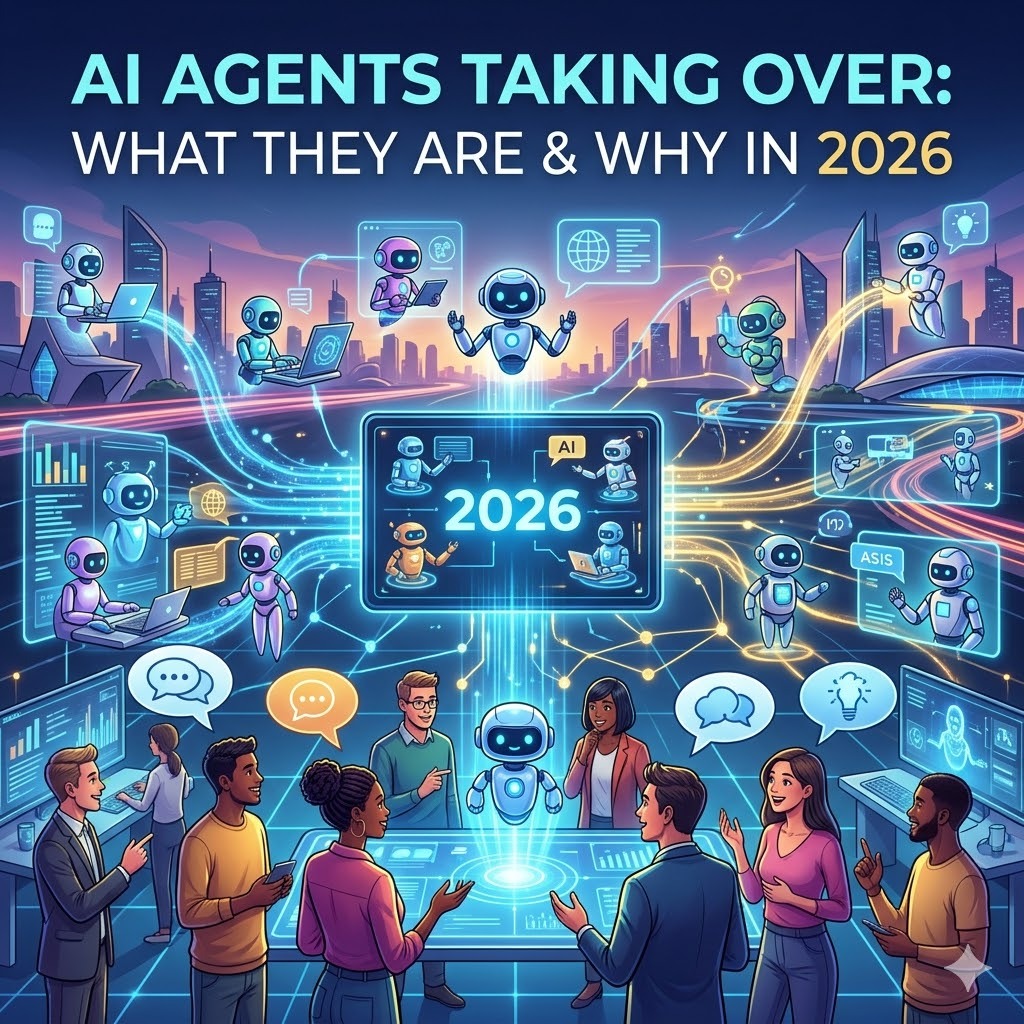
If 2023 was about chatbots and 2024–2025 was about generative AI, then 2026 is clearly the year of AI agents.
From automating entire workflows to replacing repetitive human tasks, AI is no longer just responding. It’s acting. And that shift is changing everything.
What Exactly Are AI Agents?
AI agents are advanced systems that can plan, decide, and execute tasks independently.
Unlike traditional AI tools that wait for prompts, agents can:
- Set goals
- Break them into steps
- Use tools and APIs
- Adapt based on results
Think of them as digital workers rather than assistants.
Companies like OpenAI, Google, and Microsoft are heavily investing in agent-based systems, pushing AI beyond chat interfaces into real-world execution.
Why AI Agents Are Trending Right Now
The hype isn’t random. It’s driven by real capability leaps.
1. From Answers to Actions
Earlier AI models could generate content. Now, agents can:
- Book meetings
- Analyse data
- Write and deploy code
- Manage tasks across apps
This transition from thinking to doing is the key shift.
2. Rise of Autonomous Workflows
Businesses are now using AI agents to:
- Automate customer support
- Handle marketing campaigns
- Manage internal operations
Instead of hiring multiple roles, companies can deploy one system that coordinates everything.
3. Multi-Tool Integration
Modern agents can connect with:
- CRMs
- Email platforms
- Databases
- APIs
This makes them far more powerful than standalone AI tools.
How AI Agents Actually Work
At a basic level, an AI agent follows a loop:
- Goal Input: “Create a marketing campaign”
- Planning: Breaks into steps
- Execution: Uses tools (email, analytics, etc.)
- Evaluation: Checks results
- Iteration: Improves output
This loop continues until the goal is achieved.
What makes this powerful is the ability to adapt in real time—something traditional software simply can’t do.
Real-World Examples of AI Agents
Business Operations
Companies are using agents to:
- Generate reports
- Analyse customer data
- Optimise workflows
Software Development
AI agents can now:
- Write code
- Debug issues
- Deploy updates
Developers are shifting from coding everything to supervising AI systems.
Personal Productivity
Individuals are using agents to:
- Plan schedules
- Manage emails
- Conduct research
This turns AI into a personal operations manager.
Big Players Leading the AI Agent Race
The competition is intense and strategic.
- OpenAI is pushing agent-based workflows through its latest models
- Google is integrating agents into its ecosystem (Docs, Gmail, Search)
- Microsoft is embedding AI agents into enterprise tools like Office and Azure
This isn’t just innovation. It’s a race to control the future of digital work.
The enterprise AI agent market moved from experimentation to commercial deployment when Anthropic launched Claude Cowork as a generally available desktop automation platform. The first major AI agent product specifically engineered around enterprise governance, access controls, and compliance requirements rather than raw capability.
The Benefits: Why Businesses Are Adopting Fast
4 key advantages driving rapid adoption of AI in businesses.
1. Massive Efficiency Gains
AI agents dramatically reduce execution time by automating multi-step workflows that previously required manual effort. Tasks like data analysis, reporting, and campaign setup that once took hours can now be completed in minutes with consistent accuracy.
2. Cost Reduction
By handling repetitive and operational tasks, AI agents reduce the need for large support teams. Businesses can reallocate budgets more effectively, focusing human resources on strategy, creativity, and high-impact decision-making rather than routine execution work.
3. 24/7 Operation
AI agents operate continuously without downtime, enabling businesses to maintain productivity around the clock. Whether it’s processing data, responding to queries, or managing systems, they ensure workflows keep running even outside standard working hours.
4. Scalability
AI agents allow businesses to scale operations without proportionally increasing costs or workforce size. A single agent can manage multiple processes simultaneously, making it easier to handle growing workloads and expanding business demands efficiently.
The Risks: What People Are Concerned About
4 key risks businesses can’t ignore
Despite the benefits, AI agents introduce serious challenges that organisations must carefully manage. As adoption accelerates, concerns around control, security, and long-term dependency are becoming harder to overlook.
1. Loss of Human Jobs
As AI agents take over repetitive and operational tasks, many roles, especially in administration, support, and entry-level functions, are at risk. This shift may lead to workforce disruption, requiring reskilling and adaptation across multiple industries.
The workforce anxiety this displacement creates is already measurable at the generational level. Gen Z, the first cohort entering the labor market with AI agents already occupying entry-level task categories, reports rising anger and anxiety toward AI tools even as their daily usage of those same tools continues to increase.
2. Lack of Control
AI agents operate with a level of autonomy that raises critical concerns around oversight. If an agent makes an incorrect decision or executes the wrong action, it becomes difficult to determine accountability and implement immediate corrective measures.
3. Security Risks
Granting AI agents access to internal systems, databases, and tools increases exposure to potential security breaches. If compromised, these agents could unintentionally leak sensitive data or create vulnerabilities that malicious actors might exploit.
This is not a theoretical risk category. The documented security threats specific to organizational AI deployment span data exfiltration, prompt injection, supply chain compromise, and access control failures, forming a threat surface that grows proportionally with every additional workflow an agent is granted permission to execute.
4. Over-Reliance on AI
As businesses increasingly depend on AI agents for core operations, there’s a growing risk of losing human oversight and understanding. Over-reliance can make organisations vulnerable if systems fail or behave unpredictably under complex conditions.
The Future: Where AI Agents Are Heading
4 key trends shaping what comes next.
We’re still early in the AI agent lifecycle, but the trajectory is becoming increasingly clear. As capabilities improve and adoption expands, these systems are set to redefine how businesses operate and how individuals interact with technology.
1. Fully Autonomous Companies
Some startups are already experimenting with AI agents handling core business operations, from marketing to customer support. This model reduces human dependency and creates lean, highly automated organisations capable of operating with minimal intervention.
2. Personal AI Employees
Individuals may soon rely on multiple AI agents to manage daily tasks such as scheduling, communication, and research. These digital assistants will act more like employees, proactively handling responsibilities rather than waiting for instructions.
3. AI-to-AI Collaboration
AI agents are expected to collaborate with each other, forming interconnected systems that complete complex workflows. Instead of isolated tools, businesses will operate ecosystems where multiple agents communicate, coordinate, and optimise outcomes together.
4. Regulation and Control
As AI agents gain more autonomy, governments and regulatory bodies will introduce frameworks to manage risks. These regulations will likely focus on accountability, transparency, and ensuring that AI systems operate within defined ethical and legal boundaries.
Final Thoughts
AI agents are not just another tech trend—they represent a fundamental shift in how work gets done.
The question is no longer “Can AI help?”
It’s now “How much can it replace?”
Those who understand and adopt this shift early will have a significant advantage. Those who ignore it may struggle to keep up.
FAQs
1. What is an AI agent in simple terms?
An AI agent is a system that can complete tasks on its own by planning, executing, and improving its actions without constant human input.
2. How are AI agents different from chatbots?
Chatbots mainly respond to user prompts with predefined or generative replies, but AI agents go further by executing tasks, using external tools, and making decisions. The key difference is autonomy. Agents don’t just talk; they act, which makes them far more powerful but also harder to control responsibly.
3. Are AI agents already being used today?
Yes, AI agents are already being deployed across industries, especially in customer support, workflow automation, and internal business operations. Many experts argue that we are in the early adoption phase, where companies are quietly integrating agents to gain efficiency advantages before widespread public awareness fully catches up.
4. Can AI agents replace human jobs?
AI agents can realistically replace repetitive, structured tasks, especially in administrative and operational roles. However, it’s widely debated that they cannot fully replace human judgment, creativity, and emotional intelligence. The likely outcome is job transformation rather than complete replacement, shifting humans toward higher-level strategic responsibilities.
5. Are AI agents safe to use?
AI agents can be safe when properly designed, monitored, and restricted within clear boundaries. However, experts caution that risks such as data leaks, incorrect automated decisions, and misuse of system access remain significant. The debate continues around whether governance can fully keep pace with rapidly advancing autonomy.
Stay Ahead of the AI Shift
AI agents are redefining how work gets done, from business operations to personal productivity.
Subscribe to The IT Horizon newsletter and stay updated with clear, no-fluff insights on the technologies shaping the future, before they reshape your industry.