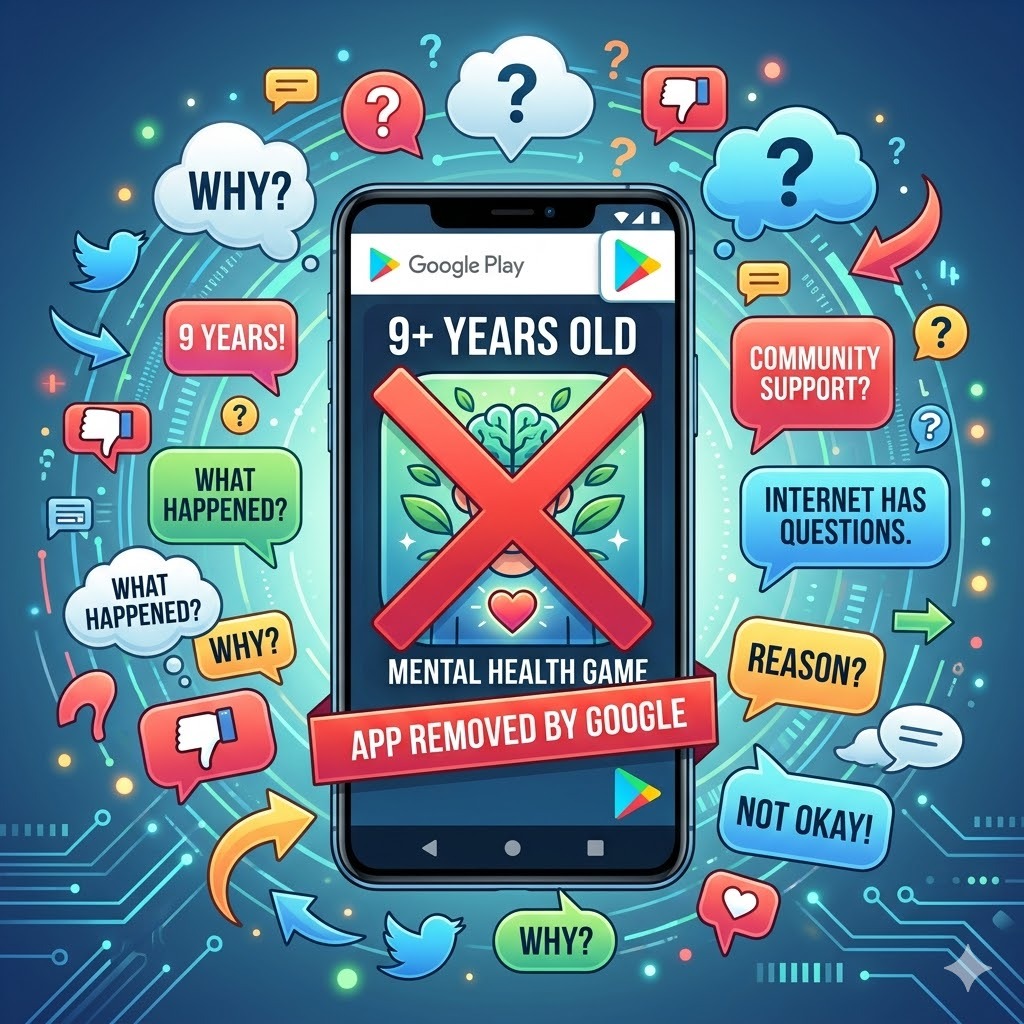
Google removed Doki Doki Literature Club from the Google Play Store on April 8, 2026, citing violations of its Terms of Service in the game’s “depiction of sensitive themes.” DDLC (a psychological horror visual novel originally released in 2017 by creator Dan Salvato) had only been available on Android for a few months following its December 2025 mobile port. It remains available on iOS, Nintendo Switch, PlayStation, Steam, and PC. Google has not issued a public, detailed explanation beyond the Terms of Service violation classification.
Dan Salvato and publisher Serenity Forge confirmed the removal in a joint statement on April 10, expressing commitment to seeking reinstatement while exploring alternative Android distribution methods.
What Doki Doki Literature Club Actually Is
Doki Doki Literature Club is a free-to-play visual novel that opens by presenting itself as a lighthearted Japanese-style dating simulation, before systematically dismantling that presentation to deliver a psychological horror experience centered on themes of depression, self-harm, and mental health deterioration. The game carries explicit content warnings at launch, stating it is not suitable for children or anyone easily disturbed by depictions of mental illness, suicide, or psychological distress.
DDLC has accumulated a documented community of players who credit the game with directly influencing their decision to seek mental health treatment.
One Bluesky commenter wrote: “Doki Doki Literature Club came out when I was in high school, and it’s genuinely the reason I sought out to get treatment for depression at the time. I’m not exaggerating when I say this game steered my life in a better direction.”
Another stated: “It’s literally helped with my depression and has still helped me grow as a person to this very day.”
These accounts are consistent across years of documented community discussion of the game’s impact.
The game has existed for 9 years. Its content has not changed. Google approved its Play Store listing in December 2025 and removed it 4 months later.
The Double Standard the Community Is Documenting
The community response to DDLC’s removal centers on 1 consistent observation: Google’s content enforcement is applied selectively in ways that do not reflect a coherent safety standard.
Users on Bluesky and Reddit identified and shared screenshots of explicitly sexual AI-generated games currently active on the Google Play Store, including titles featuring graphic sexual content, that have not received equivalent enforcement action.
One Bluesky user documented finding a card game containing explicit AI-generated sex scenes after clicking a suspicious advertisement, noting: “The more I looked, the worse it got.” Multiple users identified that Google Play hosts applications generating non-consensual imagery and content that would fail the same sensitivity threshold DDLC was removed for, by any reasonable interpretation, more severely.
The platform comparison the community draws extends beyond the Play Store. Google has not removed Twitter/X from its app store despite documented periods in 2024 during which Grok, X’s AI system, generated non-consensual nude images, including material involving minors, before restrictions were applied. Commenter after commenter on both Bluesky and The Verge’s coverage noted this specific comparison, a critically acclaimed mental health game with 9 years of documented community benefit removed, while apps generating genuinely harmful content remain available.
Platform content enforcement inconsistency is drawing formal government responses beyond community documentation. The Philippines issued Meta a direct 7-day ultimatum to suppress harmful content or face criminal prosecution, a regulatory escalation driven by precisely the same observation the DDLC community is making: that platforms apply moderation selectively in ways that serve their own interests rather than a coherent harm-prevention standard.
The App Store Gatekeeping Problem This Exposes
Google’s removal of DDLC operates within a structural power dynamic that the gaming and developer community has documented repeatedly: when Google Play and Apple’s App Store collectively control the primary distribution channels for mobile software, their content moderation decisions function as de facto censorship with no meaningful appeals infrastructure.
DDLC’s removal from Google Play does not prevent Android users from playing the game; Android’s sideloading capability allows direct APK installation outside the Play Store. Serenity Forge confirmed they are “looking into potential options for alternate methods of distribution on Android devices.” However, Google has been progressively tightening sideloading restrictions across Android versions, and the community immediately identified this trajectory.
One commenter noted: “Google wants to take away sideloading, so censorship like this is total and complete.” Another referenced the precedent of games like Nu:Carnival, an adult visual novel, distributing directly via APK on its own website precisely because app store approval was never available.
The developer community commenter who described the situation most precisely was one who observed: “1 billion+ people have surrendered their right to artistic expression to Google.” The legal framework supporting that surrender is Section 230 of the Communications Decency Act, which protects platform operators from liability for third-party content while granting them broad discretion to moderate or remove content at their own judgment.
Google’s Play Store content policies operate within this framework: the company bears no legal obligation to explain or justify individual removal decisions beyond citing Terms of Service violations.
The legal immunity Section 230 provides platforms for content moderation decisions (“Good Samaritan” protection) does not extend to all platform conduct. A California jury found Meta and Google liable for deliberately addicting a child user, establishing that platform design choices carrying documented harm can generate civil damages even when content moderation decisions themselves remain protected.
What the Removal Actually Tells Us About Automated Enforcement
The community consensus on Bluesky identified a probable root cause that Google has not confirmed or denied: the removal was likely an automated content classification decision rather than a human editorial judgment. One commenter stated, “I just have a feeling that this wasn’t a human-made decision. I can’t picture DDLC existing for almost 9 years without anyone batting an eye at these aspects until now.” Another asked directly: “Could you ask if anyone at Google actually played and understood the game? I’m thinking no.”
Automated content moderation systems classify content based on keyword detection, image analysis, and pattern matching against policy violation categories. DDLC contains explicit references to suicide and self-harm, content that automated systems flag under mental health-sensitive content policies. The systems do not read narrative context, artistic intent, or documented real-world impact. A game that uses depictions of mental health crisis to create empathy and encourage treatment-seeking, and a game that glorifies or normalizes self-harm would produce identical flag signals from an automated classifier reading surface-level content attributes.
Our Honest Opinion
The enforcement pattern is the problem, not the policy!
Content policies prohibiting harmful depictions of self-harm and mental health crises on platforms accessible to minors are defensible in principle. Google Play hosts applications used by children, and a policy framework addressing sensitive content has a legitimate purpose.
The question of what digital content children should access is being answered by governments as well as platforms. Greece moved to ban social media access entirely for users under 15, a blunter and more transparent enforcement instrument than automated content classifiers making removal decisions without human contextual judgment.
The contradictory position the community is articulating is not that sensitive content policies should not exist. It is that Google’s enforcement of those policies produces outcomes that are inconsistent, arbitrary, and demonstrably disconnected from actual harm prevention.
A 9-year-old game with documented evidence of positive mental health impact was removed 4 months after a human-reviewed approval, while AI-generated explicit content and applications with demonstrably harmful outputs remain available, which does not describe a coherent safety framework. It describes an automated classification system making enforcement decisions without the contextual judgment that distinguishes a game helping people survive depression from a game encouraging them to harm themselves, and a company that either cannot or will not correct that distinction after the fact.
Platform content moderation, app store gatekeeping, and the policy decisions shaping what software reaches users are covered at The IT Horizon. Subscribe to our newsletter. We track every removal, reinstatement, and policy shift that affects how digital content is distributed and who controls access to it.