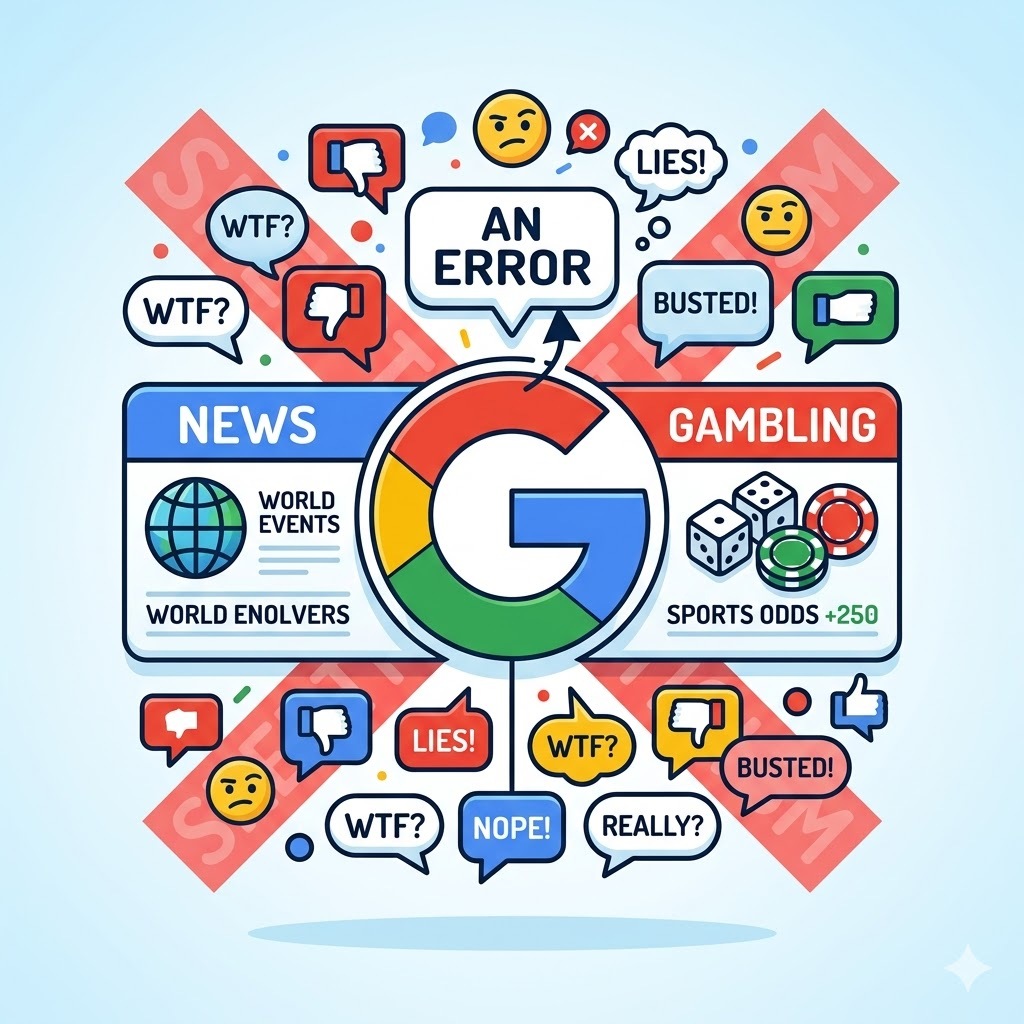
Google News displayed Polymarket prediction market bets alongside legitimate news articles from sources including The Guardian and Reuters, presenting cryptocurrency-staked wagers on future world events as if they were journalism. Google spokesperson Ned Adriance told The Verge on April 11, 2026, that the appearance was an error: “This site briefly appeared in Google News in error, and it is no longer surfacing in News.” The results were removed. The explanation landed with considerably less conviction than the incident itself.
Reports of Polymarket bets appearing in Google News surfaced on social media as early as January 2026, approximately 3 months before Google called it an error.
What People Were Actually Seeing
Polymarket is a cryptocurrency-based prediction market where users stake real money on the probability of future events occurring. The platform generates page titles structured as questions
- “Will ChatGPT Be Out as the #1 Free App in the US Apple Store by April 10?”
- or “Will ships transit the Strait of Hormuz?”
These questions are phrased in ways that are, as Futurism noted, “weirdly specific and intriguing when you don’t know the context.”
When Futurism searched “will ships transit the strait,” a search query directly relevant to the live US-Iran conflict and Strait of Hormuz blockade, Google News returned a Polymarket bet on the specific number of ships permitted to pass, positioned directly below The Guardian and Reuters. A user without prior knowledge of Polymarket’s nature would encounter a specific numerical prediction about a geopolitical crisis, formatted identically to a news article headline, with no visual or structural indication that it represented a financial wager rather than reported information.
Polymarket CEO Shayne Coplan has publicly described his platform’s market prices as “the most accurate thing we have as mankind right now, until someone else creates some sort of a super crystal ball.” That framing, prediction markets as superior information products, is central to how Polymarket and its competitor Kalshi have positioned themselves in media and financial partnerships across 2025 and 2026.
Why “Error” Is a Difficult Word to Accept Here
Google’s algorithmic news curation does not operate through a single switch. Google News eligibility requires a site to pass policy review, technical integration standards, and content classification before appearing in results. The Reddit community identified the implausibility of the “error” explanation immediately. One commenter stated directly: “That shit doesn’t get on-boarded and formatted for the news feed accidentally.” Another noted: “There is no way ANYTHING is an accident on their main page feeds/results. An A/B test, maybe, but not an accident.”
The A/B testing hypothesis carries structural credibility. Google routinely tests new content types and integrations against live user segments before deciding whether to proceed with full deployment. An accidental appearance lasting from January through April, 3 months, while generating social media commentary, is a more consistent timeline with a monitored test than with an undetected technical error.
This content type expansion sits within a broader pattern of Google restructuring what its search and news surfaces show users. The same AI-centric overhaul rebuilding Google Search around Gemini-generated results is simultaneously redefining which sources and content categories qualify as information worth surfacing.
Google has already established a formal commercial relationship with both Polymarket and Kalshi through a Google Finance data integration deal, displaying prediction market probability data within Google’s financial products. Whether the News appearance was related to that existing partnership remains unconfirmed. Google did not answer The Verge’s follow-up questions on that specific connection.
The Broader Context: Prediction Markets Are Actively Buying Into News Infrastructure
Polymarket and Kalshi’s appearance in Google News did not occur in a vacuum. Both platforms have been aggressively pursuing integration with journalism and media infrastructure across 2025–2026.
CNN, Fox News, and CNBC have established data-sharing deals with Kalshi, displaying prediction market probabilities on air during news broadcasts. Fox News formalized a Kalshi deal on April 7, 2026, 4 days before the Google News error disclosure. Arizona’s criminal charges against Kalshi were put on hold on April 11, the same day Google removed Polymarket from News results. A US appeals court ruled on April 7 that New Jersey cannot regulate Kalshi under state gambling law.
The regulatory and media integration trajectory for prediction markets is moving in 1 direction, deeper embedding into mainstream information infrastructure, regardless of whether Google’s specific News appearance was intentional or accidental.
| Platform | Media/Finance Deal | Date |
| Polymarket + Kalshi | Google Finance data integration | 2025 |
| Kalshi | Fox News on-air data deal | April 7, 2026 |
| Kalshi | CNN, CNBC on-air data deals | 2025–2026 |
| Polymarket | Google News appearance | January to April 2026 |
The Information Integrity Problem Nobody Is Naming Directly
The specific harm the Polymarket-in-Google-News incident creates is not that prediction markets exist or that their probability estimates lack value. The harm is categorical confusion, presenting a financial instrument as a journalistic product to users who have no mechanism to distinguish between them in a formatted news feed.
A Reuters article stating “11 ships transited the Strait of Hormuz on Wednesday” is reported as fact. A Polymarket bet titled “Will 15+ ships transit the Strait of Hormuz this week?” is a crowd-aggregated financial probability estimate that functions as neither reporting nor analysis. Placing both in the same visual and categorical context, without structural differentiation, degrades the user’s ability to assess what they are reading and on what epistemic basis it was produced.
The degradation of source quality signals in search results is not limited to prediction markets; scaled AI content generation tools are flooding Google’s index with algorithmically produced articles that pass technical eligibility standards while carrying none of the editorial accountability that distinguishes journalism from content production.
Google’s stated policy for News eligibility is that sources must “create content about current issues, events, and important topics.” Polymarket creates financial instruments about current issues, events, and important topics, a distinction that matters considerably for users making decisions based on what they believe is journalism.
Conclusion
Google’s error explanation is the least interesting version of this incident. Whether the Polymarket appearance was an accidental misconfiguration, an A/B test, or a deliberate pilot that was walked back under scrutiny, the 3-month duration and the active commercial relationship between Google and both major prediction market platforms establish that this was not a random technical anomaly.
The contradictory position targets the error framing directly. Prediction market platforms have secured broadcast deals with 3 major US cable news networks, regulatory victories in federal appeals courts, and a Google Finance integration. All within the past 12 months.
Characterizing their appearance in Google News as an error while their data simultaneously appears in Google Finance, Fox News, CNN, and CNBC requires distinguishing between news and finance infrastructure that the prediction market industry has spent 2 years systematically erasing. The error may have been real. The direction of travel it briefly made visible is not accidental at all.
Platform policy decisions, algorithmic news curation, and the information integrity questions reshaping how people consume news are covered at The IT Horizon. Subscribe to our newsletter. We track every editorial system failure, policy shift, and platform decision that affects what you see when you search for the news.