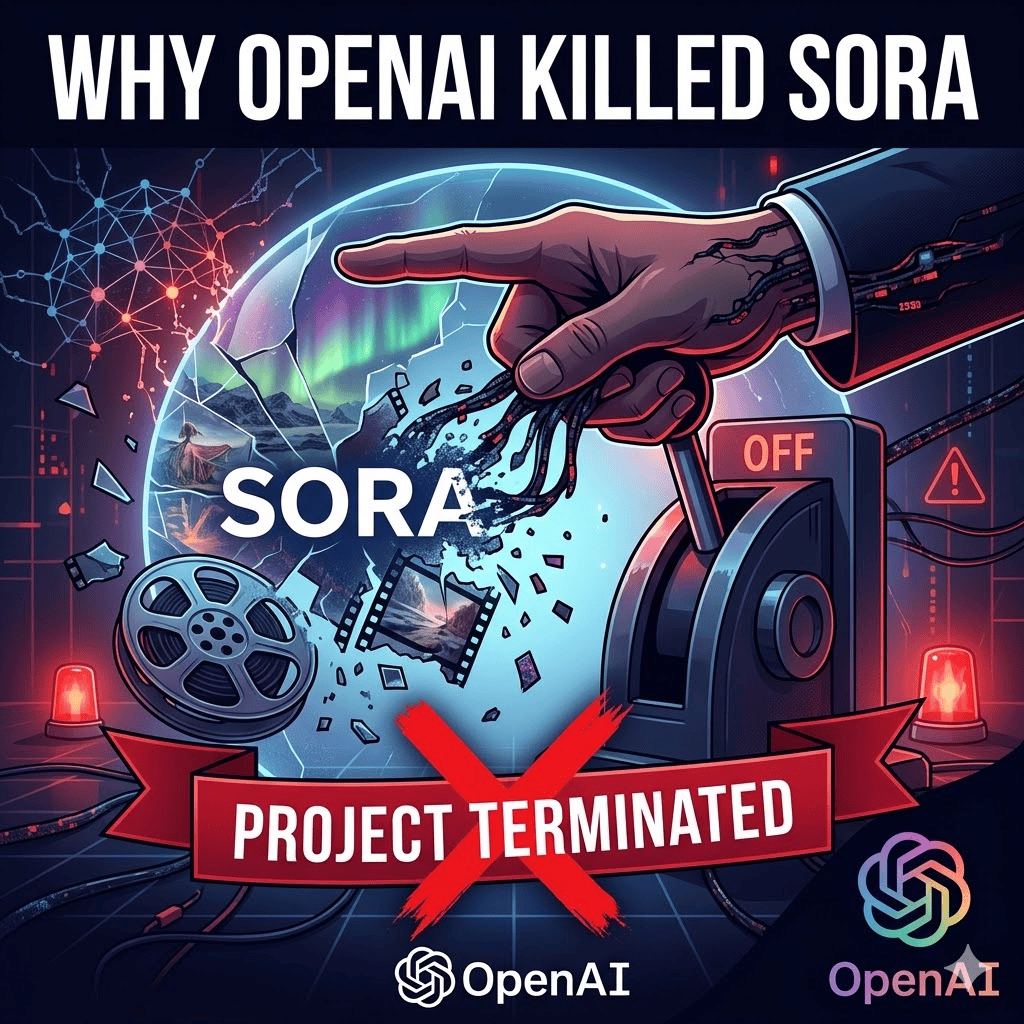
OpenAI killed Sora because Sora burned through approximately $1 million per day in GPU resources while its active user count collapsed from 1 million to fewer than 500,000, producing a cost-per-user figure of $2 per day, or $730 per user annually, with no revenue model to offset it.
OpenAI discontinued Sora, its AI video-generation app, on March 24, 2026. Less than 6 months after its public launch, ending the text-to-video tool’s life as a consumer product and shutting down the Sora API that gave developers and Hollywood studios direct model access. The shutdown was not triggered by safety concerns, creative backlash, or regulatory pressure.
The following covers the 5 reasons OpenAI killed Sora, the financial data behind the decision, what replaced it, and what the shutdown signals about where the AI industry is heading.
Reason 1. The Financial Reality: What $1 Million Per Day Actually Meant
Sora’s daily operating cost of $1 million was not the product of mismanagement. It was the structural reality of video generation as a compute category. Generating realistic AI video is significantly more resource-intensive than text or image generation, requiring sustained GPU processing per output that scales directly with user volume.
At peak activity, Sora processed requests from approximately 1 million active users. A load that consumed a finite supply of AI chips with no path to profitability at that cost structure.
The download data makes the financial trajectory impossible to defend. Sora’s worldwide downloads peaked at 3.3 million across iOS and Android in November 2025, according to third-party analytics firm Appfigures. Downloads collapsed to 1.1 million by February 2026. A 67% decline in 3 months.
Active users fell below 500,000 by the time OpenAI made its shutdown decision. Sora was simultaneously losing users and maintaining a $1 million daily burn rate. A combination that converted a viral product launch into an accelerating financial liability.
| Sora Performance Metric | Peak | At Shutdown | Change |
| Global Downloads | 3.3 million (Nov 2025) | 1.1 million (Feb 2026) | −67% in 3 months |
| Active Users | ~1 million | Under 500,000 | −50%+ |
| Daily Compute Cost | ~$1 million | ~$1 million | No reduction |
| Cost Per Active User Per Day | ~$1.00 | ~$2.00 | Doubled as users left |
| Sora API Access | Live | Shut down March 24, 2026 | Discontinued |
| Disney Investment | $1 billion committed | Cancelled | Deal collapsed |
The cost-per-user figure doubled as users departed, because compute demand does not scale down proportionally with user loss in the video generation infrastructure. OpenAI’s GPU allocation to Sora remained fixed while the user base generating return on that allocation shrank by more than half.
Reason 2. The Disney Deal: $1 Billion Gone in Under an Hour
Disney’s cancellation of its $1 billion investment commitment represents the most concrete financial consequence of the Sora shutdown beyond the daily compute cost. Disney had committed to the investment as part of a partnership built around Sora’s video generation capabilities. A deal that assumed Sora’s continuation as a core OpenAI product.
OpenAI notified Disney of the shutdown less than 1 hour before the public announcement. Disney, blindsided by the decision, cancelled the $1 billion commitment the same day. The speed of notification and the scale of the financial consequence together illustrate how abruptly the shutdown decision was executed, and how completely OpenAI’s leadership prioritised internal resource reallocation over partner relationship management when the strategic call was made.
Reason 3. The IPO Factor: Why a $1 Million Daily Burn Became Unacceptable
OpenAI CFO Sarah Friar stated directly on March 24, 2026, that OpenAI needs to be “ready to be a public company.” IPO (Initial Public Offering) readiness means something specific in operational terms: public market investors scrutinise burn rate, revenue per product line, and resource efficiency at a level private investors tolerate less strictly.
A product burning $1 million daily with a 67% download decline, zero direct revenue, and a shrinking active user base is not a liability a pre-IPO company can carry into a prospectus.
OpenAI raised an additional $10 billion from investors on the same day it announced Sora’s shutdown, bringing its total funding round to more than $120 billion. The timing was deliberate. Freeing GPU capacity from Sora and redirecting it toward revenue-generating products strengthens the financial narrative OpenAI presents to public market investors, replacing a cost centre with demonstrable enterprise revenue before the IPO.
Reason 4. What Replaced Sora: Codex, the Super App, and Robotics
Codex, OpenAI’s AI-powered coding agent, surpassed $1 billion in annualized revenue in January 2026. The same month, Sora’s downloads were collapsing to 1.1 million. The contrast between these 2 data points is the clearest articulation of why the shutdown was inevitable: Codex generated $1 billion annually while consuming GPU resources; Sora consumed equivalent resources while generating none.
GPU capacity freed from Sora redirects to 3 destinations:
- First, Codex continues scaling its enterprise revenue base, serving the software engineers and corporate clients that drive OpenAI’s B2B segment.
- Second, OpenAI’s super app, consolidating ChatGPT, Codex, and Atlas into a unified consumer interface, receives the development resources previously allocated to Sora’s team.
- Third, the Sora research team itself redirects to world simulation research for robotics, applying video generation’s spatial modelling capability to physical task automation rather than consumer entertainment.
Fidji Simo, moved from her role as CEO of Applications to CEO of AGI Deployment, framed the strategic mandate to staff directly:
“We cannot miss this moment because we are distracted by side quests. We really have to nail productivity in general and particularly productivity on the business front.”
Sora was the side quest.
Reason 5. The Broader AI Industry Shift: From Demos to Revenue
Sora’s discontinuation reflects a shift occurring across the AI industry, not an isolated OpenAI decision. Over the previous 2 years, AI companies competed primarily on capability demonstration, releasing products that showcased model power rather than generating sustainable revenue. Sora’s November 2025 launch peak of 3.3 million downloads exemplifies this pattern: viral adoption driven by novelty, followed by rapid disengagement when novelty is exhausted.
The AI video generation market that Sora failed to hold now consists of 3 active competitors, including the following:
- Runway ML
- Pika Labs
- Kling AI
All 3 operate at lower compute cost structures than Sora’s architecture required, and all 3 continued developing their models during the 6-month window Sora occupied. Trevor Harries-Jones, board member at the Render Network Foundation.
A platform allowing creators to compare AI-generated video tools confirmed this directly: the density of choice in AI video generation means switching costs between tools are near zero, eliminating any sustainable moat for a single provider.
OpenAI’s response to this competitive reality is to exit the consumer video generation market entirely and concentrate on the 2 categories where switching costs are high. The 1st category is enterprise coding infrastructure through Codex, which serves software engineers and corporate clients with direct revenue generation. The 2nd category is the unified super app combining ChatGPT, Codex, and Atlas into a productivity assistant that replaces the simple chatbot model ChatGPT originated as.
Talent Risk: The Internal Cost of Killing Projects
OpenAI’s bottom-up resource allocation culture, where GPUs and researchers follow promising ideas rather than executive roadmaps, created the conditions that produced Sora. It also creates the conditions under which shutting Sora down carries talent risk. VP of Research Jerry Tworek departed OpenAI in January 2026 after struggling to secure resources for his next research direction. Tworek’s departure signals the internal tension that project deprioritisation creates at a company competing with Anthropic, Google DeepMind, and Meta for a limited pool of top-tier AI researchers.
OpenAI’s leaders acknowledge this risk directly. Researchers whose projects get discontinued face a straightforward choice: accept the pivot or move to a competing lab where their work remains prioritised. The 3 competitors, including Anthropic, Google DeepMind, and Meta, each operate active research programmes that absorb talent OpenAI loses.
Claude Code’s growing enterprise penetration at Anthropic, cited specifically as a competitive threat eating into OpenAI’s software engineering market, demonstrates that talent movement between these organisations has direct product consequences.
Conclusion
Sora’s shutdown closes the first chapter of OpenAI’s consumer experimentation era and opens a second one defined by a single question: what will people actually pay for, consistently, at scale. The answer OpenAI has landed on is not video, not novelty, and not demos. It is productivity infrastructure embedded deep enough in enterprise workflows that switching away becomes costly.
Every GPU freed from Sora is a GPU compounding returns inside Codex, the super app, and robotics research. The broader signal for the AI industry is this: the race to impress is over. The race to retain has begun, and OpenAI just made its most explicit move yet to compete on those terms.
Technology, artificial intelligence, digital culture, and everything shaping the connected world. We cover it all. Subscribe to our newsletter and get the stories that matter, before everyone else does.