
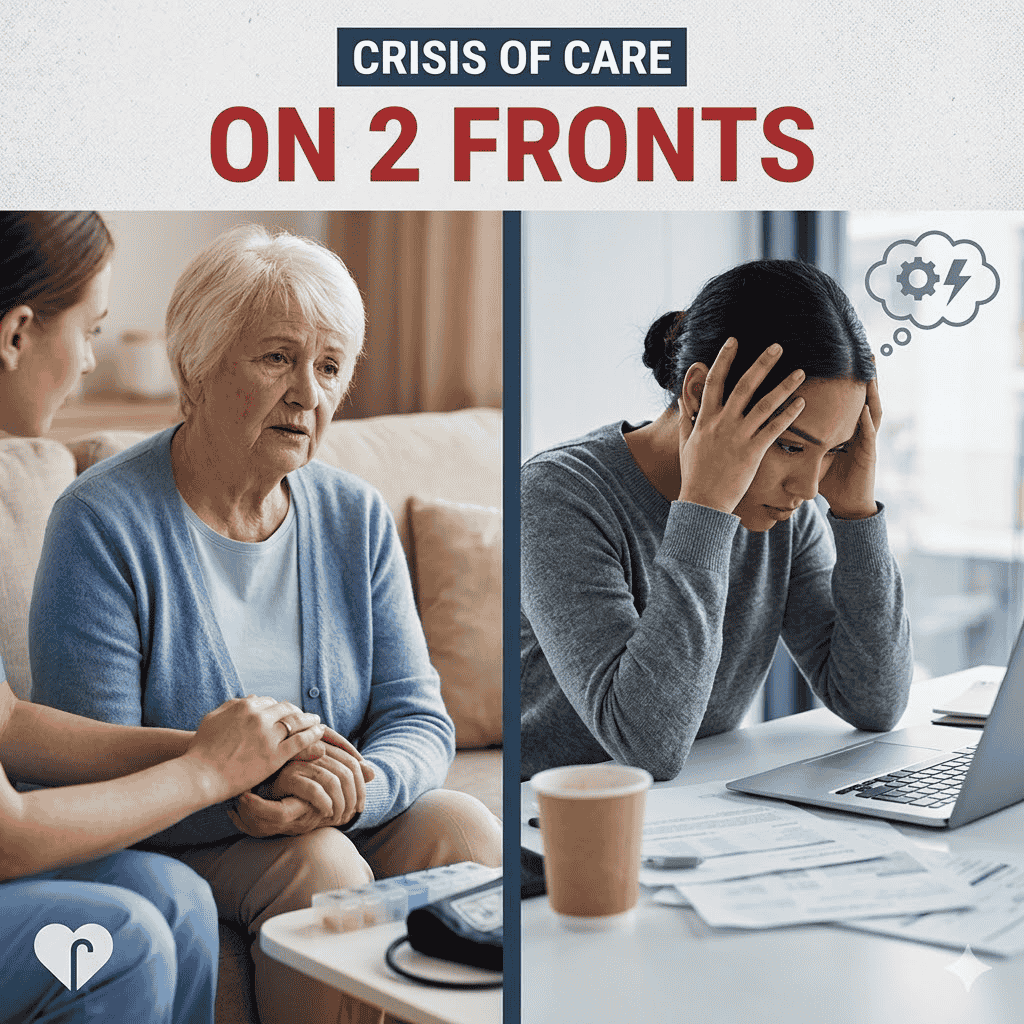
The United States is simultaneously running out of childcare and eldercare. Neither crisis is close to being resolved.
Families across the country cannot find affordable, available care for their young children. At the same time, the population of adults aged 75 and older is growing faster than the systems designed to support them can absorb.
In Wisconsin alone, families of 30,000 children cannot find childcare, 70% of rural areas qualify as childcare deserts, and the 75-and-older population is projected to grow by more than 40% by 2030. Both industries face the same structural problem: not enough workers, not enough facilities, not enough funding.
A growing number of communities are responding to both crises at once by combining them into a single solution.
What Intergenerational Care Actually Is
Intergenerational care is exactly what the name suggests: multiple generations sharing the same space, structured activities, and daily routines. The most common model places a preschool or daycare programme inside or alongside a nursing home or senior centre. Older adults spend time with young children through reading sessions, arts activities, technology help, and unstructured play. A less formal version operates through community centres where different age groups participate in shared programming without a clinical care setting.
Suzanne Morley, health promotion programme coordinator with the Wisconsin Institute for Healthy Aging, describes the model plainly: “Sometimes it might be in a more health care-based setting where there’s a nursing home, and there’s younger generations, like a preschool in the same facility. Or it can kind of be a little bit less formal and be in community centres.”
Morley has been tracking the rise of intergenerational programmes across Wisconsin and notes that interest has grown substantially over the past 5 to 6 years, driven by a wave of peer-reviewed research confirming measurable benefits for both age groups.
What the Research Says About Both Age Groups
For older adults
Social isolation is one of the most serious and underacknowledged health threats facing elderly people in the United States. Morley draws on a growing body of research to identify the specific health consequences of elder isolation: it increases the risk of dementia, heart disease, diabetes, and depression, a cluster of outcomes that makes it both a quality-of-life issue and a healthcare cost issue.
The research on intergenerational interaction as a direct counter to these outcomes is specific and measurable. Studies cited by the Wisconsin Institute for Healthy Aging show that regular structured contact with younger generations produces the following documented outcomes in older adults:
- Improved cognition: Including measurable protection against dementia and cognitive impairment, particularly in adults over 75
- Lower blood pressure: A direct physiological response to positive, purposeful social engagement
- Increased self-confidence and self-efficacy: Particularly when older adults take on mentoring or reading roles with children, restoring a sense of purpose and contribution
- Improved overall health outcomes: Across multiple physical and psychological markers
The AARP’s 2020 National Alliance for Caregiving report, Caregiving in the United States, found that 21% of caregivers rate their own health as fair to poor, and 23% report their health has worsened specifically because of caregiving demands, reinforcing how critical external support structures are for both those giving and receiving care.
For young children
Paula Drew, director of policy and research at the Wisconsin Early Childhood Association, frames the developmental case directly: “Our seniors have a lot to give in terms of their skills, and they can put those skills to use with young children who really are starving for that one-on-one attention. That does so much for their brain development.”
The neuroscience supporting this is well established. The first 5 years of life represent the period of the most intensive brain development a human being will ever experience, approximately 90% of core brain architecture is formed before age 5. Children who receive consistent, attentive one-on-one interaction during this window develop stronger language, social, and cognitive foundations than those who do not.
Research cited in the Journal of Management Inquiry’s 2025 curated discussion on the crisis of care, edited by Sarah Wittman and Lotte Bailyn of George Mason University and MIT, respectively, confirms that the absence of consistent caregiving during early developmental windows has measurable, long-term consequences for educational and health outcomes.
Where It Is Already Working
Plymouth, Wisconsin: The Generations programme, 10+ years of results
The small rural community of Plymouth in Sheboygan County has operated an intergenerational programme called Generations for more than 10 years. Generations is a nonprofit community centre for seniors that partners with an on-site daycare centre, creating a daily environment where elderly residents and young children share space, structured activities, and informal relationships.
Meghann Weeden, who runs Generations, describes the core outcome as “creating a community inside the community where people can get support and feel valued and seen and heard.” The programme’s decade-long track record makes Plymouth one of the most established working examples of the intergenerational model in Wisconsin, demonstrating sustained outcomes for both populations without requiring the construction of new facilities.
Doreen Salkowski, a retired teacher who volunteers at Generations, describes the personal impact of the programme: “I love it. I feel like I’m back in the classroom again. Everybody benefits. The community benefits. They’re able to see the young people as they’re growing, interacting more with the older people, respecting them more.” Salkowski’s account reflects a consistent finding in intergenerational research that the benefit to older adults is not merely social but purposeful, restoring a sense of active contribution that retirement often removes.
Walworth County: The Groundswell Collective’s proposed combined facility
The Groundswell Collective, a grassroots organization in Walworth County, is actively pushing for a combined daycare and older adult facility to be established in an empty wing of a county-run nursing home. Maddie Sweetman, a Groundswell member, frames the need in terms of the specific isolation that rural communities face: “We all sort of know what it feels like to have that isolation and be sort of stuck where we are, and I think rural communities can suffer extra from that. And so intergenerational care like this would bridge some of these gaps.”
The Groundswell Collective’s proposal represents a model that has specific cost advantages. Repurposing existing infrastructure rather than building new facilities means capital investment is dramatically lower, and the shared staffing and administrative overhead reduces operational costs for both programmes simultaneously.
The National Policy Dimension: The Care Across Generations Act
The Care Across Generations Act, co-authored by US Representative Bryan Steil, a Republican from Wisconsin’s 1st Congressional District, would establish a federal grant programme specifically allowing long-term adult care facilities to operate childcare programmes and facilitate structured intergenerational activities. The bill carries bipartisan support in Congress, reflecting the non-partisan reality that childcare and eldercare shortages affect rural conservative and urban liberal communities equally.
The bill’s design addresses the most immediate barrier most facilities face: the upfront cost of restructuring physical space and programming to accommodate both age groups simultaneously. Federal grant funding would allow facilities that already serve one population to expand into serving 2, using existing staff, infrastructure, and administrative systems.
Wittman, Bailyn, and the Journal of Management Inquiry’s Crisis of Care
The most comprehensive academic analysis of the structural forces driving both crises simultaneously was published in the Journal of Management Inquiry in February 2025. Titled “The Crisis of Care: A Curated Discussion,” the paper was co-edited by Sarah Wittman of George Mason University and Lotte Bailyn of MIT’s Sloan School of Management, and assembled contributions from 23 researchers across economics, sociology, organizational behaviour, feminist theory, and careers research.
The paper’s central argument is that childcare and eldercare shortages are not separate policy failures but symptoms of the same structural problem: a society that has systematically undervalued care work of all kinds, built economic and employment systems that assume care is handled invisibly by women outside the workforce, and then failed to adapt those systems as women entered the workforce en masse.
Key findings from the paper include:
- The United States is the only industrialized high-income nation without national paid parental leave or federally subsidized preschools
- The US maternal postpartum mortality rate far exceeds that of comparable nations, with approximately 80% of deaths considered likely preventable, according to a 2024 Commonwealth Fund analysis by Gunja, Gumas, Masitha, and Zephyrin
- During the COVID-19 pandemic, a national panel survey of 2,500 working parents by Modestino, Ladge, Swartz, and Lincoln found that 26% of women who left jobs cited the lack of childcare as the primary reason
- 1 in 5 full-time US workers regularly provides care for a family member or friend with a serious illness or disability, according to a 2021 survey by Harrington and McInturff for the Rosalynn Carter Institute for Caregivers
- Approximately two-thirds of married-couple families with children under 18 are dual-earner households, according to the US Bureau of Labour Statistics 2024 Employment Characteristics of Families report
Claudia Goldin, Nobel Prize-winning economist at Harvard University and contributor to the Wittman-Bailyn paper, identifies “greedy work,” jobs with steep pay curves rewarding unlimited hours, as the core driver of care inequality. Her analysis shows that when 1 partner in a couple takes a flexible, lower-paying job to manage caregiving, and the other takes a high-demand, high-paying job, the result is both gender inequality and couple inequity. Goldin’s solution: reduce the cost of flexibility by restructuring jobs so that flexible roles are more productive and better compensated.
Erin Kelly of MIT Sloan, in her contribution to the same paper, argues for broad work redesign rather than individual accommodations, citing randomized field experiments showing that dual agenda work redesign initiatives, which address both organizational efficiency and employee personal needs simultaneously, reduce turnover, improve health outcomes, and increase job satisfaction without reducing productivity.
Ellen Ernst Kossek of Purdue University and Julia Bear of Stony Brook University contribute specific evidence on “work-life inequality,” the finding that access to flexibility policies is heavily stratified by occupation and socioeconomic status, with front-line workers having less access to schedule control than professionals, while bearing the heaviest caregiving burdens.
Why the Same Workers Are Caught in the Middle
The 2 care crises are not separate problems that happen to exist at the same time. They draw from the same shrinking workforce, create the same scheduling conflicts for working adults, and produce the same economic strain on families trying to pay for both.
Christine Beckman of USC Marshall School of Business and Melissa Mazmanian of UC Irvine, in their contribution to the Wittman-Bailyn paper, introduce the concept of “temporal cascades,” the chain reaction of caregiving responsibilities that ripples outward when 1 worker is called away unexpectedly. When a professional must stay late, a paid caregiver must also stay late, who then must arrange care for their own dependents, which in turn disrupts someone else’s schedule. The cascade reveals that ideal worker performance is not individual. It is built on an invisible infrastructure of other people’s time, largely women’s time, that organizations benefit from without accounting for.
Pamela Stone of Hunter College and Meg Lovejoy of Harvard, tracking high-achieving professional women across 2 books, Opting Out (2007) and Opting Back In (2019), found that women who left elite careers for caregiving did not return to their former careers. They reinvented themselves into lower-paying, traditionally female fields or gig economy work. Stone and Lovejoy call this “occupational resegregation over the life course,” the process by which women who started careers breaking barriers in male-dominated fields ultimately redirect into care-oriented professions after motherhood.
The women studied did not do this by choice but because the elite jobs they left were structured around an ideal worker norm that was incompatible with caregiving of any kind.
What Intergenerational Care Solves and What It Does Not
Intergenerational programmes directly address several dimensions of both crises:
- Elder isolation: Reduced through daily structured interaction without additional staffing requirements
- Childcare availability: Increased by adding capacity within existing facilities rather than building new ones
- Brain development for children: Supported through consistent one-on-one adult attention during the highest-impact developmental window
- Rural community cohesion: Strengthened by creating shared social infrastructure in areas where geographic isolation compounds both problems
What intergenerational programmes do not solve is the structural workforce shortage, the absence of federal funding frameworks, or the underlying economic devaluation of care work that Wittman, Bailyn, Goldin, and their 20 co-contributors identify as the root cause. Drew of the Wisconsin Early Childhood Association states the market failure without ambiguity: “This textbook of a broken market. It’s just not working.”
The Care Across Generations Act, if passed, would begin to address the funding gap at the facility level. The broader structural solutions, including national paid leave, federally subsidized childcare, comparable worth legislation, and work redesign at the organizational level, remain contested policy terrain.
Final Takeaway
The United States has spent decades treating childcare and eldercare as separate policy problems requiring separate solutions. The research published by Wittman and Bailyn, the field evidence from Weeden’s Generations programme in Plymouth, and the grassroots momentum behind the Groundswell Collective in Walworth County all point toward the same conclusion: these are not separate problems. They are the same problem. A society that built its economy on invisible care work and is now facing the cost of that assumption as the care system fractures simultaneously at both ends of the age spectrum. Intergenerational care does not fix the structural failure. But it demonstrates that the resources to begin addressing both crises may already exist, in the same buildings, among the same communities, waiting to be pointed at each other.
Scientific research, health policies, and the findings reshaping how communities care for every generation, our newsletter covers every story worth knowing about. Subscribe and stay informed.