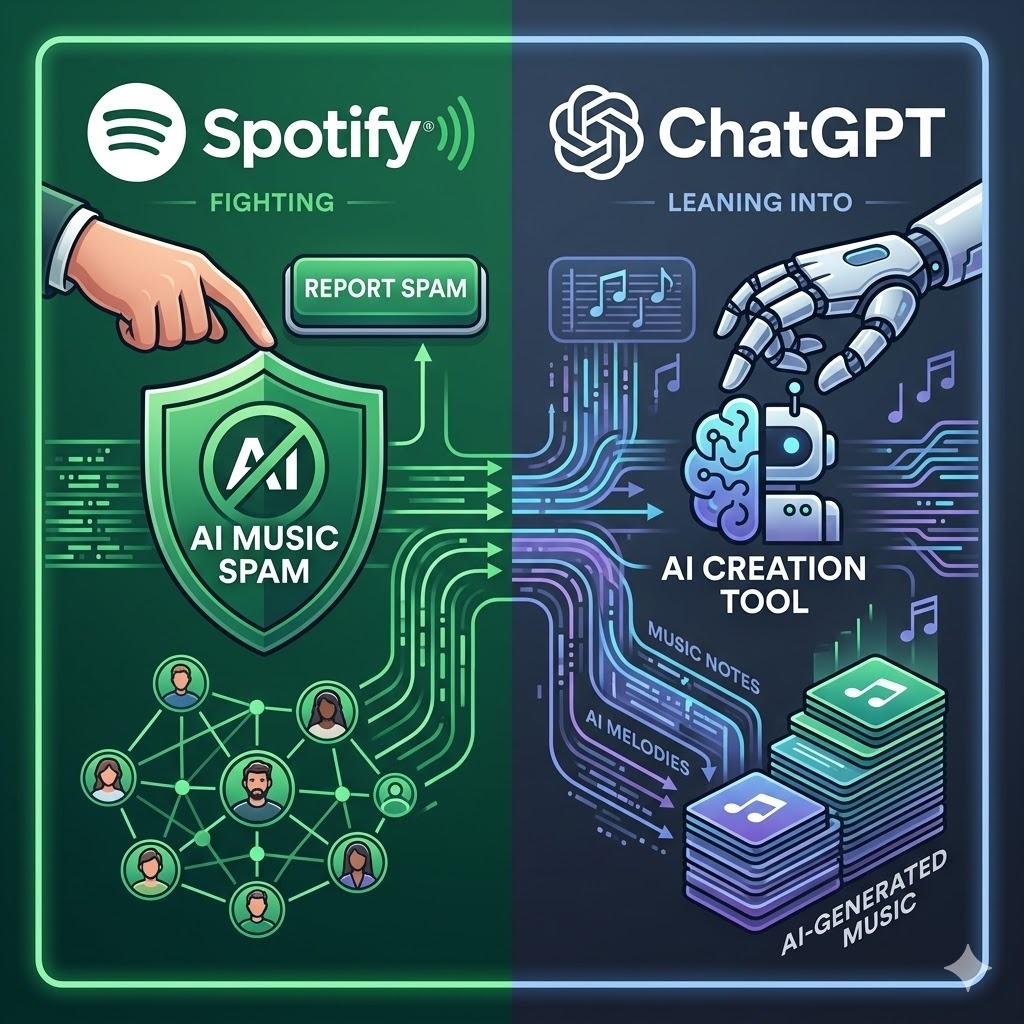
2 of the world’s most-used digital platforms made significant AI-related announcements this week. Spotify introduced a protection system to stop AI-generated music from appearing on real artists’ profiles without permission. At the same time, ChatGPT launched a deeper Shopify integration that turns the chatbot into a full product discovery and purchasing tool.
Both moves reflect the same underlying reality: AI has changed how platforms work at a fundamental level, and those platforms are now building systems to manage the consequences.
Spotify’s AI Music Problem and Its New Fix
What Is Happening on Spotify Right Now
Spotify currently has a problem that most listeners do not know about, and most artists cannot easily fix. AI-generated music tracks, created in minutes, assigned to a real artist’s name, are appearing on real artists’ official Spotify profiles without the artist’s knowledge, approval, or involvement.
This is not a rare edge case. It has become common enough that Spotify is now treating it as a platform-level crisis requiring a structural solution.
The consequences are not limited to embarrassment. A recent US legal case ended in a guilty plea directly tied to AI-generated tracks paired with bot-driven streams to generate fraudulent royalty payouts. Automated content, uploaded at volume and credited to real artists, can extract real money from the royalty system.
Beyond fraud, wrongly credited releases skew listener data, break discovery algorithms, and redirect earnings away from the actual creators whose names are being used.
The Artist Key: The Fix
Alongside Artist Profile Protection, Spotify introduced the Artist Key. A unique code that trusted distribution partners embed in legitimate releases. Verified releases carrying the Artist Key skip the manual approval queue entirely, so frequent releasers working through established channels do not face delays. The 2-layer system, manual approval for unverified releases, automatic approval for key-verified ones, attempts to balance protection with practicality.
What Artist Profile Protection Does
Artist Profile Protection is Spotify’s direct fix for the AI spam problem. It introduces 1 mandatory checkpoint, 2 decision outcomes, and 1 bypass mechanism, collectively giving artists control over what appears on their profile before it goes live, not after damage is already done.
The mechanic works across 3 steps:
- A release arrives carrying an artist’s name as a credit.
- The artist receives a notification and manually approves or blocks the release.
- If approved, the track publishes normally, feeding into stats, recommendations, and listener data. If blocked or ignored, the track stays off the artist’s profile entirely.
The track may still exist elsewhere on the platform, but it cannot touch the artist’s identity, metrics, or listener relationship without explicit permission. This is a fundamental shift from the current model, where releases auto-populate on artist profiles the moment they pass distribution.
How It Compares to Apple Music’s Approach
Both Spotify and Apple Music are addressing the same underlying problem from different angles. The following covers how the 2 platforms currently compare across 4 dimensions.
| Platform | Feature | Approach | Current Status |
| Spotify | Artist Profile Protection | Artist approval before profile publish | Limited beta |
| Spotify | Artist Key | Trusted partner bypass code | Beta, alongside the above |
| Apple Music | AI Content Tagging | Label-side flagging at upload | Active rollout |
Neither system is complete on its own. Apple’s tagging relies on labels being honest and accurate at the point of upload. Spotify’s approval layer relies on artists being responsive. A slow artist could inadvertently delay their own legitimate releases. Both platforms are working toward the same goal through different gatekeeping mechanisms.
What This Fix Does Not Solve
Artist Profile Protection is meaningfully useful. It is not a complete solution. It does not:
- Remove AI spam tracks already published before the feature existed
- Stop mislabelled AI content from appearing on other platforms
- Fix the deeper structural problem of how royalties get attributed when content is mislabelled at the distribution level
What it does is move control earlier in the process, before a fraudulent release can affect an artist’s statistics, distort their listener data, mislead their fans, or redirect their earnings. Spotify has not committed to a public timeline for expanding the beta beyond its current limited group.
ChatGPT Just Became a Place to Actually Buy Things
While Spotify is fighting to keep AI-generated content off its platform, OpenAI is moving in the opposite direction. OpenAI is actively integrating AI deeper into one of the most human-driven behaviours on the internet: shopping.
Both stories reflect the same tension playing out across the digital world in 2026: AI is reshaping platforms faster than the rules governing them, and every major platform is now deciding whether to resist that change, accommodate it, or build entirely new systems around it.
OpenAI has rolled out a deeper Shopify integration that allows ChatGPT users to browse a brand’s full product catalogue and complete purchases, not inside a clunky embedded form, but through an in-app browser routed to the merchant’s own website. The feature is available across all 4 ChatGPT tiers, including Free, Go, Plus, and Pro, and began reaching users this week.
Why the Previous Version Failed
OpenAI’s original shopping feature was called Instant Checkout. A proprietary pipeline that handled the entire purchase inside ChatGPT. The concept was ambitious. The execution frustrated merchants. Retailers received insufficient control over their own storefront experience, and the one-size-fits-all checkout model did not serve the diversity of how different brands operate. OpenAI confirmed the shift directly, stating the initial version “did not offer the level of flexibility” it was aiming for.
How the New System Works
Shopify merchants now build what the company calls “agentic storefronts,” integrations that connect their product catalogue directly to ChatGPT. The experience works across 3 stages:
- Discovery: A user asks ChatGPT for a product recommendation; ChatGPT surfaces items from a brand’s actual store with full catalogue access
- Browsing: The user explores the brand’s products inside the conversation
- Purchase: ChatGPT opens an in-app browser routed to the merchant’s own checkout on their own website
Major retailers, including Target, Sephora, and Nordstrom, already support the new experience alongside Shopify merchants.
Old vs. New: How the 2 Approaches Compare
The shift from Instant Checkout to agentic storefronts changes 5 key dimensions of the shopping experience.
| Dimension | Instant Checkout (Old) | Agentic Storefront (New) |
| Checkout Location | Inside ChatGPT | Merchant’s own website |
| Merchant Control | Limited | Full control |
| Product Discovery | Basic | Full catalogue browsing |
| Supported Merchants | Select partners only | All Shopify merchants + major retailers |
| User Access | Limited rollout | Free, Go, Plus, Pro |
What OpenAI Is Actually Building
OpenAI is not trying to become a payment processor or compete with Shopify’s checkout infrastructure. The strategic position it is building is earlier in the shopping journey. The moment when intent forms and a decision begins. The traditional path to purchase involves a search, multiple browser tabs, review sites, and eventually a product page. ChatGPT’s agentic storefront compresses that entire sequence into a single conversation, then hands control back to the user at the final step: the checkout itself.
This division of responsibility is deliberate. Research and discovery are automated. The purchase decision remains human. OpenAI’s revised approach acknowledges something the Instant Checkout model ignored: most people still want to feel like they made the buying decision themselves, even when AI did most of the work leading up to it.
Final Takeaway
Spotify and ChatGPT are both responding to the same pressure. AI has moved faster than the platforms built to host it, and the rules around identity, attribution, and commerce are being rewritten in real time.
Spotify’s Artist Profile Protection puts control back in the hands of creators before damage occurs. ChatGPT’s Shopify integration puts the AI earlier in the shopping journey while leaving the final decision to the buyer. Both are practical, imperfect, and necessary first steps toward platforms that work for people rather than against them.
AI product updates, platform policy changes, and the stories reshaping how we create, discover, and buy, our newsletter covers every development worth following. Subscribe and stay ahead.