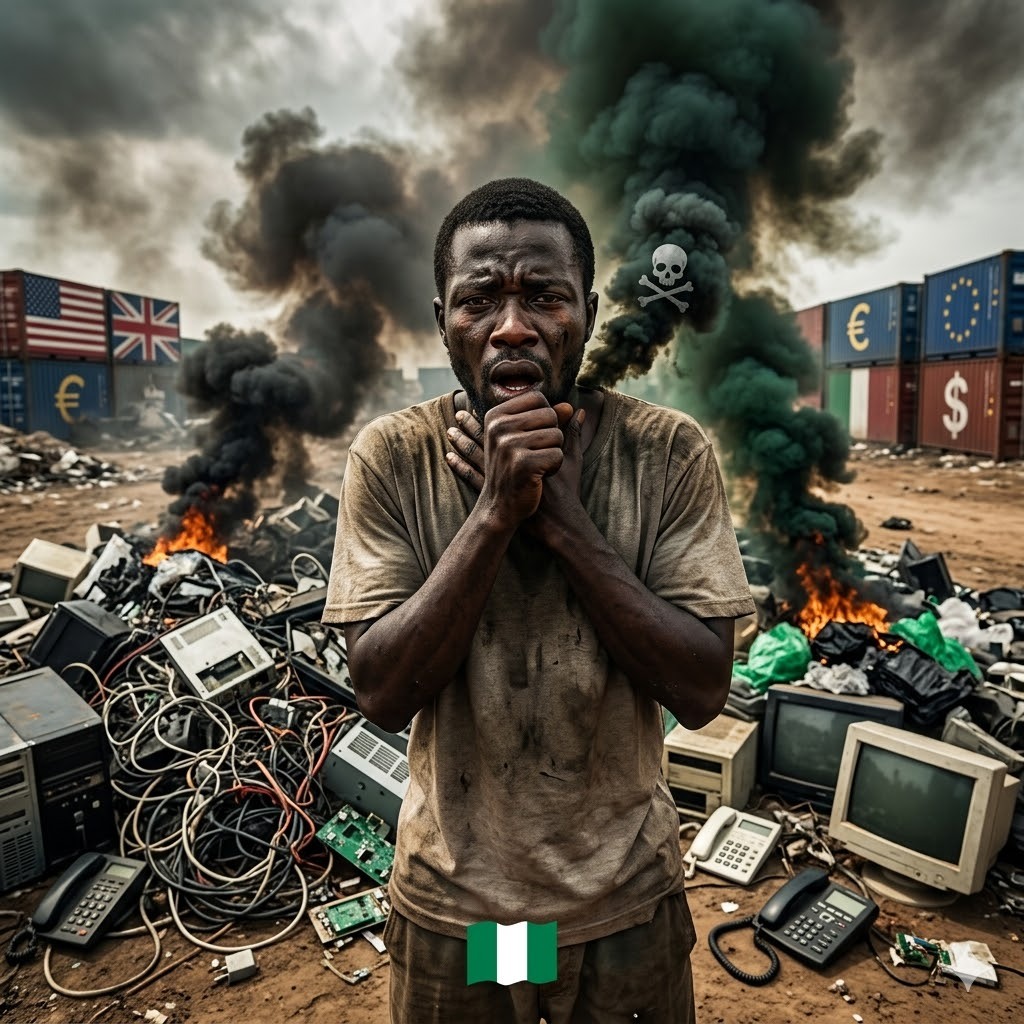
Nigeria’s e-waste crisis is not a recycling problem. It is a systematic transfer of toxic liability from wealthy nations to one of Africa’s most populated countries, operating through mislabeled shipping containers, regulatory loopholes, and a consumer base with no affordable alternative. Around 60,000 tonnes of used electronics enter Nigeria through key ports every year, according to the United Nations, with at least 15,700 tonnes arriving already damaged on the day they land.
Over 75% of what arrives in developing countries is, in the words of environmental policy analyst Chinwe Okafor, “truly junk.”
Where the Electronics Come From and How They Arrive
Nigeria’s used electronics import pipeline originates from 8 countries. A UN tracking study covering 2015 and 2016 identified Germany, the United Kingdom, Belgium, the Netherlands, Spain, China, the United States, and the Republic of Ireland as the primary sources of used electronics shipped into Nigeria, accounting for more than 85% of total import volume.
The supply chain operates through a network of collectors and brokers sourcing discarded appliances from weekend markets, private households replacing old devices, and contractors clearing equipment from offices, hotels, and hospitals across Europe. Baban Ladan Issa, who ships used electronics from Ireland to Nigeria, confirmed the practice directly to Al Jazeera: “Some suppliers mix working and damaged goods together.”
Shipments valued at millions of naira are consolidated and sent to Lagos by sea, then distributed south to market networks in Kano state, sometimes packed inside vehicles to reduce inspection exposure.
The consumer electronics lifecycle that feeds this pipeline is accelerating. Manufacturers routinely end software support for devices still in working condition, forcing users in wealthier markets to upgrade and flooding the secondary market with functional hardware that enters the export chain as ‘second-hand goods’ regardless of its actual remaining lifespan.
The documentation layer that enables this trade is straightforward. Shipping records reviewed by Al Jazeera show consignments labelled as “personal effects,” a classification that limits port inspection depth. Nigerian environmental regulations and the Basel Convention, the international treaty governing transboundary movement of hazardous waste, both prohibit this practice. Both are routinely bypassed.
What Buyers Actually Get
The Sabon Gari Market in Kano, one of Nigeria’s largest electronics hubs, sells imported appliances under labels including “London use” and “Direct Belgium.” The branding implies quality. The products frequently do not survive long enough to justify the claim.
Marian Shammah, a 34-year-old cleaner, paid 50,000 naira ($36) for a second-hand refrigerator. Within 1 month, the freezer section had failed. Her food spoiled. Her savings were gone. She returned to the same market within weeks to start the process over.
Umar Hussaini, a vendor at the market, described buying a used refrigerator that stopped cooling within 3 months, forcing his household to purchase food daily at a higher cost because storage had become impossible. Salisu Saidu, a small business owner, lost an entire inventory of frozen goods when a used freezer he had purchased failed weeks after installation.
Retailer Chinedu Peter estimated that approximately 40% of electronics arriving at his stock level carry faults on receipt. Importer Ibrahim Bello placed the figure at 20–30%. Neither figure represents an edge case. Both figures represent normal business conditions in a market where seller Umar Abdullahi acknowledged to Al Jazeera: “We buy them untested from suppliers in Europe, and we also sell them untested so we can make our profit.”
The Health Crisis Behind the Market
E-waste toxicity from imported electronics in Nigeria produces documented health consequences across 3 distinct exposure pathways: informal recyclers, nearby residents, and the broader contamination of soil and water systems.
Informal recyclers in Kano dismantle imported electronics by hand, without protective equipment, inhaling fumes from burning cables and handling components containing mercury, lead, and cadmium. Their weekly earnings range from 3,500 to 14,000 naira, between $2.50 and $10. The documented symptoms include persistent coughing, chest pain, headaches, eye irritation, and breathing difficulties.
Many of the imported refrigerators and air conditioners still contain R-12 and R-22 refrigerant gases, CFC and HCFC compounds banned across Europe and the United States for causing ozone depletion and linked to cancer, miscarriages, and neurological disorders. These gases persist in the environment for between 12 and 100 years.
Dr Ushakuma Michael Anenga, gynaecologist at Benue State Teaching Hospital and second vice president of the Nigerian Medical Association, described the exposure risk to Al Jazeera in direct terms: “Exposure to heavy metals and refrigerant gases in e-waste causes extreme, brief and long-term health issues, generally affecting the breathing and renal organs. Common casual practices like exposed burning and dismantling result in direct, high-level exposure for workers and nearby residents. Children and pregnant girls are particularly inclined because those toxicants can disrupt development or even skip from mother to unborn baby.”
Field assessments conducted by Nigeria’s Federal University Dutse confirmed rising levels of heavy metals in soil and drainage channels in and around Kano state. Research published in the International Journal of Environmental Research and Public Health links long-term e-waste exposure in these communities to chronic headaches, skin irritation, breathing problems, neurological concerns, and miscarriages.
| Toxic Component | Source Device | Health Risk | Environmental Persistence |
| R-12 / R-22 refrigerants | Imported fridges, ACs | Cancer, miscarriage, neurological damage | 12–100 years |
| Mercury | Screens, switches | Neurological disorders, kidney damage | Indefinite in soil |
| Lead | Circuit boards, cables | Brain damage, developmental disruption | Decades |
| Cadmium | Batteries, semiconductors | Kidney failure, bone disease | 10–30 years |
Who Profits and Who Pays
The economic logic of the e-waste export pipeline is structurally straightforward. Disposing of electronic waste through certified recycling in Europe costs money. Shipping it to Nigeria labelled as “second-hand goods” generates revenue. The gap between those 2 outcomes funds an industry built on transferring environmental liability from countries with strict regulations to countries with enforcement gaps.
Ibrahim Adamu, programme officer at Lagos-based NGO Ecobarter, identified the mechanism to Al Jazeera directly: “The highest profits are captured by exporters and brokers who arbitrage the gap between disposal costs in Europe or Asia and the strong demand for ‘tokunbo’ goods in Nigeria.” Okafor added that “exporting nations regularly take advantage of loopholes by means of labelling non-functional e-waste as ‘second-hand goods’ or ‘for repair‘”, estimating that over 75% of what arrives qualifies as non-functional upon landing.
Nigeria’s National Environmental Standards and Regulations Enforcement Agency (NESREA) maintains that the country prohibits e-waste imports and regulates the entry of used electronics through functionality and compliance requirements. The market conditions documented in Kano suggest that enforcement does not match regulation at the volume of trade currently passing through Nigerian ports.
The gap between regulation and enforcement that allows toxic electronics to enter Nigeria through mislabeled containers mirrors a structural pattern documented across every domain where digital and physical infrastructure intersect. Written rules and actual practice diverge most severely in precisely the environments where the consequences of that gap fall on the least protected populations.
West Africa, collectively across Benin, the Ivory Coast, Ghana, Liberia, and Nigeria, generates between 650,000 and 1,000,000 tonnes of e-waste annually, according to the Basel Convention’s E-Waste Africa Programme. A significant portion of that volume originates not from domestic consumption, but from imported near-end-of-life devices that enter the waste stream within months of arrival.
Shammah returned to Sabon Gari Market within weeks of her refrigerator’s failure. She was already reconsidering her options. “I don’t really trust these fairly used appliances again, but I still have to buy something because we need it at home,” she told Al Jazeera. “This time I’m thinking… I can buy a new one from a proper shop, even if it takes longer, because I don’t want to lose my money again.“
The system that put her in that position has no equivalent incentive to change.
Environmental technology, e-waste policy, and the global systems shaping how electronics are made, used, and discarded are covered at The IT Horizon. Subscribe to our newsletter — we track the technology stories that matter beyond the product launch cycle.