
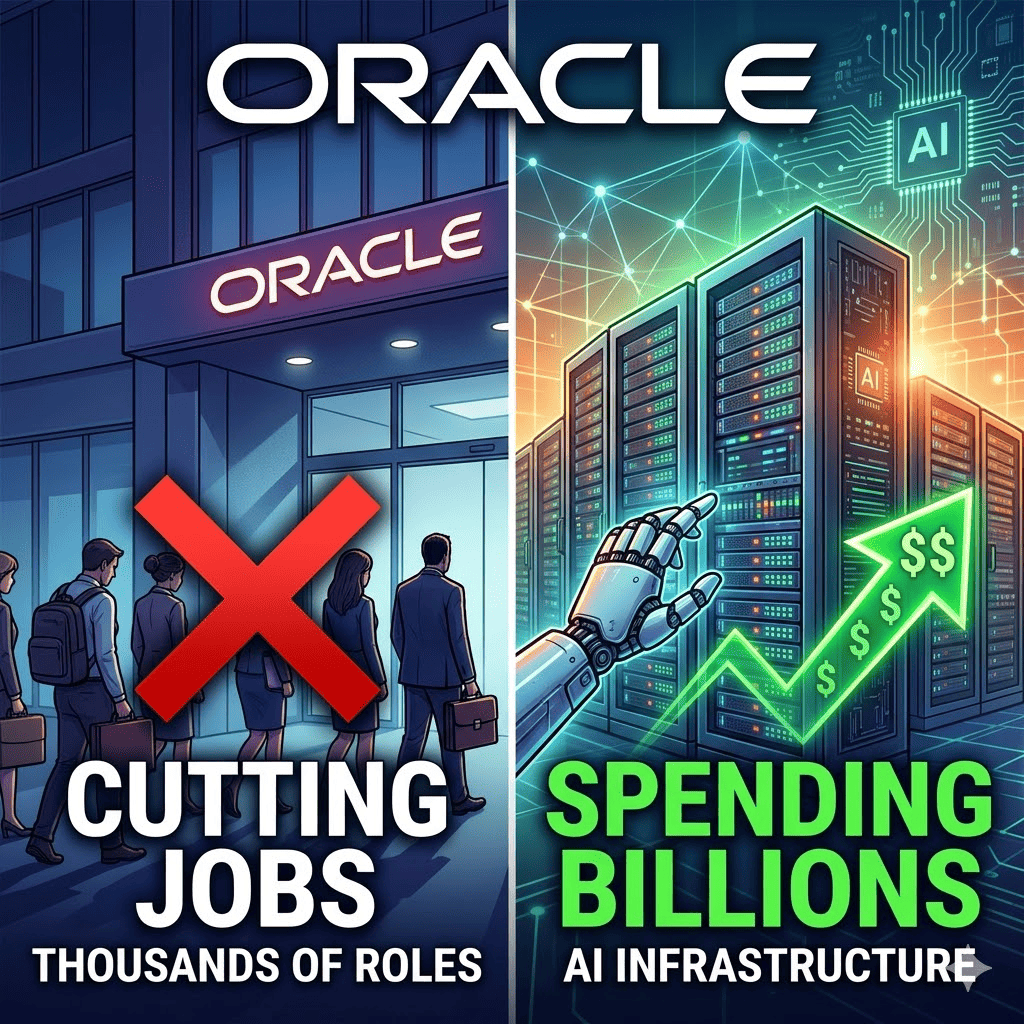
Oracle notified thousands of employees of layoffs on March 31, 2026, as the company accelerates a debt-funded AI infrastructure buildout that is simultaneously consuming capital and pressuring the core software business that generated Oracle’s revenue for decades.
Oracle employed 162,000 people as of May 2025. TD Cowen analysts estimate the cuts will reach 20,000 to 30,000 employees, representing 12 to 18% of Oracle’s total workforce, and project the reduction will generate $8 to $10 billion in incremental free cash flow.
Why Oracle Is Cutting Jobs and Spending More at the Same Time
Oracle’s core business is its flagship database product, enterprise software that stores and serves corporate data for thousands of large organizations globally. Generative AI coding tools and AI-native database alternatives are beginning to reduce the need for traditional database administration, threatening the revenue base Oracle has built its business on.
At the same time, cloud infrastructure competitors, including Amazon, Microsoft, and Google, are significantly larger than Oracle and are outspending it on AI data center capacity.
Oracle’s response is to redirect headcount budgets toward GPU and CPU infrastructure, cutting the cost of human labour to fund the capital expenditure that AI competition demands.
Layoff notification emails reviewed by Business Insider confirmed the approach directly:
“After careful consideration of Oracle’s current business needs, we have made the decision to eliminate your role as part of a broader organizational change.”
The Financial Picture:
There are 4 numbers that define Oracle’s situation. Let’s take a closer look at each number and its respective situation.
i) $2.1 billion: Oracle’s total projected restructuring cost for fiscal year 2026, the majority of which covers employee severance. At TD Cowen’s estimated 20,000 to 30,000 cuts, the implied average severance cost per eliminated role ranges from $70,000 to $105,000 per employee.
ii) $50 billion: Oracle’s debt and equity raise announced in January 2026 to fund AI infrastructure. During its most recent earnings call, executives confirmed no further debt raises are planned for the remainder of 2026, suggesting the $50 billion capital raise covers the current buildout phase.
iii) $553 billion: Oracle’s remaining performance obligations as of its most recent earnings disclosure, representing contracted future revenue not yet recognized. This figure, which jumped 359% following an agreement with OpenAI worth over $300 billion, means Oracle holds one of the largest committed revenue pipelines in the cloud sector, even while cutting workforce costs aggressively.
iv) Down 25%: Oracle’s stock price declined year to date as of March 31, 2026, with a steeper 48% decline over the previous 6 months. Investor concern centres on the scale of debt Oracle is carrying relative to its cash flow generation, a concern the layoffs are designed to address directly.
Why Oracle’s Stock Rose 4% on the Day of the Layoff Announcement
Oracle shares rallied over 4% on March 31, 2026. It was the same day the layoffs became public. This reaction is counterintuitive only on the surface. Stock markets interpret large-scale layoffs at capital-heavy companies as a signal of cost discipline and improved future cash flow. TD Cowen’s projection of $8 to $10 billion in incremental free cash flow from the cuts gave investors a concrete number to price into Oracle’s valuation. The market is not reacting to job losses. It is reacting to the cash generation that those job losses unlock.
Oracle Is Not Alone: AI-Driven Workforce Cuts Across 3 Companies
Oracle’s restructuring is part of a simultaneous pattern across multiple large technology and financial organizations in the same reporting period.
| Company | Layoff Scale | AI Investment Rationale |
| Oracle | 20,000–30,000 est. (12–18% of workforce) | $50 billion AI data center buildout |
| Meta | Hundreds now, up to 20% of the workforce planned | AI infrastructure cost reallocation |
| HSBC | Deep cuts under consideration | AI operational overhaul |
Each company’s individual decision follows the same logic: human headcount costs are being converted into AI infrastructure capacity. The collective result is a simultaneous, industry-wide reduction in technology and knowledge worker employment, driven not by revenue decline, Oracle’s $553 billion RPO confirms demand is accelerating, but by a deliberate reallocation of capital from people to machines.
Final Takeaway
Oracle is not struggling. It holds $553 billion in contracted future revenue, a landmark OpenAI agreement, and growing GPU and CPU demand that its own CEO describes as exceeding supply. The layoffs are not a distress signal. They are a strategic decision to fund the infrastructure race with headcount savings. For the thousands of Oracle employees receiving termination notices today, the distinction offers little comfort. For investors, it explained a 4% stock rally on the same afternoon.
The tech world moves fast. Our newsletter keeps you faster, covering everything from product launches and industry deals to the stories most people miss. Subscribe and never fall behind.