
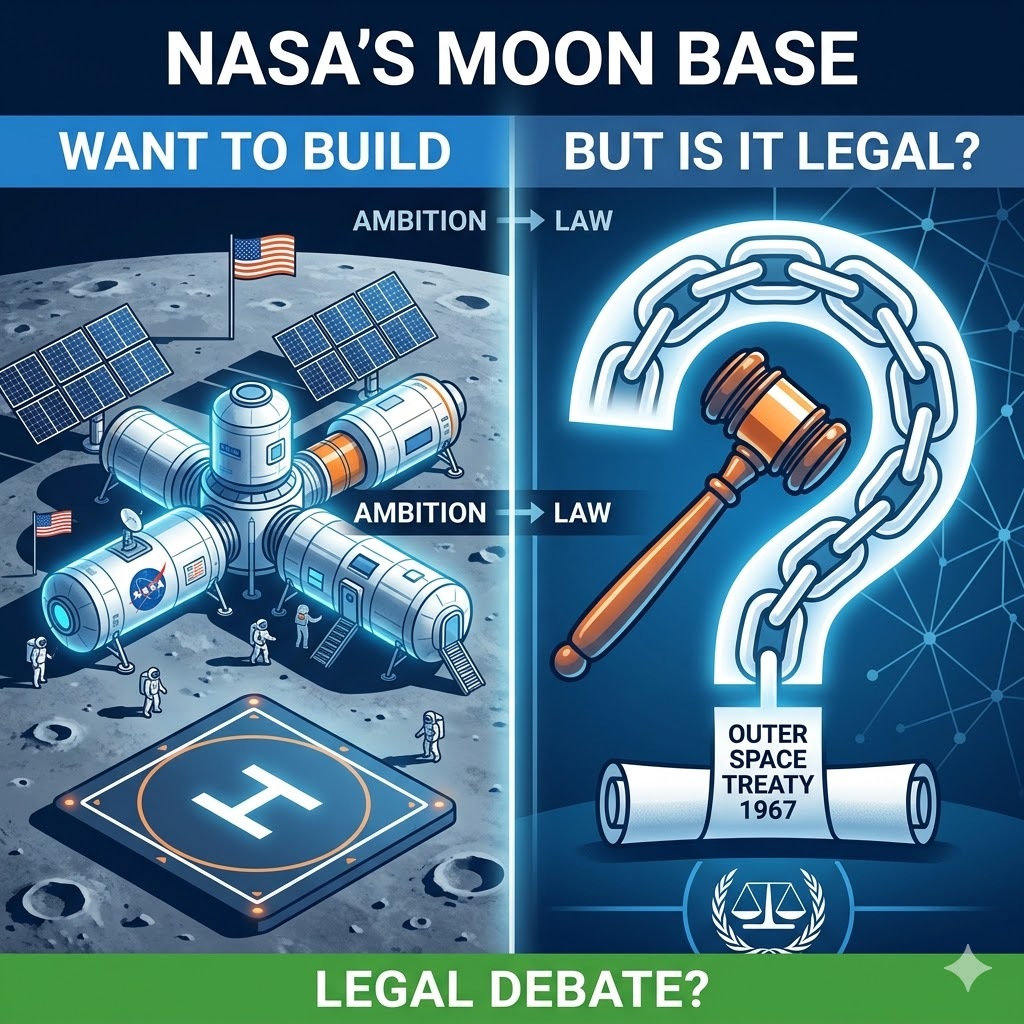
NASA’s Artemis program just sent 4 astronauts toward the Moon on April 1, 2026. The first crewed lunar mission in over 50 years. But while the world watches the launch, a quieter and more complicated question is building among legal experts, international governments, and space policy analysts: Is what NASA is planning to do on the Moon actually legal?
The answer, depending on who you ask, ranges from “probably not” to “it depends on how you read a 60-year-old treaty.”
What NASA Actually Wants to Build
Artemis II is a test flight. The crew will loop around the Moon and come home. But it is a stepping stone toward something much larger. NASA’s goal is to establish a permanent Moon base by the early 2030s where astronauts can live for weeks or months at a time, extract resources from the lunar surface, and use the Moon as a launchpad for future missions to Mars.
This is where the legal problems begin. A short visit to the Moon raises no serious legal questions. Staying, building, and mining are entirely different matters.
The Law That Governs Space: Written Before Any of This Was Possible
The primary legal document governing human activity in space is the Outer Space Treaty, signed in 1967, nearly 60 years ago. The treaty is clear on 1 fundamental point: no nation can claim sovereignty over the Moon or any other body in space. The Moon belongs to all of humanity. No country owns it, and no country can own it.
What the treaty does not clearly address is what happens when a country builds a permanent structure on the Moon, extracts its resources, and occupies a strategic location for years. Those scenarios simply did not exist as realistic possibilities in 1967.
Space law expert Cassandra Steer, founder of the Australasian Centre for Space Governance, identifies the core conflict directly. The United States has taken the legal position that extracting resources from the Moon is not the same as claiming ownership of the Moon, and is therefore permitted under the treaty.
Steer disagrees: “That is an incorrect interpretation of the Outer Space Treaty. You’re trying to carve out a loophole.”
Professor Joanne Gabrynowicz, Professor Emerita of Space Law at the University of Mississippi, put it more bluntly: “The Outer Space Treaty is quite clear that you cannot appropriate the Moon or any other celestial body. A permanent base would be a form of appropriation.“
What Resources Is NASA Actually After
NASA’s interest in the Moon is not purely scientific. The agency has described its resource goals on the Moon as a “lunar gold rush,” a phrase that reveals the economic stakes underneath the scientific language.
The 3 primary resources NASA is targeting are:
- Water ice: Found in permanently shadowed craters near the lunar poles. Water can be split into hydrogen and oxygen, providing both breathable air and rocket fuel. A Moon base that can produce its own fuel becomes a refuelling station for deeper space exploration.
- Helium-3: A rare isotope on Earth but present on the Moon’s surface, with potential applications in nuclear fusion energy.
- Rare earth elements: Including scandium and others used in electronics and advanced manufacturing.
The circular logic of Artemis, as Steer observes, is this: NASA says it needs a Moon base to access these resources, and it needs these resources to sustain the Moon base.
Independent space policy analyst Namrata Goswami frames the broader concern: “There are a lot of unanswered questions about the legal framework for a permanent Moon base. We need to have a serious discussion about the governance of the Moon before we start building anything there.“
The Artemis Accords: Agreement or Workaround
To navigate the legal uncertainty, the United States created the Artemis Accords. A separate agreement, not a formal international treaty, that over 60 nations have signed. The Accords establish principles for space exploration: sharing scientific data, peaceful use of space, and emergency assistance between missions. Most of these are broadly supported and uncontroversial.
But the Accords also include 2 provisions that legal experts find deeply problematic.
- First, they explicitly permit the extraction and use of space resources, stating this does not conflict with the non-appropriation principle of the Outer Space Treaty.
- Second, they allow nations to establish “safety zones” around their lunar activities, areas where other nations cannot interfere with ongoing operations.
Neither provision claims outright ownership of the Moon. But taken together, they create a system where whoever arrives first at a resource-rich lunar location, begins extracting from it, and establishes a safety zone around it effectively controls that location, without technically owning it.
Rebecca Boyle, journalist and author of Our Moon, draws the historical parallel clearly: “I think the Artemis Accords might open the door for these sorts of access claims on the Moon, where someone who gets to a spot first uses the safety zone rule to lay claim to whatever is there.“
The US integrated the Accords directly into the Artemis program, meaning countries that wanted access to NASA’s Moon missions had to sign the document. Canada, Japan, Australia, the UK, and the UAE signed early. France, India, Germany, Saudi Arabia, and Israel followed.
Steer describes the result plainly: “You’re just trying to rewrite the treaty, and somehow you’ve convinced 60 countries to do it with you.“
The China Problem
The country most conspicuously absent from the Artemis Accords is China. China did not sign, does not recognise the Accords’ interpretation of space law, and is developing its own lunar program, the International Lunar Research Station, in partnership with Russia, with a target of landing Chinese astronauts on the Moon potentially before the US completes its own landing.
China has built its own international coalition, carrying payloads from European countries and Saudi Arabia on its lunar rovers and signing cooperative agreements with Russia. The Moon is becoming a 2-bloc geopolitical contest: the US-led Artemis coalition and the China-Russia ILRS program, with the legal framework for resource access and territorial priority being actively contested between them.
Is This About Science or Geopolitics
NASA’s public messaging on Artemis emphasises science, learning about the formation of the Solar System, testing technologies for Mars, and advancing human knowledge of deep space. But the resource language, the “lunar gold rush” framing, and the strategic urgency around beating China to key lunar locations tell a different story.
Steer states the real driver without ambiguity: “The multi-trillion-dollar question is, why go to the Moon? And it is, to my mind, purely geopolitical.”
She draws a direct line between the Moon race and other domains of US-China competition: “It’s no different from the AI race, it’s no different from competition around other resources, around oil, around water. It’s another domain where the US is grasping at straws to remain the single dominant power.“
What Needs to Happen Before Anyone Builds Anything
The Outer Space Treaty was written in 1967. The Moon base NASA is planning did not exist as a realistic concept until the 21st century. The gap between what the law says and what nations are actually doing is growing, and no formal international process is currently underway to close it.
3 things need to happen to resolve the legal uncertainty:
- A formal update or successor to the Outer Space Treaty: Written by a broad international coalition, not just the nations already participating in Artemis
- A universally accepted definition of what constitutes appropriation: Specifically addressing permanent structures, safety zones, and resource extraction
- Inclusion of China and Russia: In any governance framework. Because a Moon governance system that excludes the 2 nations building competing infrastructure is not a governance system, it is a coalition
Until these 3 things exist, the Moon base NASA is planning rests on a legal foundation that multiple international law experts describe as a reinterpretation, not an implementation, of the treaty that governs it.
Final Takeaway
Artemis II is a genuine triumph of engineering and human ambition. 4 people are currently travelling toward the Moon. What comes after them, including the base, the mining, the safety zones, and the decades of permanent occupation, operates in a legal grey zone that no one has resolved and few are publicly discussing. The rockets are ready. The lawyers are not.
Space exploration, science policy, and the decisions shaping humanity’s future beyond Earth, our newsletter covers every development worth following. Subscribe and stay informed.