
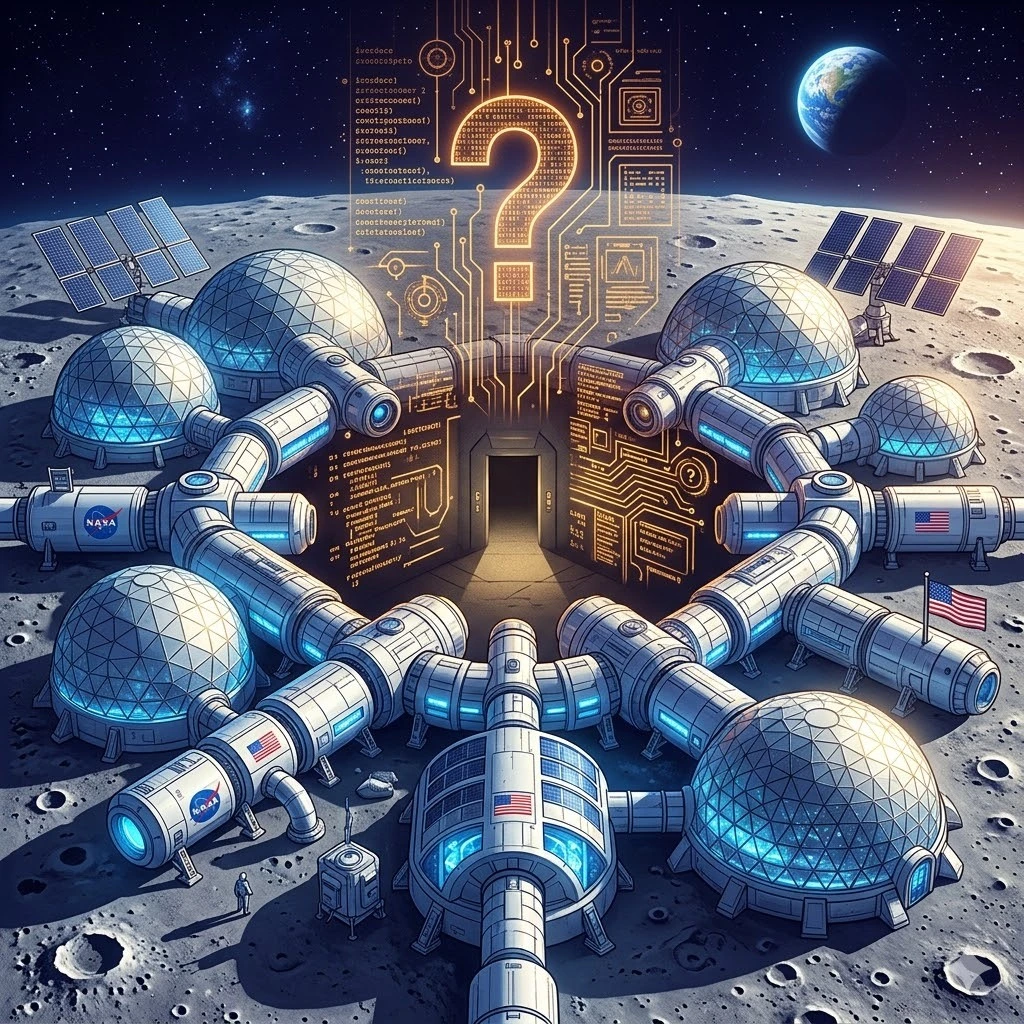
NASA Administrator Jared Isaacman announced a $20 billion plan to build a permanent Moon base on March 24, 2026, committing the agency to dozens of missions over 7 years, pausing the Gateway orbital station project, and launching the world’s first nuclear-powered interplanetary spacecraft to Mars by the end of 2028.
The announcement came at NASA’s internal “Ignition” event and represents the most detailed, costed, and timeline-specific lunar base plan the agency has ever published.
Why NASA Cancelled Gateway and What That Means
Gateway was NASA’s plan for a small space station orbiting the Moon. A waypoint in lunar orbit that astronauts could dock with before descending to the surface. It had international partners, committed hardware, and years of development behind it.
NASA has now paused Gateway “in its current form” to redirect that investment toward surface infrastructure directly. The strategic shift is significant: instead of building in lunar orbit and descending from there, NASA is going straight to the Moon’s surface and building everything there. Applicable Gateway hardware will be repurposed rather than scrapped. The pivot reflects a simpler, more urgent priority get boots and equipment on the surface faster, before China does.
The 3-Phase Moon Base Plan
NASA’s Moon base builds across 3 distinct phases, each adding capability to the last.
Phase 1: Build, Test, Learn
Phase 1 delivers the foundation: communications networks, navigation systems, robotic landers, and lunar terrain vehicles sent to the surface through CLPS, NASA’s Commercial Lunar Payload Services programme, which uses private companies to deliver cargo to the Moon. NASA targets up to 30 robotic landings starting in 2027. This phase has no permanent human presence. It establishes the infrastructure that makes the next 2 phases possible.
Phase 2: Establish Early Infrastructure
Phase 2 moves astronauts onto the surface regularly. Semi-habitable structures support recurring crewed operations, with missions targeting a landing every 6 months initially. Japan’s space agency JAXA contributes a pressurised rover, an enclosed vehicle that astronauts can live and work in on the surface without spacesuits. Other international partners contribute additional scientific payloads, rovers, and transport capabilities.
Phase 3: Enable Permanent Human Presence
Phase 3 delivers the infrastructure for continuous human habitation. Italy’s space agency ASI provides Multi-purpose Habitats. Canada’s space agency CSA contributes a Lunar Utility Vehicle. Heavy cargo landing systems deliver the infrastructure, including power systems, habitat modules, and life support, that transform periodic visits into a permanent Moon base.
Isaacman provided no completion date for Phase 3 but confirmed: “We will invest approximately $20 billion over the next seven years and build it through dozens of missions.”
What $20 Billion Actually Buys and Whether It Is Realistic
The ISS, Earth’s existing space station in low orbit, cost more than $100 billion, required 37 shuttle flights, 160 spacewalks, and 2 decades to build. NASA is now proposing to build a Moon base in a significantly more hostile environment, with no existing infrastructure, for $20 billion. That is one-fifth the cost of the ISS, on a more ambitious project, in a harder location.
Whether $20 billion is a realistic figure or an optimistic placeholder depends on factors NASA has not yet fully specified, including how many missions the “dozens” actually represents and what Phase 3’s heavy habitat delivery systems cost individually. The number is best understood as a political commitment and a starting figure rather than a final engineering budget.
The 4 Human Health Hazards of Living on the Moon
Building a Moon base is an engineering challenge. Keeping humans alive inside it is a biological one. Long-duration lunar habitation presents 4 specific threats that low-Earth orbit does not.
- Space radiation: The Moon has no magnetic field and no atmosphere to deflect cosmic rays and solar particle events. Astronauts on the Moon receive radiation doses far higher than on the ISS, increasing cancer risk over extended stays.
- Micrometeorites: Without an atmosphere to slow them, tiny particles continuously strike the lunar surface at extreme speeds. Any structure must withstand constant bombardment.
- Lunar regolith: Moon dust is as sharp as glass at a microscopic level. It destroys equipment seals, contaminates spacesuits, and is dangerous to human lungs if inhaled. Apollo astronauts experienced regolith damage after only days on the surface.
- Low gravity effects: The Moon’s gravity is one-sixth of Earth’s. Extended exposure causes bone mass loss, muscle atrophy, and cardiovascular changes. Weeks of low-gravity habitation produce measurable physical deterioration.
NASA has not publicly detailed how Phase 3 habitats will address each of these 4 threats at the engineering level.
The US-China Race: 2 Years That Matter
The geopolitical urgency behind the $20 billion announcement is the 2-year gap between the 2 programmes competing for the Moon.
| Programme | Crewed Landing Target | Moon Base Partner |
| NASA Artemis IV | 2028 | US-led international coalition (60+ nations) |
| China ILRS | 2030 | Russia |
NASA’s Artemis IV crewed landing targets 2028, 2 years ahead of China’s 2030 crewed landing target. The nation that lands first establishes the first permanent surface infrastructure, sets the first safety zones around resource-rich locations, and creates the facts on the ground that international law will ultimately have to accommodate. Isaacman stated the stakes explicitly: “The clock is running in this great-power competition, and success or failure will be measured in months, not years.”
Space Reactor-1 Freedom: The First Nuclear-Powered Spacecraft to Mars
Alongside the Moon base announcement, NASA confirmed it will launch Space Reactor-1 Freedom, the first nuclear-powered interplanetary spacecraft, to Mars before the end of 2028.
Nuclear electric propulsion uses a fission reactor to generate electricity, which powers an ion drive, delivering far more efficient, sustained thrust over long distances than chemical rockets can provide. Beyond Jupiter, where sunlight is too weak for solar panels to generate meaningful power, nuclear propulsion is the only currently viable technology for high-powered deep-space missions.
When SR-1 Freedom reaches Mars, it will deploy the Skyfall payload, a group of Ingenuity-class autonomous helicopters that will continue exploring Mars from the air. Ingenuity, NASA’s original Mars helicopter, completed the first powered controlled flight on another planet in 2021. Skyfall scales that capability into a fleet.
Final Takeaway
Humanity has dreamed about living on the Moon since before anyone had ever left Earth. NASA is now putting $20 billion and a deadline behind that dream, and for the first time, it feels less like science fiction and more like a construction schedule. The Moon does not care about deadlines, budgets, or geopolitics. It has radiation, dust sharp enough to destroy machinery, and gravity weak enough to slowly break down the human body.
Whether a $20 billion plan is enough to overcome all 3, while beating China there, resolving international law, and keeping 60 partner nations aligned, is the question this generation of space exploration will spend the next decade trying to answer. Apollo proved humans could reach the Moon. Artemis is betting they can stay.
Space exploration, science policy, and the missions defining humanity’s future beyond Earth, our newsletter covers every development worth following. Subscribe and stay informed.