
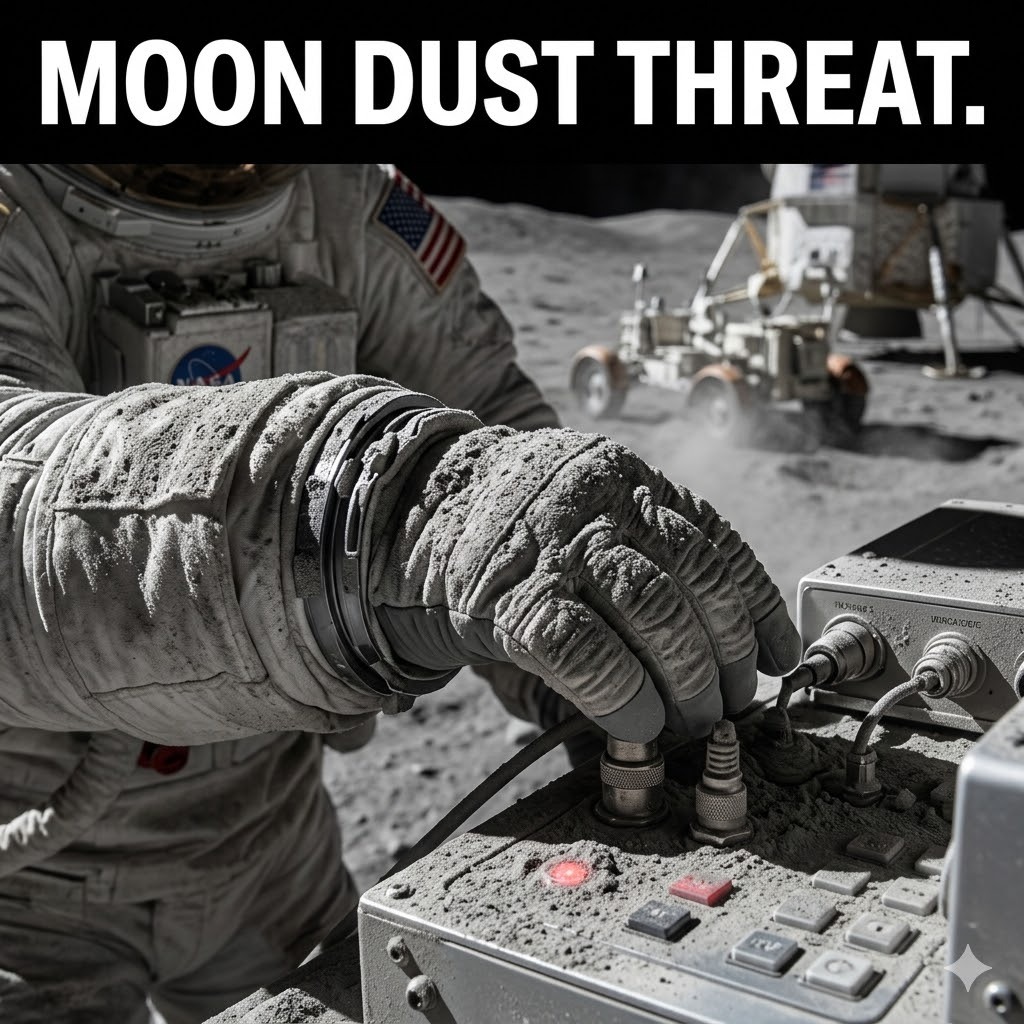
NASA just launched 4 astronauts toward the Moon on Artemis II. The $20 billion Moon base plan is official. The rockets work. The hardware is tested. And yet one of the most serious threats to everything NASA is planning is not a technical failure, not a budget shortfall, and not China. It is dust.
Specifically, Moon dust. One of the strangest, most destructive, and least understood substances in the solar system, and a problem that Apollo astronauts described as their single biggest nightmare 50 years ago.
What Moon Dust Actually Is
Moon dust is not like the dust in your house. It is the product of billions of years of meteorite impacts on a world with no atmosphere, no wind, and no water to smooth anything down. Every collision shatters rock, melts it, vaporises it, and refreezes it, creating particles that are jagged, sharp, and microscopically tiny. Under a microscope, a grain of Moon dust looks like a shard of broken glass. It never smooths out, because nothing on the Moon smooths anything out.
Planetary scientist Phil Metzger, formerly of NASA’s Kennedy Space Centre, describes Moon dust as similar to “the fine hairs on a gecko’s feet that allow it to walk up walls.”
It sticks to everything. Not just because of its jagged shape, but because of its electrostatic charge. The Moon has no magnetic field and no atmosphere to deflect solar radiation. On the sunlit side, ultraviolet light knocks electrons off dust particles, giving them a positive charge. On the dark side, solar wind deposits electrons, giving particles a negative charge. Either way, the dust clings aggressively to any surface it contacts.
What Apollo Astronauts Actually Experienced
The 6 Apollo missions gave humanity its first direct experience with Moon dust, and every crew came back with the same report. The dust was everywhere, stuck to everything, and impossible to remove.
Apollo 17 astronaut Gene Cernan described it during his post-mission debriefing: “It just sort of inhabits every nook and cranny in the spacecraft and every pore in your skin.”
Astronauts tracked it into the lunar module after moonwalks, where it scratched helmet visors, weakened pressure suit seals, irritated eyes, and triggered what Apollo 17 geologist Jack Schmitt called “lunar hay fever.” Apollo 12 commander Pete Conrad attempted to vacuum dust off his suit with a NASA-supplied device and called it “a complete farce.”
Apollo 16 commander John Young, years after his mission, still believed that “dust is the number one concern in returning to the Moon.” NASA never found a solution during the Apollo programme. The missions were short enough that dust was a severe inconvenience rather than a mission-ending problem. For a permanent base, the calculation changes completely.
Why Landing Makes It Far Worse
The dust problem does not begin when astronauts step outside. It begins the moment a rocket engine fires near the lunar surface.
Why the Moon is different from Earth
On Earth, the atmosphere slows particles down. Larger objects travel farther, smaller ones stop quickly. The Moon has no atmosphere at all. Nothing slows anything down.
What happens when a rocket fires near the surface
A rocket engine firing at the lunar surface launches dust and debris at extreme speeds across 3 distinct ranges:
- Fine dust: Accelerates up to 1,000 metres per second and travels hundreds of kilometres, potentially distributing across the entire Moon
- Sand-sized particles: Travel up to 10 to 100 metres per second, reaching distances of 600 metres or more
- Gravel-sized particles: Travel shorter distances but at speeds comparable to bullets
What Apollo 12 proved
Apollo 12 landed deliberately near Surveyor 3, a robotic probe that had been sitting on the Moon since 1967. Just 2 years earlier. When the crew brought pieces of Surveyor 3 back to Earth, researchers found the probe’s white paint had turned tan and was thoroughly sandblasted by dust from the Apollo 12 landing alone. Metzger led the team that studied it: “We see the lunar soil particles penetrated deep into the surface all over the Surveyor. We see the paint all cracked up.” That damage came from 1 small lander, present for just a few days.
Why does Artemis make this worse?
The landers planned for Artemis and commercial missions are significantly larger than the Apollo Lunar Module. Larger landers mean more engine thrust. More thrust means faster particles travelling greater distances.
Metzger’s warning is direct: “If you land too close to your outpost, it could be like pelting your outpost with gravel travelling at the speed of bullets.“
The Levitating Dust Problem Nobody Expected
Beyond landing dust, there is a 2nd dust phenomenon that took decades to understand, and it was discovered from 172 reels of forgotten tape sitting under a university lecture hall, covered in dust.
Who discovered it and how
Australian physicist Brian O’Brien designed the Dust Detector Experiment (a small box with 3 solar cells) that flew on Apollo 11 and all subsequent Apollo missions. Its job was to measure how much dust accumulated on the lunar surface over time.
O’Brien’s data was recorded on magnetic tape, stored after the missions, and then lost. In 2006, the tapes were rediscovered beneath the seating of a lecture hall at Curtin University in Perth, covered in, of all things, dust.
What the recovered data revealed
Once decoded and analysed by O’Brien and undergraduate researcher Monique Hollick, the tapes showed something nobody had predicted:
- The lunar module took off, blasting the nearby dust detector clean in the process
- The astronauts left no humans, no vehicles, and no activity remained on the surface
- The dust detector slowly became dusty again on its own, with nothing there to disturb it
Why this happens
O’Brien’s explanation is this. After each 2-week lunar night, sunlight returns to the surface. Ultraviolet radiation hits the fine dust particles that are kicked up, charging them electrostatically. The charged particles begin repelling each other and repelling the surface itself. They lift off the ground and levitate, forming a slow-moving dust storm at ground level, just high enough to settle onto nearby equipment. This happens every single lunar sunrise, repeating for weeks after any high-activity landing event, until the collateral dust is finally exhausted.
What does this mean for a Moon base?
A permanent Moon base would not just face dust problems during landings. It would face a recurring dust storm at every sunrise, around every area of regular human activity, for as long as operations continue, whether anyone is landing that day or not.
What Breathing Moon Dust Does to Human Lungs
Moon dust is not just a hardware problem. It is a direct health threat to any human living on the lunar surface long-term.
What is breathing Moon dust?
Breathing Moon dust means inhaling microscopic sharp particles kicked up on the lunar surface that are too small for the human body to filter out, causing permanent damage deep inside the lungs.
Why Moon dust bypasses the body’s defences
The human body filters out most airborne particles through nose hairs, mucus, and the natural cough reflex. These defences work well on Earth. Moon dust defeats them across 2 critical size thresholds:
- Particles smaller than 10 microns: Approximately one-seventh the diameter of a single human hair, pass straight through the body’s standard filtering systems and lodge permanently in deep lung tissue
- Particles smaller than 2 microns: The size of fine flour was found in Apollo 17 soil samples, meaning Moon dust regularly reaches this extreme fineness
What long-term exposure causes
Particles lodged permanently in lung tissue cause progressive, irreversible lung damage over time, similar in mechanism to the lung disease caused by coal dust or asbestos, where the body doesn’t remove the particles, and inflammation builds around them indefinitely.
The data gap that makes this scarier
There is currently no established safe exposure limit for Moon dust. No human has been exposed to it long enough to generate reliable health data. Apollo astronauts spent a maximum of a few days on the surface. A Moon base would require astronauts to live there for weeks or months, an exposure duration with no medical precedent and no confirmed safe threshold.
The Solutions and Why None Are Simple
Metzger and NASA researchers have identified 3 potential dust mitigation approaches, none of which are straightforward.
1. Landing pads: Constructing hardened surfaces for rockets to land on would dramatically reduce dust ejection. Building them requires either hauling prefabricated metal structures from Earth at enormous fuel cost, or using microwave or laser tools to melt lunar regolith into a flat, solid surface, experimental technology not yet ready for deployment.
2. Anti-static coatings: NASA’s Goddard Space Flight Centre has tested coatings using atomic layer deposition, applying ultra-thin films of indium tin oxide to surfaces to dissipate electrostatic charge and prevent dust adhesion. Early results are promising for spacesuits and rover surfaces, but the technology has not yet been tested in lunar conditions.
3. International agreements on sandblasting: Metzger has argued that countries planning Moon missions need a formal agreement acknowledging that landing near another nation’s hardware will damage it. Without such an agreement, he warns: “Countries are going to be able to claim effective territory” based on where they land and what they protect.
Final Takeaway
Moon dust has been the most underestimated problem in human space exploration for 60 years. Apollo astronauts warned about it. The data existed on 172 forgotten reels of magnetic tape in a university storage room. The physics of how it travels, levitates, and destroys equipment is well understood. And yet NASA’s $20 billion Moon base plan has no publicly detailed dust mitigation strategy for long-duration habitation.
The Moon does not care about construction schedules or geopolitical timelines. The dust was there billions of years before the first human looked up at it, and it will be the first thing any Moon base crew has to conquer, every single day.
Space science, exploration research, and the discoveries shaping humanity’s understanding of the universe, our newsletter covers every story worth following. Subscribe and stay informed.