Travel planning used to be a full-time job before the trip even started. Dozens of browser tabs, hours of comparing flights and hotels, cross-referencing reviews, trying to build an itinerary that balanced budget, interests, and logistics. The actual journey was often the easiest part.
Artificial intelligence is dismantling that friction and going significantly further than simply saving time. AI is now reshaping how destinations are discovered, how trips are booked, how languages are crossed, and how journeys are managed in real time without the traveller having to intervene at all.
There is a broader shift in how travellers are thinking about the technology available to them. AI is no longer something they associate only with coding or content generation. It is something they are actively looking to apply to the way they move through the world.
From Generic Lists to Personal Canvases: How AI Changed Discovery?
The first thing AI changed in travel was not booking or planning. It was a discovery. The moment before a trip exists when a person starts imagining where they will go.
Traditional travel discovery was built around lists: the 10 best beaches in Europe, the top cities to visit in Asia, the most popular destinations for solo travellers. These lists were useful but entirely generic. They reflected what was popular in the aggregate, not what suited a specific individual.
AI-powered content platforms ended that era. Fahd Hamidaddin, Founding CEO of the Saudi Tourism Authority and President of the TOURISE Summit, described the shift directly in a conversation with AI News: “AI has turned travel discovery into a personal canvas. Platforms like Instagram Reels no longer just show ‘where to go’; they curate journeys that feel tailor-made for each traveller.”
The mechanism is straightforward. Platforms now analyse an individual’s engagement history, what they watch, save, linger on, skip, and surface travel content that matches their revealed preferences rather than population averages. A user who consistently engages with remote hiking content, cold-weather landscapes, and small-guesthouse accommodation will see a fundamentally different set of destination suggestions than a user who engages with beach clubs, large resort hotels, and city nightlife content.
The downstream effect on tourism itself is significant. Hamidaddin notes that AI-driven discovery is beginning to spread demand away from chronically overcrowded tourist destinations, Venice, Santorini, and Bali, toward lesser-known locations that match travellers’ interests but have historically lacked the marketing reach of the most famous destinations. AI is not just personalising discovery for the traveller. It is redistributing tourist traffic across the globe in ways that benefit smaller communities and preserve the integrity of the places that were previously being loved to death.
AI-Powered Trip Planning: Eliminating Decision Fatigue
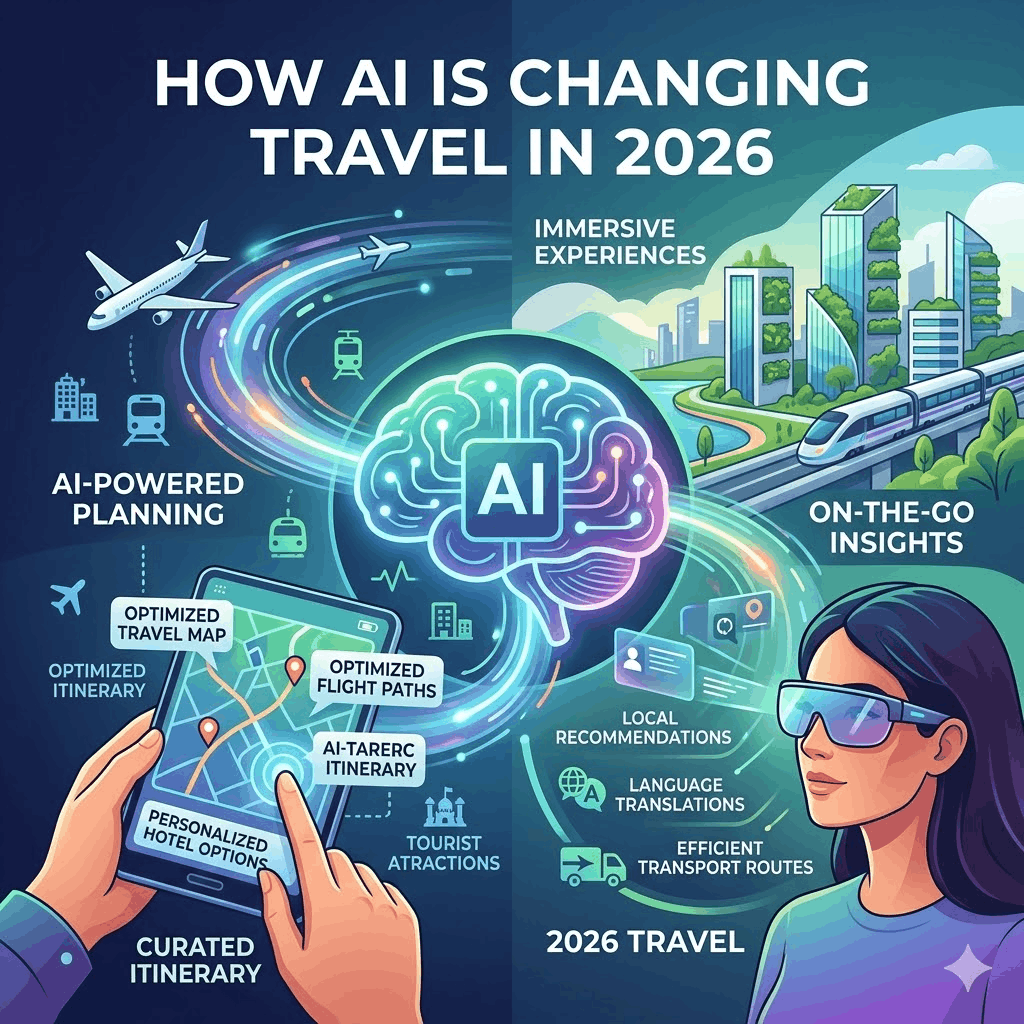
Once a destination is chosen, the planning process historically involved hours of research across multiple platforms. AI-powered planning tools have compressed the way we plan and experience travel.
1. Hopper
Hopper uses historical flight data, dynamic pricing models, and predictive analytics to identify the optimal booking window for specific routes, alerting users when prices are at their lowest and predicting whether fares will rise or fall. Rather than requiring a traveller to monitor prices manually across days or weeks, Hopper handles that surveillance continuously and surfaces the right moment to book.
2. TripPlanner AI
TripPlanner AI and similar tools take a broader approach, accepting prompts like “10-day trip to Japan, mid-range budget, mix of city and rural, interested in food and architecture” and generating a complete day-by-day itinerary with accommodation suggestions, transport logistics, and activity recommendations. What previously required days of research is produced in seconds.
3. MaaltalkNow’s AI Trip Talk
MaaltalkNow’s AI Trip Talk feature uses a conversational interface powered by ChatGPT-4o, allowing users to explore destinations, adjust plans in real time, and receive personalised recommendations through natural dialogue rather than form-filling. The flexibility of a conversational interface means that changing a parameter, “actually, can we add a day in Kyoto?” requires a single sentence rather than a complete re-planning process.
4. TripIt Pro and App in the Air
TripIt Pro and App in the Air handle the operational layer of travel: tracking flight schedules, gate changes, and weather delays, sending immediate notifications and suggesting adjustments before the traveller even realises there is a problem.
The cumulative effect of these tools is the elimination of decision fatigue. The cognitive exhaustion of making dozens of micro-decisions during travel planning. AI absorbs that burden while leaving the genuinely personal choices, which experiences matter most, and how to balance adventure with rest, in the hands of the traveller.
Real-Time Language Translation: Dissolving the Most Persistent Barrier
Language barriers have shaped the geography of tourism for as long as travel has existed. People cluster in destinations where their language is widely spoken. Authentic local experiences are missed because communication is too difficult. Cultural exchange is limited by the inability to have a real conversation.
AI-powered translation has fundamentally changed this equation.
1. Google Translate
Google Translate now handles over 133 languages with real-time spoken conversation translation, so both parties speak in their own language and hear a translation almost instantaneously. The accuracy has improved to a level where genuine conversation is possible across most major language pairs, not just the extraction of basic information.
2. iTranslate and SayHi
iTranslate and SayHi offer similar spoken translation capabilities with interface designs optimised for use in the field, in markets, restaurants, and public transport, where the environment is noisy, and the interaction is spontaneous.
Visual translation has become one of the most practically useful AI features for travellers. Camera-based translation, pointing a phone at a menu, sign, or handwritten note and receiving an instant overlay of the translated text, removes what was previously one of the most disorienting aspects of travel in non-Roman-script countries. MaaltalkNow’s Smart Maaltalk Lens extends this further, providing not just a translation but contextual information about what the user is looking at, cultural details about a dish, historical background on a location, practical information like opening hours.
Hamidaddin frames this development in broader terms: “AI is dissolving barriers, including linguistic, cultural, and economic. It’s curating authentic connections that go beyond sightseeing into meaningful exchange.” The ability to communicate removes the most fundamental obstacle between a traveller and a genuinely local experience.
AI Personalization in Booking: The Hyper-Personalized Itinerary
AI-powered booking engines have moved well beyond search-and-filter interfaces. Current systems build entire personalised itineraries based on a traveller’s stated preferences, revealed engagement history, budget parameters, and travel dates, integrating flights, accommodation, activities, and transport into a single coherent plan.
The personalisation extends to mood and context, not just stated preferences. Systems increasingly account for signals like the time of year, travel duration, whether the trip is solo or group, and even the types of content a user has engaged with recently to calibrate recommendations.
Booking.com, Expedia, and Airbnb all now deploy AI personalisation at the booking layer, surfacing accommodation options ranked by predicted fit with a specific user rather than by raw popularity or price. For Airbnb in particular, AI also powers the matching of hosts to guests in ways intended to improve compatibility and reduce booking cancellations.
The risk associated with this personalisation is real and acknowledged by industry leaders. Hamidaddin put it plainly: “AI empowers travellers like never before, matching experiences to passions, budgets, and even moods. But unchecked, algorithms quietly narrow horizons, nudging people toward predictable options.”
A system optimised purely for engagement will tend to show users more of what they have already shown interest in, reinforcing existing preferences rather than expanding them. The traveller who has always visited beach destinations will keep being shown beach destinations, and the algorithm will never prompt them to consider the mountain trek that has changed their perspective entirely.
The solution Hamidaddin advocates is transparency: “AI is a compass, not a cage, and travellers must always hold the final word.”
Real-Time Budgeting: Staying in Control on the Road
Budget management during travel has historically been one of the most stressful practical dimensions of a trip. Currency conversions, unexpected expenses, and spending across multiple categories. The picture of where the money is going is rarely clear until it is too late to adjust.
AI-powered budgeting tools solve this in real time.
1. Trail Wallet and Trabee Pocket
Trail Wallet and Trabee Pocket automatically categorise travel expenses, convert currencies at live rates, and provide daily spending summaries with projections for the remainder of the trip. Rather than a post-trip accounting of overspending, these tools provide a running forecast, allowing daily adjustments before budget problems become budget crises.
2. MaaltalkNow’s Travel Account Book
MaaltalkNow’s Travel Account Book breaks spending down into categories, including food, transportation, lodging, and entertainment in the local currency, providing a visual overview that makes the trade-offs between budget categories immediately legible. Knowing that accommodation is consuming 55% of the daily budget when 40% was planned is information that changes a traveller’s decisions in real time, whether to find a cheaper hotel for the next 2 nights or to cut back on restaurant spending.
3. Splitwise
Splitwise handles the additional complexity of group travel budget management, tracking shared expenses, calculating individual balances, and managing the often socially awkward accounting of who owes what across a multi-person trip.
Agentic AI: The Next Frontier of Travel Technology
All of the AI applications described so far operate in an assistive mode. They provide information, suggestions, and alerts, but the traveller still makes every decision and takes every action.
The next phase of AI in travel is fundamentally different. Agentic AI systems do not just recommend. They act. They book, reschedule, cancel, and reroute on the traveller’s behalf, in real time, in response to changing conditions.
Hamidaddin describes this vision directly: a future where AI automatically rebooks flights disrupted by weather, adjusts hotel reservations when arrival times change, and reschedules activity bookings in response to itinerary shifts. All without requiring the traveller to make a single phone call or navigate a single rebooking interface. “That’s frictionless travel, where the logistics fade, and the adventure takes centre stage,” he said.
Saudi Arabia’s “Spirit of Saudi” platform is already moving in this direction, using AI to showcase authentic cultural experiences while managing the logistical layer that connects travellers to artisans, festivals, and local businesses. Hamidaddin describes the ambition as “agentic journeys, where AI travel companions handle logistics seamlessly, freeing travellers to focus on discovery and connection.”
The ethical stakes of agentic AI in travel are significant. When an AI system makes autonomous decisions that involve financial transactions and the structure of a person’s travel itinerary, the questions of transparency, accountability, and control become critical. Hamidaddin outlines the principles clearly: “With agentic AI, the stakes rise: when an AI acts on a traveller’s behalf, we must ensure transparency, explainability, and accountability. Agency must never replace autonomy.”
The TOURISE Summit, the first global platform dedicated to shaping responsible travel technology, is specifically focused on establishing ethical frameworks for agentic AI in travel, creating shared standards across government, business, and technology before the technology scales to a point where standards become reactive rather than proactive.
AI Navigation and Hyperlocal Exploration
Getting around unfamiliar cities has been transformed by AI-powered navigation. Google Maps, Citymapper, and HERE WeGo use live traffic data, transit schedules, and walking routes to guide travellers with real-time precision. But the generation of tools now goes beyond route guidance.
Modern AI navigation apps offer predictive routing, suggesting detours to avoid crowds at tourist sites, scenic alternatives based on revealed preferences, and spontaneous recommendations for stops en route that match the traveller’s interests. Systems that learn from past behaviour begin to offer contextually relevant suggestions throughout the day. A traveller who spent the morning at a modern art museum will receive afternoon suggestions for nearby galleries and design-focused cafés rather than generic tourist recommendations.
MaaltalkNow’s Lens feature combines visual recognition with real-time local data. A photo of a landmark returns not just identification but historical context, practical visiting information, and tips aggregated from other travellers. The experience approximates having a knowledgeable local companion rather than a search engine.
What Travellers Need to Know About Using AI Tools
Connectivity is foundational. Most AI-powered travel features rely on real-time data, which requires a stable internet connection. International eSIM plans and local data options have made connectivity significantly more accessible, but travellers heading to remote destinations need to assess their connectivity options before becoming dependent on AI tools that do not function offline.
Privacy requires active management. AI travel apps routinely request access to location data, camera, microphone, and activity history. The personalization these apps provide is built on that data. Travellers who want the benefits of AI personalisation need to be aware of what they are sharing and with whom. Reviewing privacy settings, understanding what data is retained, and opting out of data collection practices that feel excessive are all reasonable steps that the best apps make straightforward.
Cultural context is not fully captured by algorithms. AI tools provide impressive contextual information, but they do not replicate the nuance of genuine local knowledge, the spontaneous insight from a conversation with a resident, or the understanding that comes from being present in a place with genuine attention. AI reduces friction. It does not replace the human experience of travel. The best use of AI travel tools is as infrastructure that handles logistics so that more mental and emotional bandwidth is available for the experience of discovery.
Final Opinion
AI in travel is no longer an emerging category. It is the current standard for travellers who are informed about what the technology does. The gap between planning a trip with AI tools and planning one without them is measured in hours of research eliminated, booking windows optimised, language barriers dissolved, budget overruns prevented, and disruptions automatically managed. What AI does not do is decide what travel means to you, which experiences are worth seeking, which discomforts are worth enduring, and what you want to carry home. Those remain human questions. AI handles everything else.
AI tools, digital innovation, and the technologies transforming how we live and work, The IT Horizon covers every development worth knowing about. Subscribe and stay ahead.