
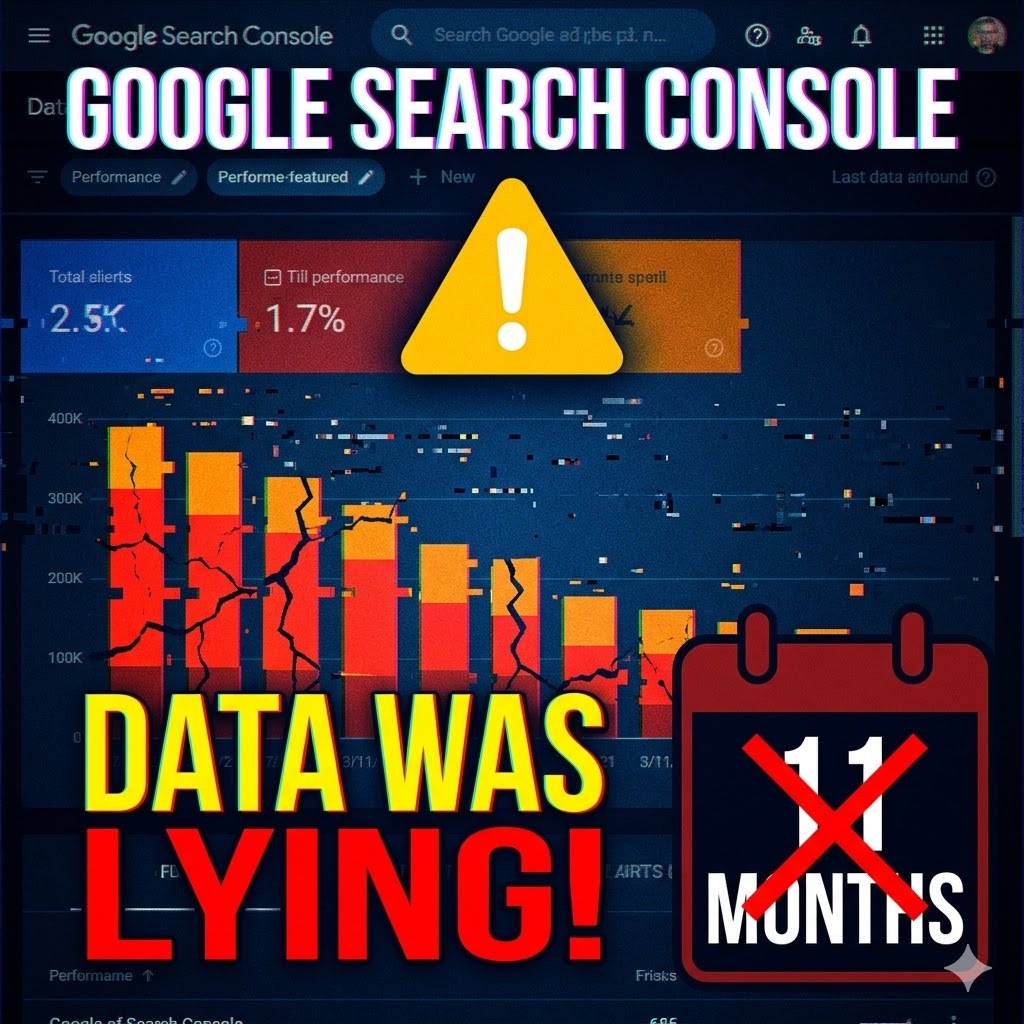
Google Search Console impression data has been inaccurate since May 13, 2025. On April 3, 2026, Google officially confirmed a logging error caused Search Console to over-report impressions across the Performance report for approximately 11 consecutive months, making it one of the longest-running data quality failures in Search Console’s documented history.
The fix is now rolling out. Reported impressions will drop. That drop is not a rankings loss. It is the data becoming accurate for the first time since spring 2025.
Every SEO report, board presentation, and content strategy built on Search Console impression data during those 11 months was built on numbers that were too high.
What Google Actually Confirmed
Google’s official disclosure on April 3, 2026, updated its Data Anomalies in Search Console page with a direct statement: a logging error prevented Search Console from accurately reporting impressions from May 13, 2025, onward. Google confirmed 3 specific facts about the bug.
Impressions were over-reported from May 13, 2025, through April 2026. Clicks and all other metrics were entirely unaffected by the error. The fix rollout will take several weeks, during which reported impressions will visibly decrease across Performance reports.
Google did not confirm how inflated the numbers were. Google did not explain the technical mechanism that caused the error. Google did not explain why the bug ran undetected for 11 months inside the most widely used organic search measurement tool in the world.
The SEO community noticed the gap between what Google said and what Google did not say immediately.
The Community Found It Before Google Did
Google’s April 3 disclosure did not arrive without warning. Independent SEO consultant Brodie Clark published a LinkedIn post on March 30, 2026, 4 days before Google’s acknowledgment, flagging unusual impression spikes across desktop properties, particularly within merchant listings and Google Images search appearance filters. Practitioners across his thread confirmed identical patterns on their own properties.
Glenn Gabe identified a compounding problem Google’s announcement did not address at all: AI Mode data had been merged into Search Console Performance report totals since June 17, 2025, with no dedicated filter to separate it from traditional organic, featured snippet, or AI Overview data. AI Mode now serves 75 million daily active users. That entire data stream flows into the same impression totals with no isolation mechanism.
AI Mode’s unmeasured influence on Search Console data is a measurement symptom of a deeper structural change. Google is actively rebuilding its entire search interface around Gemini-powered AI results, making the inability to isolate AI Mode impressions from organic impressions not a temporary reporting gap but a permanent reflection of how fundamentally the search product has changed.
As Gabe put it directly: “We now have the 10-blue links, featured snippets, AIOs, and now AI Mode all grouped in the performance reporting under Web Search. Good luck trying to figure this out in GSC.”
The common question across every practitioner thread was identical: how many decisions were made on data that turned out to be wrong?
The 3 Overlapping Data Problems Nobody Is Separating
Google’s disclosure addressed 1 logging bug. The impression data contamination during this period involved 3 simultaneous and overlapping problems, each producing its own distortion layer on top of the others.
| Problem | Start Date | Impact | Status |
| Logging error inflating impressions | May 13, 2025 | All impressions count over-reported. | Fix rolling out in April 2026. |
| Scraper inflation via &num=100 parameter | Pre-May 2025 | Rank-tracking scrapers registering phantom impressions. | Partially resolved September 12, 2025. |
| AI Mode data merged into Web totals | June 17, 2025 | AI Mode impressions indistinguishable from organic. | No fix. No filter exists as of April 2026. |
The scraper layer is particularly significant. Before September 12, 2025, rank-tracking tools relied on Google’s &num=100 parameter to return 100 results per page in a single query. Every scraper load registered impressions for every URL on that page in Search Console, regardless of whether any human saw them. When Google deprecated the parameter on September 12, 2025, practitioners reported overnight impression drops of 20–40% and the “Alligator Effect,” the widening gap between rising impressions and flat clicks. Snapped shut immediately.
The critical unresolved question is whether the September scraper correction brought impressions back to a clean baseline or whether the logging bug was simultaneously inflating numbers underneath. If both problems ran concurrently from May through September 2025, the September correction removed only 1 inflation layer while the other continued undetected for 6 more months.
Any impression trend line spanning mid-2025 to mid-2026 contains at least 5 documented data discontinuities. Year-over-year impression comparisons using data from this period are structurally unreliable.
The Metric That Broke Everything Downstream
Impression data is not a cosmetic vanity metric sitting at the top of a dashboard. Impressions are the denominator in CTR calculations, and CTR is one of the most widely reported SEO KPIs at the board and leadership level. When the denominator runs inflated for 11 months, the damage does not stay contained to 1 number. It cascades across every metric derived from it.
Click-Through Rate calculations were artificially depressed for 11 months. CTR equals clicks divided by impressions. Inflated impressions produce lower CTR outputs regardless of actual click performance. Pages that appeared to underperform on click-through rate may have been performing normally. Content that was deprioritized, rewritten, or defunded based on “declining CTR” signals may have been penalized for a measurement error rather than genuine audience rejection.
The industry response to perceived CTR decline accelerated AI content generation at exactly the moment the underlying measurement was most unreliable. Tools, like Replit, promising to scale content output in response to search performance signals were operating on impression data that was structurally wrong for the entire period during which those signals appeared most alarming.
The AI Overviews click suppression narrative was measured with a broken instrument. From mid-2025 onward, the SEO industry observed a consistent pattern: impressions rising while clicks stayed flat. The dominant interpretation attributed this divergence to AI Overviews satisfying queries directly on the SERP, suppressing click-through to publisher websites. Studies were published. Budgets were reallocated. Content strategies were revised.
The impression denominator producing those “declining CTR” readings was inflated for the entire observation period. The actual magnitude of AI Overviews’ impact on organic click behavior may differ materially from what the industry concluded, and separating the genuine behavioral shift from the measurement artifact is now impossible without clean baseline data.
The impossibility of establishing a clean baseline matters beyond internal reporting. The SEO industry has been developing tactics to manipulate AI-driven search results based on performance signals drawn from the same contaminated dataset, meaning the optimization strategies now being deployed at scale were calibrated against wrong numbers.
What Every Marketing Team Must Do Before the Fix Completes
Search Console impression data will decrease visibly over the coming weeks as Google’s correction propagates. 4 immediate actions to protect your reporting integrity during the rollout.
1. Switch the primary reporting KPI to clicks
Google explicitly confirmed clicks were unaffected by the error. Total organic clicks and click growth rate are the only reliable impression-adjacent metrics in Search Console until the correction fully stabilizes.
2. Export raw data immediately
Capture daily-level data from every Search Console property before the fix finishes propagating. Pre-fix impression numbers are needed to calculate property-specific inflation magnitude once a post-fix baseline is established. This data will not be recoverable after normalization completes.
3. Annotate every reporting dashboard
Mark 4 specific dates in every dashboard using Search Console data: May 13, 2025 (bug begins), June 17, 2025 (AI Mode data merged), September 12, 2025 (&num=100 parameter deprecated), and April 3, 2026 (fix begins rolling out). Any stakeholder reading a dashboard without these annotations will misinterpret the coming impression drop as a performance decline.
4. Communicate proactively with leadership
The impression drop arriving on dashboards over the next several weeks requires a pre-emptive explanation. Show click data alongside impression data to demonstrate that actual organic traffic remained stable while impression counts were inflated. The numbers are going down because they are becoming more accurate, not because rankings dropped.
Conclusion
A year of decisions built on the wrong number.
The Google Search Console impression bug is a data infrastructure failure with a clean technical explanation and a straightforward remediation path. Google is fixing it. Impressions will normalize. Clean baselines will eventually be established.
The harder question is not technical. It is strategic. Every content prioritization decision, every CTR-based audit conclusion, every board-level impression growth narrative, and every “AI Overviews are suppressing our traffic” analysis produced between May 2025 and April 2026 drew on a wrong denominator. Some of those decisions were directionally correct despite the bad data. Some were not. Distinguishing between them requires a corrected dataset that does not yet exist, and will not exist until the fix fully propagates, a clean post-correction baseline is established, and the 3 overlapping distortion layers are separated and measured individually.
Google confirmed the bug in 47 words. Quantifying what 11 months of inflated impressions actually cost in misdirected strategy, reallocated budget, and incorrectly evaluated content will take considerably longer and considerably more than 47 words to answer.
Google’s data corrections, algorithm updates, and measurement changes affect every digital strategy built on search. Subscribe to The IT Horizon newsletter. We track every platform-level change that impacts how your content performs, gets measured, and gets found.