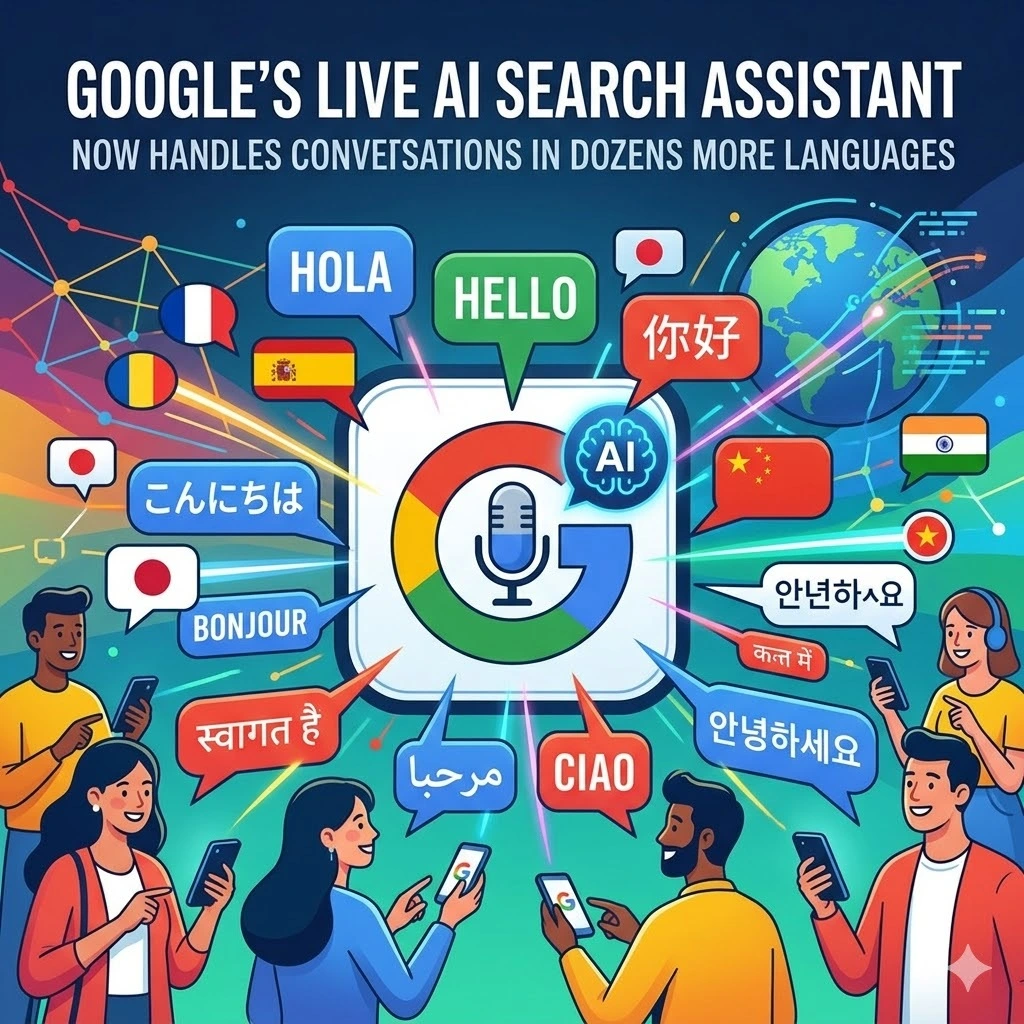
Google Search Live, the real-time voice-and-camera AI search assistant, now reaches more than 200 countries and territories, and handles conversations in dozens more languages where AI Mode is available. This ability makes it the widest-distributed conversational AI search tool globally.
Gemini 3.1 Flash Live, Google’s new audio-focused AI model, powers this worldwide rollout by delivering faster responses, more natural back-and-forth conversations, and inherently multilingual processing across every supported region.
This analysis details Search Live operations, Gemini 3.1 Flash Live integration, and a 2-step activation sequence.
Search Live Operations
What Search Live Is
Search Live is Google’s real-time, multimodal conversational search tool that processes voice input, camera input, or both simultaneously, responding with audio answers and supporting web links within AI Mode.
How Search Live Operates
Search Live operates on a request-response cycle that completes in real time. A user submits a voice query, a camera feed, or both simultaneously — the Gemini 3.1 Flash Live model processes the combined input, retrieves relevant web data, and delivers an audio response with supporting links within the same session. Each response keeps the conversation context open, meaning follow-up questions continue from where the previous answer ended without restarting the query cycle.
What AI Mode Is
AI Mode is Google’s conversational, generative search layer that replaces the standard results page for eligible queries, delivering dynamic, dialogue-based answers instead of a static list of 10 blue links. Search Live operates exclusively within AI Mode, meaning it inherits AI Mode’s full generative context window, follow-up conversation capability, and web retrieval integration. The 3 core components of Search Live are listed below:
- The voice input module
- The camera sensor integration
- The Gemini 3.1 Flash Live audio response engine
All 3 working together inside a single interface accessible through the Google app on Android and iOS.
How Search Live Fits Into Google’s AI Search Ecosystem
Search Live, Google Translate real-time, and AI Mode together form a 3-product multimodal language layer inside Google’s ecosystem, covering conversational search, live speech translation, and visual context queries from a single platform. This integration positions Search Live not as a standalone feature, but as 1 of 3 interconnected tools that collectively extend Google’s voice-and-vision capability across search, translation, and camera-based discovery.
What is Multimodal AI and the Multimodal Conversational Search Tool?
Multimodal AI is an artificial intelligence system that processes 2 or more input types, such as text, voice, image, and video, within a single model, producing responses that draw from all active input channels simultaneously rather than handling each in isolation.
A multimodal conversational search tool applies this capability directly to search queries, accepting voice and camera input together, processing both through a unified AI model, and delivering a contextually complete response that neither input alone could generate. Search Live is a multimodal conversational search tool because it processes a spoken question and a live camera feed simultaneously. The voice input carries the query, the camera input carries the visual context, and Gemini 3.1 Flash Live merges both into 1 audio response with supporting web links.
Multimodal AI search differs from standard voice search across 3 dimensions, including the following:
- Input Depth
- Context Accuracy
- Response Specificity
Standard voice search processes spoken text and matches it to indexed web content. Multimodal conversational search processes spoken text plus real-world visual data, matches both to indexed content, and generates a response calibrated to the specific object, scene, or situation the camera sees, producing answers that are 3 layers deeper than a text-matched voice query.
Gemini 3.1 Flash Live: The Model Powering the Global Rollout
Gemini 3.1 Flash Live is the audio-focused AI model that powers Search Live’s international expansion, sitting within the Gemini model family below Gemini Ultra and Gemini Pro in reasoning depth, but optimised specifically for speed and real-time audio processing. Gemini 3.1 Flash Live delivers 2 measurable improvements: reduced response latency and increased conversational naturalness. These 2 characteristics are most critical for voice-first interactions where delays break the dialogue experience.
The model is inherently multilingual, meaning it processes and responds in a user’s preferred language without requiring a separate translation layer. Gemini 3.1 Flash Live supports all languages where AI Mode is currently available. A coverage scope that enables Search Live’s simultaneous deployment across 200+ countries rather than a phased regional rollout.
| Search Live Component | Specification | Data Point |
| Powering Model | Audio AI Model | Gemini 3.1 Flash Live |
| Global Reach | Countries and Territories | 200+ |
| Language Support | Coverage Scope | All AI Mode languages |
| US Launch | Original Rollout Date | September 2025 |
| Input Modalities | Query Types Supported | Voice, camera, or both |
| Output Format | Response Type | Audio response + web links |
| Access Point 1 | Platform | Google app, Android, and iOS |
| Access Point 2 | Secondary Entry | Google Lens, Live tab |
| Translate iOS Feature | Real-Time Speech | Headphone audio delivery |
| Translate Expansion | New Countries Added | 9 |
How to Use Search Live: 2-Step Activation
Search Live activates in 2 steps through the Google app: opening the application and tapping the Live button.
Step 1: Open the Google App
Open the Google app on Android or iOS. Search Live is available to all users with AI Mode enabled. No additional download or account upgrade required.
Step 2: Tap the Live Button
Tap the Live button beneath the search bar to activate the assistant. From that point, Search Live listens to voice input, delivers an audio response, and continues the conversation through follow-up questions. All within the same session.
Accessing Search Live Through Google Lens
Access Search Live through Google Lens if you are already using the camera for visual identification. Tap the Live option at the bottom of the Lens screen to transition from static visual search into a real-time, back-and-forth conversation about what the camera sees.
3 Real-World Use Cases for Search Live’s Voice and Camera Input
Search Live’s multimodal input system covers 3 distinct real-world scenarios, each mapping to a different combination of voice, camera, and follow-up conversation.
1. Home Repair and Installation
Point the camera at a shelving unit, wall bracket, or appliance and ask the installation question aloud. Search Live processes both the visual context and the spoken query simultaneously, delivering audio instructions alongside links to relevant guides. This camera-plus-voice input mode removes the need to type a product name or model number. The camera identifies the object directly.
2. Language Learning and Translation
Speak a phrase or sentence in a target language and ask Search Live to correct pronunciation, explain grammar structure, or provide contextual usage examples. The inherently multilingual Gemini 3.1 Flash Live model processes queries in the user’s native language and responds in the same language. No manual language switching required. Follow-up questions in the same session deepen the explanation without restarting the query.
3. Travel Navigation and Local Discovery
Point the camera at a street sign, landmark, or restaurant menu in a foreign language and ask for context, translation, or recommendations aloud. Search Live integrates camera input with web retrieval, delivering real-time audio responses with supporting links. Multimodal search satisfies travel use cases by integrating visual data with voice queries.
Search Live vs. Competing Voice AI Search Tools
Search Live’s 200-country availability makes it the most geographically distributed conversational AI search tool currently deployed, placing it ahead of 3 direct competitors across 4 capability dimensions.
| Capability | Search Live | Amazon Rufus | Perplexity Voice | Microsoft Copilot Voice |
| Global Reach | 200+ countries | Limited (shopping markets) | Limited | Limited |
| Camera Input | Yes (Google Lens pipeline) | No | No | Yes (mobile only) |
| Voice Input | Yes | Yes | Yes | Yes |
| Web Retrieval | Open-web | Amazon catalog only | Open-web with citations | Bing ecosystem |
| Follow-up Conversation | Yes | Yes | Yes | Yes |
| Use Case Scope | Open-web, multimodal | Product discovery, price comparison | Research, citations | Bing and Windows queries |
| Unified Interface Components | 4 (voice, camera, web, conversation) | 2 (voice, text) | 2 (voice, web) | 3 (voice, camera, web) |
Amazon Rufus operates as a voice-and-text shopping AI assistant within the Amazon app, covering product discovery and price comparison. A narrower use case than Search Live’s open-web query scope. Perplexity Voice delivers conversational AI search responses with citations, but operates without camera input integration, limiting it to voice-only queries. Microsoft Copilot Voice processes conversational queries within the Bing and Windows ecosystems, with camera integration available on mobile but without Search Live’s direct Google Lens pipeline.
Search Live integrates voice input, live camera context, real-time web retrieval, and follow-up conversation into 1 unified interface. A 4-component architecture, none of the 3 competitors currently replicates at the same geographic scale.
Google Translate Real-Time iOS Expansion: 9 New Countries
Google Translate’s real-time speech translation feature expands to iOS devices simultaneously with the Search Live global rollout, delivering spoken translation directly through headphones as the source speech occurs. The iOS expansion covers 9 new countries, including the following:
- Germany
- Spain
- France
- Nigeria
- Italy
- the United Kingdom
- Japan
- Bangladesh
- Thailand
Real-time speech translation differs from standard text translation in 1 fundamental way: it captures spoken audio continuously, processes it through the translation model, and delivers the translated output as audio in the listener’s headphones, eliminating the read-type-submit cycle of text-based translation. Enable the real-time translation feature if your workflow involves live multilingual conversation, international travel, or cross-language professional meetings where typed translation creates unacceptable delays.
What This Global Rollout Means for Multimodal AI Search
Google Search Live’s expansion to 200+ countries represents the largest single-event deployment of a voice-and-camera conversational AI search tool to date, covering a user base that the September 2025 US-only launch did not reach. Gemini 3.1 Flash Live’s inherently multilingual architecture removes the primary barrier that delayed earlier multimodal search tools from reaching non-English markets. The requirement for language-specific model fine-tuning before regional deployment.
Search Live, Google Translate real-time, and AI Mode together form a 3-product multimodal language layer inside Google’s ecosystem, covering:
- Conversational search
- Live speech translation
- Visual context queries from a single platform
This integration positions Google’s AI search ecosystem as the most complete voice-and-vision search infrastructure currently available to consumers across global markets.
Conclusion
Google Search Live now processes voice-and-camera conversational queries in every language where AI Mode is available, reaching 200+ countries through Gemini 3.1 Flash Live’s inherently multilingual audio model. The 2-step activation gives any Android or iOS user immediate access to real-time AI search across home repair, language learning, and travel navigation use cases. Google Translate’s simultaneous iOS expansion to 9 countries extends the same real-time multilingual capability to live speech translation through headphones.
Together, these 2 updates establish Google’s voice-and-vision AI layer as the widest-distributed conversational search infrastructure in the market today.
Technology, artificial intelligence, digital culture, and everything shaping the connected world. We cover it all. Subscribe to our newsletter and get the stories that matter, before everyone else does.