A language learning app cannot make you fluent in one go. What the best ones can do is take you from knowing nothing to holding a basic conversation, introducing vocabulary, teaching grammar structure, and training your ear to recognise a new language faster than any classroom schedule allows.
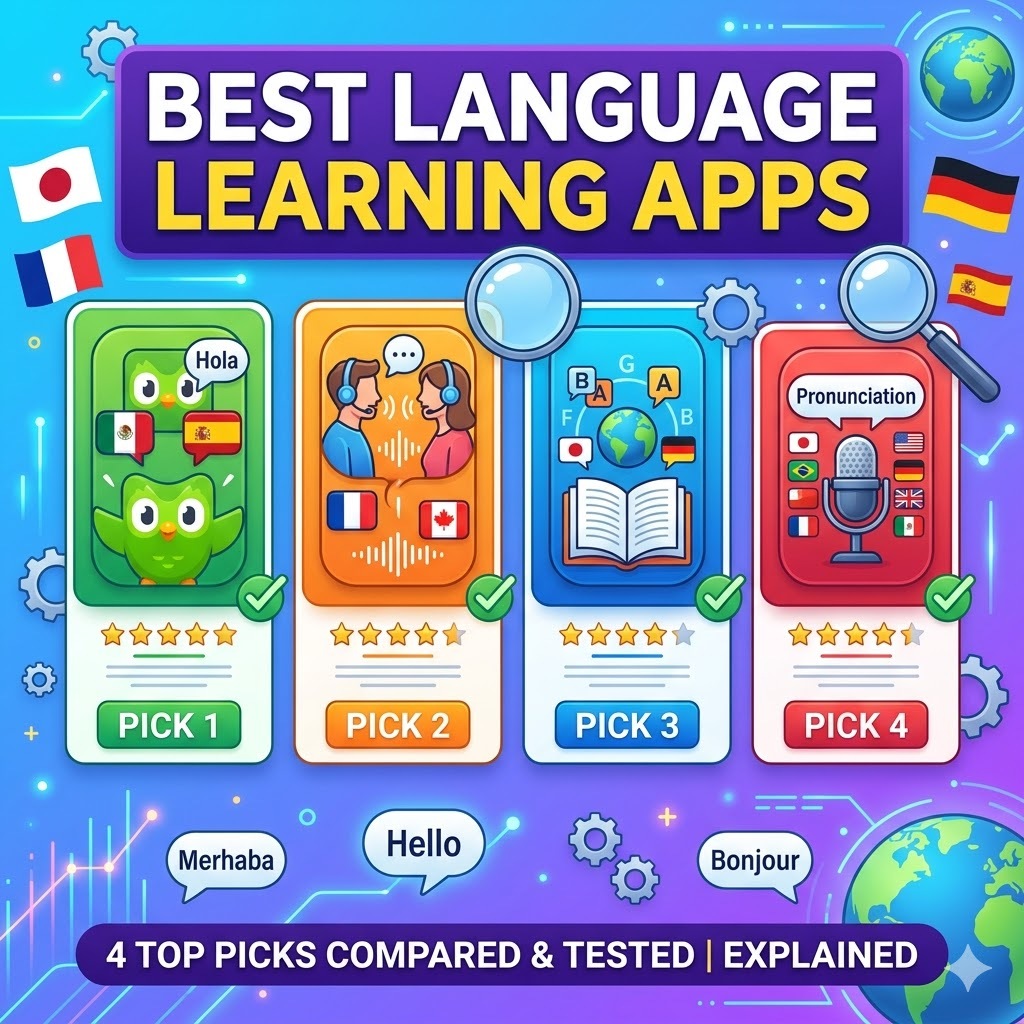
After researching 28 apps and testing the 15 most promising over 6 weeks of daily French lessons, 4 language learning apps stand out as the best options, each matched to a different learning style:
- Babbel: Best for learning grammar theory alongside vocabulary
- Speak: Best for visual learners who prefer video instruction
- Duolingo: Best free app for vocabulary practice and daily habit building
- Pimsleur: Best for audio-first, classroom-style learners
1. Babbel
Babbel is the most well-rounded language learning app tested. The legal name of Babbel’s owner company is Lesson Nine GmbH. The company was founded in 2007 by Markus Witte, Thomas Holl, Lorenz Heine, and Toine Diepstraten.
Babbel combines 5-minute interactive lessons with grammar guides, audio recaps, pronunciation practice, and AI-powered conversation in 1 structured platform. It is the only app among the 4 picks that explicitly teaches the rules behind the language rather than expecting learners to absorb them through repetition alone.
Key Specifications:
- Languages supported: 14
- Lesson duration: ~5 minutes
- Subscription options: $54 for 3 months, / $108 per year, / $299 lifetime
- Free tier: Not available
- CEFR coverage: A1 through B1 (B2 for 4 languages only)
- AI feature: Structured chatbot for conversation practice
- Platforms: iOS, Android, web
What makes it the best grammar-focused option:
Babbel teaches situational language use. Not just what words mean. But when and how to use them. Lessons explain that bonjour is the formal French greeting, while salut is casual, and that spoken sentences become questions through intonation alone. Grammar guides cover pronouns, gendered nouns, articles, and prepositions in written reference form accessible outside lessons. Babbel automatically creates additional practice for vocabulary that the learner struggles with most frequently.
Limitations to know before buying Babbel’s subscription:
- Minimum subscription is 3 months. No monthly option available.
- Supports only 14 languages. The most limited range of the 4 picks.
- Audio lesson content is limited. French includes only 5 audio recaps and 4 podcasts.
2. Speak
Speak, by 2 co-founders: Connor Zwick (CEO) and Andrew Hsu (CTO), delivers language instruction through 5-minute video lessons taught by bilingual human instructors who explain vocabulary, demonstrate pronunciation, and ask the learner to speak throughout, combining the engagement of video with the accountability of speech recognition in every lesson.
Key Specifications:
- Languages supported: 6 (Spanish, French, Korean, Japanese, Italian, English)
- Lesson duration: ~5 minutes (video)
- Subscription options: $18 per month / $84 per year
- Free tier: Not available
- Video lessons: Available through A1 Elementary Part 2 only
- AI feature: Free-form chatbot conversation on any topic
- Platforms: iOS, Android, web
What makes it the best visual option:
Speak’s instructors teach conversational nuance that other apps miss entirely. Where most apps teach the standard response ça va bien to “How are you?” in French, Speak’s instructor taught the more natural native response, “Bof,” the sound that actual French speakers use. Instructors vary greetings, praise, and responses throughout lessons, exposing learners to multiple ways of expressing the same idea. Speak’s AI chat holds free-form conversations on any topic and explains exactly what the learner said incorrectly and why.
Limitations to know before buying Speak’s subscription:
- Video lessons end after the first 4 courses. AI-only lessons replace human instruction beyond the A1 level.
- No grammar reference guide or written dictionary available
- Supports only 6 languages. The most limited of all 4 picks.
3. Duolingo
Duolingo, founded by Luis von Ahn, is the most widely used language learning app in the world, with 50 million daily active users, 37 languages for English speakers, and a completely free tier that allows full course progression without spending a single dollar. It is the best option for learners who want to build a daily practice habit, practice vocabulary through repetition, and pay nothing to start.
Key Specifications:
- Languages: 37 for English speakers, plus lessons for speakers of 27 other native languages
- Lesson duration: 5–10 minutes
- Subscription options: Free (with ads and limits) / $14 per month / $96 per year / $168 per year (AI video calls)
- Free tier: Yes, full course access with ads and daily usage limits
- AI feature: Transcription for pronunciation + AI video calls (top plan only)
- Platforms: iOS, Android, web
- Setup: 20+ taps required to start the first lesson
What makes it the best free option:
Duolingo’s spaced repetition engine dynamically adjusts which vocabulary it repeats based on which words the learner misses most frequently. Every lesson is free. Every language course is free. The gamification, including streaks, points, and an animated owl that pouts when you skip practice, is relentless and effective at building a daily habit. Duolingo also uniquely supports learners whose native language is not English, offering lessons in 8 languages for Chinese speakers and equivalent multi-language access for 26 other native language groups.
Limitations to know before buying Duolingo’s subscription:
- Grammar explanations are hidden behind a notebook icon. Not integrated into lessons
- AI conversation practice requires the $168 annual plan.
- Focuses on vocabulary memorisation more than conversational use. Learners may know many words without knowing how to use them in sentences.
- Account setup requires 20+ taps before the first lesson begins.
4. Pimsleur
Pimsleur is the oldest language learning tool. Pimsleur was developed by Dr Paul Pimsleur and later acquired by Simon & Schuster. The application is tested, originating in the cassette tape era, and is the only app with fully hands-free, 30-minute audio lessons that play in the background while commuting, exercising, or doing chores. It supports 43 languages, the widest range of the 4 picks, and rewards committed learners with the most detailed spoken language instruction of any app tested.
Key Specifications:
- Languages supported: 43
- Lesson duration: 30 minutes (audio) + 12-minute mini lessons available
- Subscription options: $21 per month, / $165 per year, / $480 lifetime
- Free tier: 1 free lesson per language
- AI feature: Transcription-based voice coach that grades pronunciation on a 3-point scale
- Platforms: iOS, Android, web
What makes it the best audio option:
Pimsleur breaks every conversation into components rather than presenting phrases as fixed blocks. Teaching the French phrase l’anglais, Pimsleur first has the learner say the full phrase, then removes the l’ and teaches anglais separately, then explains that l’ means “the” and appears far more frequently in French than equivalent articles in English. This deconstruction method builds structural understanding alongside vocabulary. A depth of a 5-minute gamified lesson delivers. Lessons are fully hands-free and play like a podcast, making Pimsleur the only app that integrates into a commute without requiring the learner to look at a screen.
Limitations to know before buying Pimsleur’s subscription:
- 30-minute lessons require significantly more time commitment than the 5-minute lessons of other picks.
- No grammar guide or written reference tool included.
- More expensive than all 3 other picks at $165 per year.
- Pronunciation is not checked during audio lessons. Only in the separate voice coach mode.
Which App Matches Your Learning Style: A Quick Decision Guide
The right language learning app depends on how you learn, not which app has the most users or the lowest price.
| If you learn best by… | Choose |
| Reading grammar rules and understanding why language works | Babbel |
| Watching a human instructor explain and demonstrate | Speak |
| Repeating exercises until vocabulary sticks, with game rewards | Duolingo |
| Listening to audio and speaking out loud, hands-free | Pimsleur |
| Combining structured learning with AI conversation practice | Babbel + Talkpal |
| Building vocabulary quickly alongside structured audio lessons | Pimsleur + Duolingo |
Comparison of the Top 4 Language Learning Apps
The 4 top language learning apps cover 4 different learning approaches, price points, and language library sizes, with a 3-year cost gap of $1,197 between the most and least expensive paid options.
| Specification | Babbel | Speak | Duolingo | Pimsleur |
| Best For | Grammar + vocabulary | Visual / video learners | Free vocabulary practice | Audio/commute learners |
| Languages | 14 | 6 | 37 | 43 |
| Lesson Duration | ~5 minutes | ~5 minutes | 5–10 minutes | 30 minutes |
| Free Tier | No | No | Yes (full course) | 1 lesson per language |
| Monthly Price | (3-month min) | $18 | $14 | $21 |
| Annual Price | $108 | $84 | $96 | $165 |
| 3-Year Cost (Annual) | $324 | $252 | $288 | $495 |
| Grammar Guides | Yes | No | Hidden | No |
| AI Conversation | Structured chatbot | Free-form chatbot | Top plan only | No |
| Hands-Free Use | No | No | No | Yes |
| CEFR Max Level | B1–B2 | A1–B1 | B1–B2 | B1–B2 |
| Platforms | iOS, Android, web | iOS, Android, web | iOS, Android, web | iOS, Android, web |
The Combination Approach: 2 App Pairings That Work Better Together
No single app covers every dimension of language learning. The 2 most effective pairings combine a structured learning tool with a conversational or vocabulary practice tool.
Pairing 1: Babbel + Talkpal Babbel builds grammar structure and vocabulary through guided lessons. Talkpal adds real-time AI conversation practice in free-form dialogue. The element that Babbel’s structured chatbot does not fully deliver. Together, the 2 apps cover theory, vocabulary, and live conversational practice across a complete learning cycle.
Pairing 2: Pimsleur + Duolingo. Pimsleur delivers deep audio instruction for spoken language. Duolingo reinforces vocabulary retention through gamified spaced repetition. Pimsleur during the commute and Duolingo for a 10-minute daily vocabulary session cover both the spoken and written dimensions of the language simultaneously.
What No Language Learning App Will Tell You: The CEFR Reality
Before choosing an app, understand the CEFR. CEFR stands for the Common European Framework of Reference for Languages. It is the global standard for measuring language proficiency, running from A1 (complete beginner) through C2 (full mastery). Most language learning apps reach A1 through B1. No app tested reaches beyond B2. The level at which a learner can understand complex text and hold detailed conversations on abstract topics.
The Foreign Service Institute estimates 600 to 750 hours of study to reach professional working proficiency in a Category 1 language like French or Spanish. At 30 minutes of daily app practice, that requires 3.3 to 4.2 years, a timeline that reframes every app’s promise of fast fluency against reality. Use apps to build the foundation. Transition to real-world conversation and immersion to go beyond it.
Final Thoughts
No language learning app replaces immersion, real conversation, or a human teacher. What these 4 best apps do is lower the barrier to starting, giving any learner a structured, accessible, and increasingly AI-powered entry point into a new language. Babbel explains the why. Speak shows how. Duolingo builds the habit. Pimsleur trains the ear. Start with the app that matches how you learn, combine it with a conversation tool once the basics are established, and move into real-world practice the moment an app stops challenging you.