
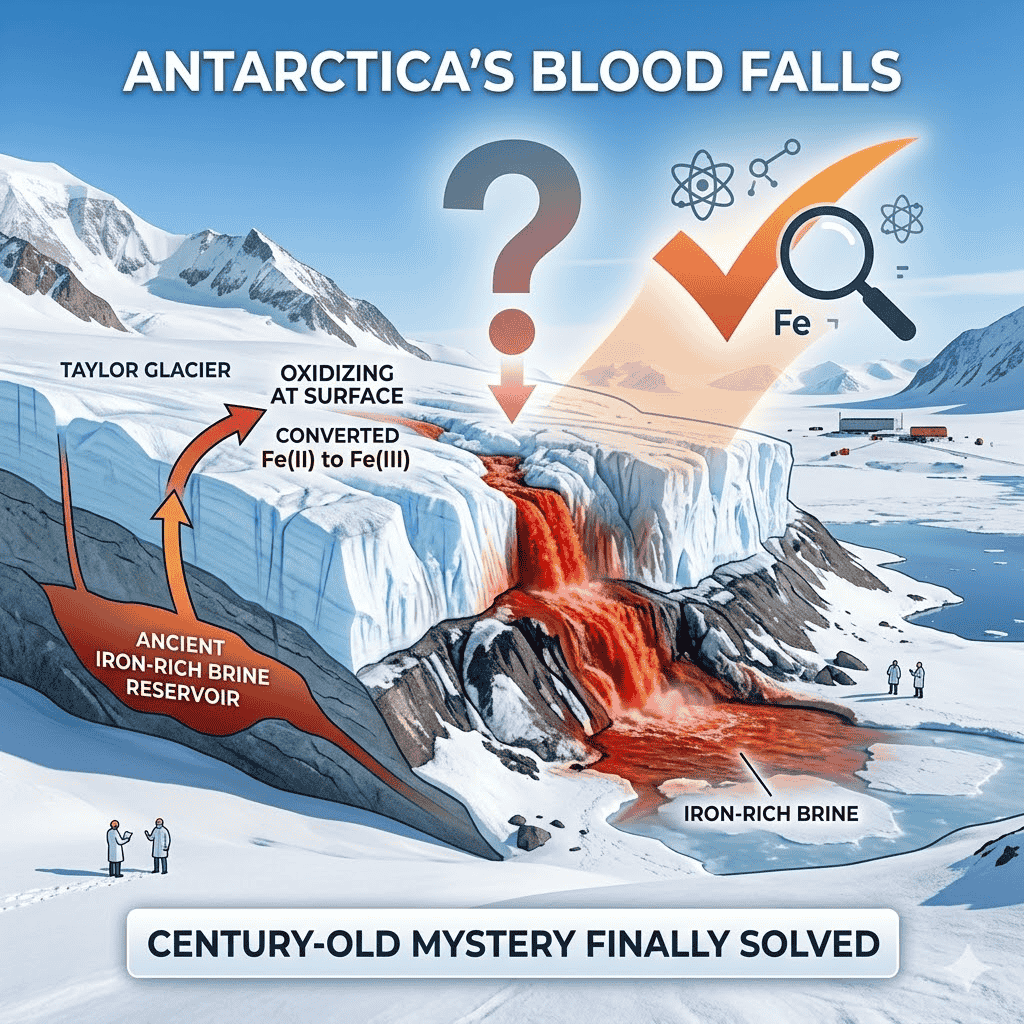
In 1911, during one of the most ambitious and deadly expeditions in exploration history, a geologist named Thomas Griffith Taylor stood at the base of an Antarctic glacier and looked at something that had no rational explanation. A waterfall, the colour of blood, was pouring out of the ice, brilliant, vivid, unmistakably crimson, onto the frozen surface of West Lake Bonney below.
Taylor named the falls after himself, recorded what he saw, and assumed the red colour came from algae. He was wrong. And it would take more than 100 years, and several overlapping waves of scientific investigation, to finally work out what was actually happening.
The last piece of that puzzle was confirmed in research published in the journal Antarctic Science in February 2026. The mystery of Blood Falls (what it is, why it stays liquid, and what drives it to the surface) is now considered fully solved.
What Blood Falls Is and Where It Exists
Blood Falls is located in the McMurdo Dry Valleys of Antarctica. It is one of the most extreme environments on Earth. The dry valleys are immense frozen deserts, largely free of ice and snow because the surrounding mountains block glacial flow, and the extreme cold and low humidity prevent precipitation from accumulating. They are, by most measures, the closest thing to a Martian landscape that exists naturally on this planet.
Taylor Glacier sits at the edge of these dry valleys. At its tongue, the leading edge of the glacier where ice meets exposed rock, a fissure periodically releases a liquid that emerges clear from beneath the ice and turns deep red almost immediately upon contact with the air. The flow is not constant. It erupts in bursts. And each time it does, the striking crimson stain against the white and grey of the Antarctic landscape looks like something from a David Cronenberg film.
The falls were first recorded during the Terra Nova Expedition, the British Antarctic expedition best known for Robert Falcon Scott’s ill-fated attempt to reach the South Pole. Taylor, an Australian geologist on that expedition, documented the phenomenon and attributed the colour to red microalgae. The glacier, the lake it drains into, and the surrounding valley all bear his name today.
Why the First Explanation Was Wrong
For decades, Taylor’s algae hypothesis held. There was no particular reason to challenge it; Antarctica was remote, access was limited, and the falls were a curiosity rather than a scientific priority.
It was not until 2003 that researchers concluded the red colour had nothing to do with algae. The real cause, the scientific consensus shifted to agree, was oxidised iron. Water containing dissolved iron compounds was reaching the surface and reacting with oxygen in the air. The same basic chemistry that turns metal rust-red.
This was a more satisfying explanation and one grounded in demonstrable chemistry. But it raised more questions than it answered:
- Where was the iron-rich water coming from?
- Why was it liquid when everything around it was frozen solid?
- What was physically pushing it to the surface?
The Discovery of What Is Underneath
The first breakthrough in understanding Blood Falls came in 2017, when a team from the University of Alaska Fairbanks and Colorado College used radar technology, specifically a technique similar to echolocation, to map what was beneath Taylor Glacier. What they found was not just a body of water but an entire subglacial water system: a network of briny channels and a subglacial lake that had been flowing continuously for approximately 1 million years, sealed beneath the ice for more than 2 million years in total.
The lake is hypersaline, meaning its salt content is higher than seawater. This extreme salinity is the reason the water has never frozen. Water’s freezing point drops as salt content increases, and the brine beneath Taylor Glacier is salty enough to remain liquid at temperatures approaching -20 degrees Celsius, far below the freezing point of fresh water.
The 2017 team also identified the mechanism that keeps the system perpetually active: as water freezes at the edges of the subglacial channels, it releases heat energy, which in turn melts the surrounding ice, maintaining a continuous hydraulic cycle that has been running for a million years without interruption.
This same 2017 research, led by scientists at the University of Alaska Fairbanks and Colorado College, confirmed that the water originated from an ancient, iron-rich lake that had been completely sealed from the surface for over 2 million years, isolated from sunlight, from atmospheric oxygen, and from any external influence. The iron dissolved in this ancient water was the source of the red colour. But the precise form that iron took, and why standard scientific tests had not fully characterised it, remained unclear.
The Nanosphere Discovery: What Actually Makes It Red
The most precise answer to the colour question came from a 2023 study published in Frontiers in Astronomy and Space Sciences, led by Ken Livi, a research scientist in the Department of Materials Science and Engineering at Johns Hopkins University’s Whiting School of Engineering.
Livi worked with Jill A. Mikucki, a University of Tennessee microbiologist who had been investigating Taylor Glacier and Blood Falls for years and who had previously been part of the team that first confirmed the presence of living organisms in the subglacial lake. Mikucki and astronomer Darby Dyar from Mount Holyoke College sent samples from Mikucki’s most recent Antarctic expedition to Johns Hopkins’ Materials Characterization and Processing facility, where Livi examined them using powerful transmission electron microscopes.
What Livi found changed the understanding of the Blood Falls phenomenon entirely.
The iron in the water was not present as a simple dissolved compound or a standard mineral. Instead, it existed as nanospheres, tiny, perfectly round particles approximately 100 times smaller than a human red blood cell, composed of iron alongside silicon, calcium, aluminium, and sodium. The moment these nanospheres reach the surface and contact oxygen, the iron oxidises instantly, producing the vivid crimson colour. The water itself emerges clear from beneath the ice. The red appears in seconds.
“As soon as I looked at the microscope images, I noticed that there were these little nanospheres and they were iron-rich, and they had lots of different elements in them besides iron, including silicon, calcium, aluminium, sodium, and they all varied,” Livi said.
The reason these nanospheres had gone undetected for so long is specific and technically important. Standard methods for identifying minerals in water samples rely on techniques like X-ray diffraction, which works by detecting the crystalline structure of known compounds. Nanospheres are amorphous. They have no crystalline structure. To standard mineral detection methods, they are effectively invisible.
Livi explains: “To be a mineral, atoms must be arranged in a very specific, crystalline structure. These nanospheres aren’t crystalline, so the methods previously used to examine the solids did not detect them.” The detection of the nanospheres required a transmission electron microscope. A significantly more powerful and specialised instrument than those used in previous Blood Falls analyses.
What Drives the Falls to Erupt: The Final Piece
With the colour explained by nanospheres and the liquid state explained by hypersalinity, the third and final mystery was mechanical: what physically forces the brine from deep beneath the glacier to the surface in periodic bursts?
This question was answered in research published in Antarctic Science in February 2026, which cross-referenced GPS data, thermal sensors, and high-resolution images collected during a Blood Falls eruption event in 2018.
The mechanism is pressure-driven and directly linked to the movement of the glacier itself. As Taylor Glacier advances, sliding slowly downstream as glaciers do, the enormous weight and motion of the overlying ice mass compresses the subglacial channels beneath it. This compression builds pressure steadily in the brine deposits. When the pressure exceeds what the ice structure can contain, the glacier gives way along its existing crevices. The pressurised brine forces its way upward through those crevices and erupts at the surface in short, forceful bursts, the characteristic spurts that observers describe as the falls “gushing.”
The 2026 research added a further finding that surprised the researchers: each eruption acts as a hydraulic brake on the glacier itself. The sudden release of pressurised brine temporarily slows the glacier’s forward movement. The outflow reduces the internal pressure that was driving the advance, creating a brief period of deceleration before the cycle begins again.
What Lives in the Dark Beneath the Ice
Perhaps the most scientifically significant aspect of Blood Falls is not the colour or the mechanism. It is what has been living in the subglacial lake for millions of years.
Mikucki’s earlier research, which mapped the subglacial cave and river systems beneath the glacier back to their source, confirmed the presence of living microbial communities in the ancient brine. These are microorganisms that have existed in complete isolation. No sunlight. No oxygen. Sealed from the surface for potentially millions of years. They survive by deriving energy from iron and sulfate compounds in the water rather than from photosynthesis, a metabolic strategy that requires none of the conditions most life on Earth depends on.
Livi describes the environment with appropriate awe: “There are microorganisms that have been existing for potentially millions of years underneath the saline waters of the Antarctic glacier. These are ancient waters.”
The discovery of this microbial ecosystem has drawn sustained interest from astrobiologists, scientists who study the conditions under which life might exist on other planets. The subglacial lake beneath Taylor Glacier is isolated, oxygen-deprived, hypersaline, cold, and completely cut off from any external energy source. These conditions closely resemble the subsurface oceans believed to exist beneath the ice shells of Jupiter’s moon Europa and Saturn’s moon Enceladus, 2 of the most frequently discussed candidates for extraterrestrial life in the solar system.
Blood Falls does not just tell scientists about Antarctica. It functions as a natural laboratory for testing theories about life in the most inhospitable environments imaginable, without the need to leave Earth.
The Mars Rover Connection
The Blood Falls research also revealed a significant limitation in humanity’s current ability to detect life on other planets, one with direct implications for the Mars rover missions.
Livi came to the Blood Falls project specifically through his background in planetary materials science and his involvement in thinking about what a Mars Rover would detect if it landed in an environment like the McMurdo Dry Valleys. Mikucki’s team had previously analysed Blood Falls samples using instruments and methods identical to those employed by the rovers currently traversing the surface of Mars.
The standard rover toolkit, which relies on techniques including X-ray diffraction for mineral identification, failed to detect the nanospheres that Livi subsequently found using transmission electron microscopy.
The implication is significant. If Mars Rovers landed near a site equivalent to Blood Falls, using their current analytical instruments, they would not be able to correctly identify what was producing the red colour. They would miss the nanospheres entirely. And if the nanospheres are the product of microbial activity, as the presence of ancient bacteria in the Blood Falls brine suggests, the rovers also miss evidence of life.
Livi stated the conclusion directly: “Our work has revealed that the analysis conducted by rover vehicles is incomplete in determining the true nature of environmental materials on planet surfaces. This is especially true for colder planets like Mars, where the materials formed may be nanosized and non-crystalline. Consequently, our methods for identifying these materials are inadequate. To truly understand the nature of rocky planets’ surfaces, a transmission electron microscope would be necessary, but it is currently not feasible to place one on Mars.”
This is one of the most practically important findings to emerge from the Blood Falls research, not just a geological or biological discovery, but a direct challenge to the adequacy of tools currently being used to search for life on another planet.
What Remains Unknown
The 2026 Antarctic Science paper is being described as the final piece of the Blood Falls puzzle. The mechanism explanation that completes a century of investigation. But one significant uncertainty remains: the impact of global warming on the system.
The subglacial brine, the microbial ecosystem, and the pressure-driven eruption mechanism are all products of conditions that have remained remarkably stable for millions of years. As global temperatures rise, Antarctic glaciers are changing.
The rate at which Taylor Glacier advances, the pressure dynamics in the subglacial channels, and the thermal balance that keeps the hypersaline brine perpetually liquid could all shift in ways that are currently impossible to predict. Whether warming will increase the frequency of Blood Falls eruptions, reduce them, or eventually destabilise the entire system remains an open scientific question.
A Summary of What Science Now Knows
The century-long investigation of Blood Falls has produced answers across 4 distinct questions:
- Why is it red? Iron-rich nanospheres, identified by Ken Livi at Johns Hopkins using transmission electron microscopy, oxidise instantly upon contact with air. The water is clear when it exits the glacier.
- Why doesn’t it freeze? The brine beneath Taylor Glacier is hypersaline, keeping it liquid at temperatures as low as -20 degrees Celsius. A perpetual hydraulic cycle of freezing and melting at the channel edges maintains the system continuously.
- Where does the water come from? An ancient subglacial lake sealed beneath the glacier for more than 2 million years, mapped by University of Alaska Fairbanks and Colorado College researchers in 2017 using radar technology.
- What drives it to the surface? Pressure buildup caused by the glacier’s forward motion, confirmed by GPS, thermal, and imaging data from a 2018 eruption event and published in Antarctic Science in 2026.
Final Takeaway
Blood Falls was discovered 115 years ago and misidentified within the first hour. It took a Nobel-level improvement in microscopy technology, a Mars rover simulation, a microbiologist’s multi-decade dedication to a single glacier, and a 2018 eruption event captured in real time to finally close the case. What emerged from that century of investigation is not just an explanation for a striking natural phenomenon. It is a set of findings about ancient life, planetary detection limits, and the hidden complexity of systems buried beneath ice that will inform science well beyond Antarctica. Thomas Griffith Taylor would not have recognised any of the science. He would almost certainly have been astonished by what was hiding beneath the falls he named.
Earth science, space research, and the scientific discoveries reshaping how we understand the planet and the universe, our newsletter covers every story worth following. Subscribe and stay informed.