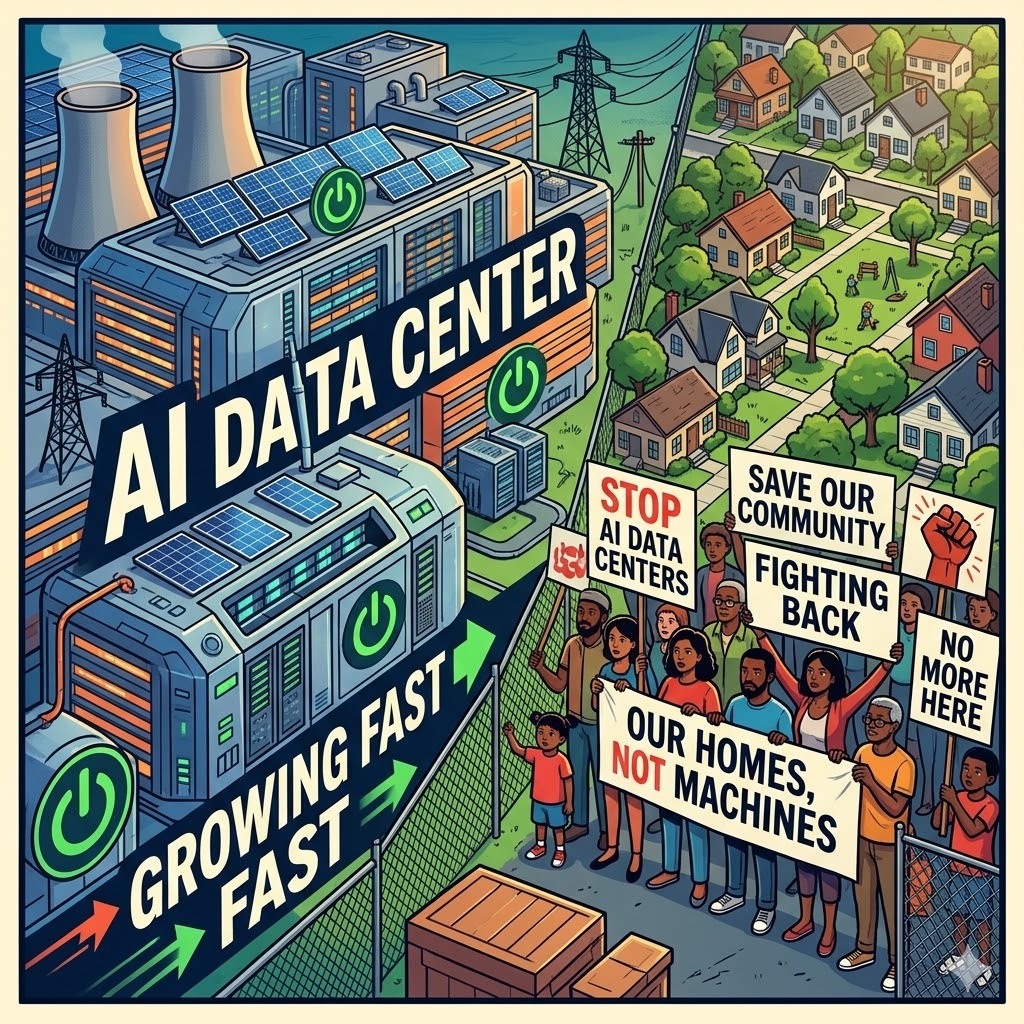
There are more than 5,400 AI data centers in the United States right now. That number is expected to triple within 5 years. More than 350 environmental groups have sent Congress a letter with 1 clear demand: stop building new ones until proper rules exist to protect people, water, and the environment.
This is the story of what AI data centers actually are, what they cost the communities around them, and why ordinary people across the country are showing up to fight them.
What Is an AI Data Center
An AI data center is a large building full of powerful computers that run AI systems. When you use ChatGPT, Google Search, or any AI tool, your request travels to one of these buildings, gets processed, and comes back to you. The computers inside work constantly, and they generate enormous amounts of heat. To stop them from overheating, they need 2 things in huge quantities: electricity and water.
There are 2 main types. Hyperscale data centers are massive, at least 10,000 square feet, and are owned by companies like Google, Amazon, Microsoft, and Meta. These handle the heaviest AI tasks, like training large AI models. Colocation data centers are smaller shared spaces where multiple businesses rent space for their own equipment.
How Much Water and Electricity Do They Actually Use
The numbers are hard to picture, so here is a comparison.
| Resource | Data Center Usage | Equivalent To |
| Water (medium data center) | 110 million gallons per year | 1,000 households annually |
| Water (large data center) | Up to 5 million gallons per day | A town of 10,000–50,000 people |
| Water (all US data centers) | 163.7 billion gallons per year | Entire cities combined |
| Electricity (current) | 4% of the US national demand | – |
| Electricity (projected) | 12% of the US national demand within 3 years | 30 million households |
If data centers triple as projected, they will need as much water as 18.5 million households in a country that has just over 130 million households total. US electricity bills have already risen 21% since 2021, driven largely by data center expansion. That cost is paid by ordinary people, not the tech companies building them.
Where Are They Being Built and Why There
Companies building data centers look for 3 things: cheap land, weak local governments, and water nearby. Rural communities in states like Virginia, Texas, Georgia, Pennsylvania, and Arizona are the most frequent targets. Virginia currently houses the most data centers in the entire country, concentrated in an area of Ashburn called “Data Center Valley.”
State and local governments often welcome these projects in exchange for tax breaks, believing data centers will create jobs. The reality is less generous. On average, a data center employs 1,688 workers during construction.
Once it is running, it provides only 157 permanent jobs. Meanwhile, 42 US states give full or partial tax exemptions to data centers, totalling nearly $6 billion in exemptions over the past 5 years. When that tax revenue disappears, 2 things happen: public services get cut, or everyone else’s taxes go up.
What Happens to the Communities Around Them
People living near AI data centers deal with 4 documented problems.
1. Higher electricity bills. Data centers consume enormous amounts of power, driving up electricity costs for everyone connected to the same grid. In South Carolina, data centers are projected to account for 65–70% of all new energy usage in the state.
2. Power outages. The energy demand from large data centers regularly causes outages in the rural areas where they are built. The same communities have the least ability to absorb those disruptions.
3. Water competition. In dry regions, data centers compete directly with residents and farmers for limited water supplies. In Tucson, Arizona, a proposed project called “Project Blue” would have taken millions of gallons of drinking water from the desert for cooling. Residents attended every council meeting, wrote letters, and filled the council chambers until the city council voted unanimously to shut the project down.
4. Noise pollution. The constant hum of server fans and cooling systems disrupts sleep, increases stress, and pushes wildlife out of surrounding habitats.
How Communities Are Pushing Back
Community resistance to AI data centers is growing faster than the data centers themselves. In the second quarter of 2025 alone, opposition rose 125%. An estimated $98 billion in data center projects were blocked or delayed more than in all previous quarters combined since 2023.
Lansing, New York:
A Maryland company called Terawulf proposed converting an old coal power plant on Cayuga Lake into a large AI data center. Residents created an Instagram account, showed up to town board meetings, and published detailed research countering the company’s claims about sustainability and economic benefit. The community fight is ongoing.
Saline Township, Michigan:
Residents protested a $7 billion data center called Stargate, backed by OpenAI CEO Sam Altman, planned on farmland. More than 100 people gathered at the state Capitol in December 2025 to oppose it.
Tucson, Arizona:
Residents successfully blocked “Project Blue” through sustained public pressure. When the council voted to end negotiations with the developer, the packed council chambers erupted in cheers.
On December 8, 2025, more than 350 nonprofit groups. From Greenpeace and Friends of the Earth to local community organisations across all 50 states. Signed a joint letter to Congress demanding a national moratorium on new data center construction. The letter stated directly: “The harms of data center growth are increasingly well-established, and they are massive.” Senator Bernie Sanders also called for a national moratorium separately that same month.
Final Takeaway
AI data centers power the technology that billions of people use every day. They also consume water like small cities, drive up electricity bills for rural families, and produce almost no permanent jobs for the communities that host them. The $98 billion in blocked projects is proof that showing up to town meetings, to council chambers, to Capitol steps, actually works. The fight over where and how AI infrastructure gets built is no longer just a tech industry story. It is a community story, happening in backyards, on farms, and beside lakes across the country.
Environmental science, technology policy, and the stories where the two collide, our newsletter covers every development worth knowing about. Subscribe and stay informed.