
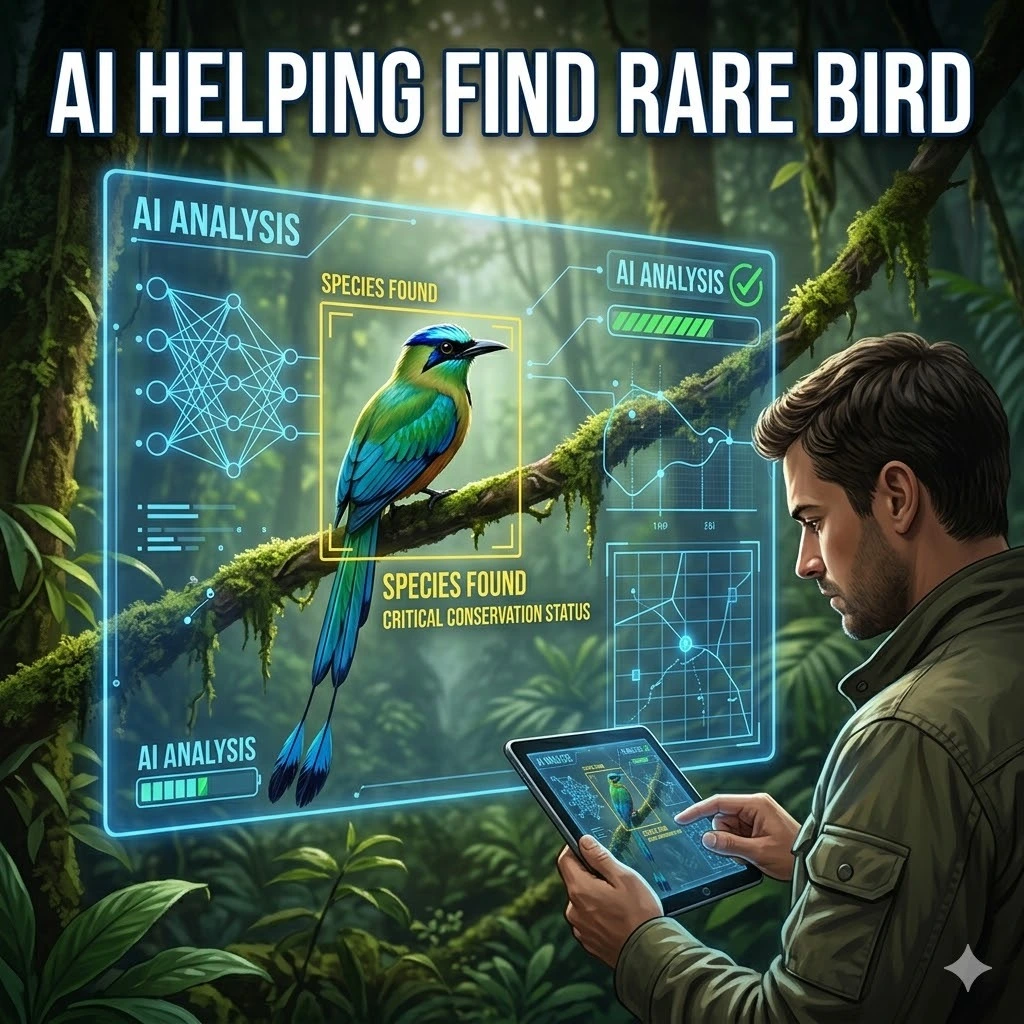
Fewer than 250 tooth-billed pigeons exist on Earth, and nobody has photographed one since 2013. Now, an AI algorithm built by Colossal Biosciences can detect this bird’s calls from audio recordings with 95% accuracy, giving conservationists the first reliable tool to locate a species that was beginning to look like it might already be gone.
What Is the Tooth-Billed Pigeon and Why Does It Matter So Much
The tooth-billed pigeon is a large bird found only in the rainforests of Samoa. It exists nowhere else on Earth. Samoans call it the manumea, or the “little dodo.”
Its connection to the dodo
The tooth-billed pigeon is one of the closest living relatives to the dodo, the famous bird that went extinct in the 17th century. Both belong to the same biological family. Losing the tooth-billed pigeon would remove the last living link scientists have to the dodo’s biology and evolutionary history.
How close to extinction is it?
The International Union for Conservation of Nature (IUCN), the global body that tracks endangered species, lists fewer than 250 tooth-billed pigeons left on Earth. To put that in perspective: a species needs at least 50 individuals to survive short-term, and around 500 for long-term genetic health. At fewer than 250, this bird is surviving.
How rare is it considered?
The IUCN’s Pigeon and Dove Specialist Group ranks it as their single highest priority species on the entire planet. Co-chair Joe Wood described it as “extremely rare and little-known,” with an “extraordinary appearance and genetic proximity to the dodo.”
When was it last seen?
The last known photograph of a living tooth-billed pigeon was taken in December 2013 by conservation officer Moeumu Uili. For over a decade after that, nobody confirmed seeing one alive.
What Is Bioacoustics and Why Is It the Right Tool for This Job
What does bioacoustics mean?
Bioacoustics is simply the science of listening to animals. Researchers place microphones in wildlife habitats, record the sounds, and analyse those recordings to identify which species are present, without ever needing to see them.
Why does it work especially well for birds?
Birds are hard to spot. They move fast, hide in dense trees, and cover large distances quickly. But they call constantly, and every species has its own unique sound. Listening for a bird is often far more practical than looking for one, especially in a thick rainforest where visibility is limited to a few metres.
The problem with the tooth-billed pigeon specifically
The tooth-billed pigeon’s calls sound almost identical to those of the Pacific imperial pigeon, a much more common bird living in the same forests. Human researchers listening to recordings struggled to tell them apart reliably. The analysis was slow, expensive, and easy to get wrong.
What Colossal built to solve this?
Colossal built an AI classifier, a type of software that learns to recognise specific sounds and sort them from background noise. It is not a consumer app you download from an app store. It is a specialised tool built for conservation fieldwork. Initially, SCS field teams uploaded audio recordings to Colossal’s system for analysis. Colossal has since packaged the classifier into a dedicated mobile application (installable on a smartphone) that allows conservationists in the field to upload audio and receive results within minutes, without sending files back to a lab and waiting days for a response.
How Colossal Built a 95%-Accurate AI From Almost Nothing
Who is Colossal?
Colossal Biosciences is a biotechnology company known for de-extinction projects, bringing back extinct animals using genetic science. Its most famous projects include genetically modified dire wolves and woolly mammoth mice. Its nonprofit arm, the Colossal Foundation, takes the same technology in the opposite direction, using it to prevent extinction before it happens. Executive director Matt James put it simply: finding a species that hasn’t been seen in over 10 years “is almost, in its own way, its own form of de-extinction.
The nearly impossible data problem
The project started in 2023. Immediately, Colossal hit a serious obstacle. To teach an AI to recognise a sound, you normally need hours of recordings to train it on. For the tooth-billed pigeon, the entire available audio dataset was 1 five-minute recording containing just 3 calls, captured from a captive bird at Berlin Zoo in Germany in the 1980s. That is not enough data. By normal standards, building an accurate AI from 3 audio samples simply should not work.
The clever workaround
Colossal solved this with a creative approach. American Samoa, a neighbouring territory just miles away, shares most of the same bird species as Samoa, except 1: the tooth-billed pigeon does not live there. Colossal fed the AI large amounts of American Samoa audio as a “control,” essentially teaching it what to ignore. Once all the shared background birdlife was filtered out, only sounds unique to Samoa remained. From that narrowed soundscape, the AI learned to match what was left against the 3 known tooth-billed pigeon calls.
The result
A working classifier built in just 2 weeks, achieving 95% accuracy at identifying the tooth-billed pigeon’s calls in the wild, built from almost nothing, using geography as a substitute for data.
What the AI Found and What Happened Next
The discovery
Colossal’s algorithm analysed audio recordings collected from areas across Samoa where tooth-billed pigeons have historically lived. It detected 47 potential tooth-billed pigeon calls. For a species that had not been confirmed alive in over a decade, 47 signals were extraordinary, proof that at least some birds were still out there.
The funding crisis it solved:
Before this result, the project was in serious trouble. Searches had come back empty for years. Feral cat populations (a direct threat to the birds) were growing.
Donors were losing confidence. PDSG co-chair Joe Wood told Mashable directly: “There was a real concern that our donors would conclude their funds were better invested elsewhere.” The 47 identified calls reversed that entirely. Funding returned. The search continued.
Matt James described the shift simply: “Now there’s a new excitement.”
How has the app changed fieldwork?
Before the mobile app existed, the process was slow. Field teams collected audio from microphones placed around the forest, sent the files back to Colossal’s lab, and waited days for results. The mobile app cut that waiting time down to minutes. Conservationists now upload recordings directly from the forest and receive analysis on the spot, allowing them to make same-day decisions about exactly where to search next.
The first visual confirmation
In March 2024, separately from the audio detections, field team member Vilikesa Masibalavu made the first clear visual sighting of a tooth-billed pigeon in years, the first direct, unambiguous confirmation that living birds still exist in Samoa’s forests.
What Comes Next: 3 Goals for Saving the Manumea
Conservation efforts now focus on 3 parallel objectives.
1. Locating and protecting remaining birds. The 47 identified call locations give field teams specific areas to search and monitor, replacing the previous approach of searching everywhere with no signal at all.
2. Biobanking genetic material. Colossal is now helping the SCS collect and store biological samples from the species. A process called biobanking. Wood explained why: “Given the rate of progress currently being made in the fields of genetic engineering and reproductive technology, biobanking seems like a crucial way of preserving future options. For the manumea, it may well be that conventional conservation techniques are simply inadequate. These pioneering approaches could offer the only glimmer of hope.“
3. Captive breeding and re-release. The longer-term goal is to capture a small number of wild birds, breed them in human care, and release them back into Samoa’s forests once invasive species, particularly high feral cat populations discovered during earlier searches, and habitat loss issues are addressed.
Why the Algorithm Matters Beyond 1 Bird
Colossal has released the tooth-billed pigeon bioacoustics algorithm as open-source, free for any conservation organisation in the world to access and adapt. The IUCN lists over 44,000 threatened species globally. Colossal’s 48 conservation partners cannot monitor all of them. CEO Ben Lamm’s vision is a publicly available app that turns ordinary people into passive monitoring stations. Anyone with a smartphone in a species’ habitat becomes a potential data point. “That’s the dream,” said Lamm. “We need citizen science.”
For a technology that started with 3 audio recordings, a 2-week development window, and a bird nobody had seen in over a decade, the reach of what it might eventually protect is extraordinary.
Final Takeaway
The tooth-billed pigeon has fewer than 250 individuals left, no confirmed photograph since 2013, and predators are actively reducing those numbers. An AI built from 3 recordings and trained in 2 weeks just gave it the best chance it has had in years. Conservation has always been a race, and for the first time, technology is helping close the gap.
Wildlife science, AI breakthroughs, and the research changing how we understand and protect the natural world, our newsletter covers every story worth following. Subscribe and stay informed.