
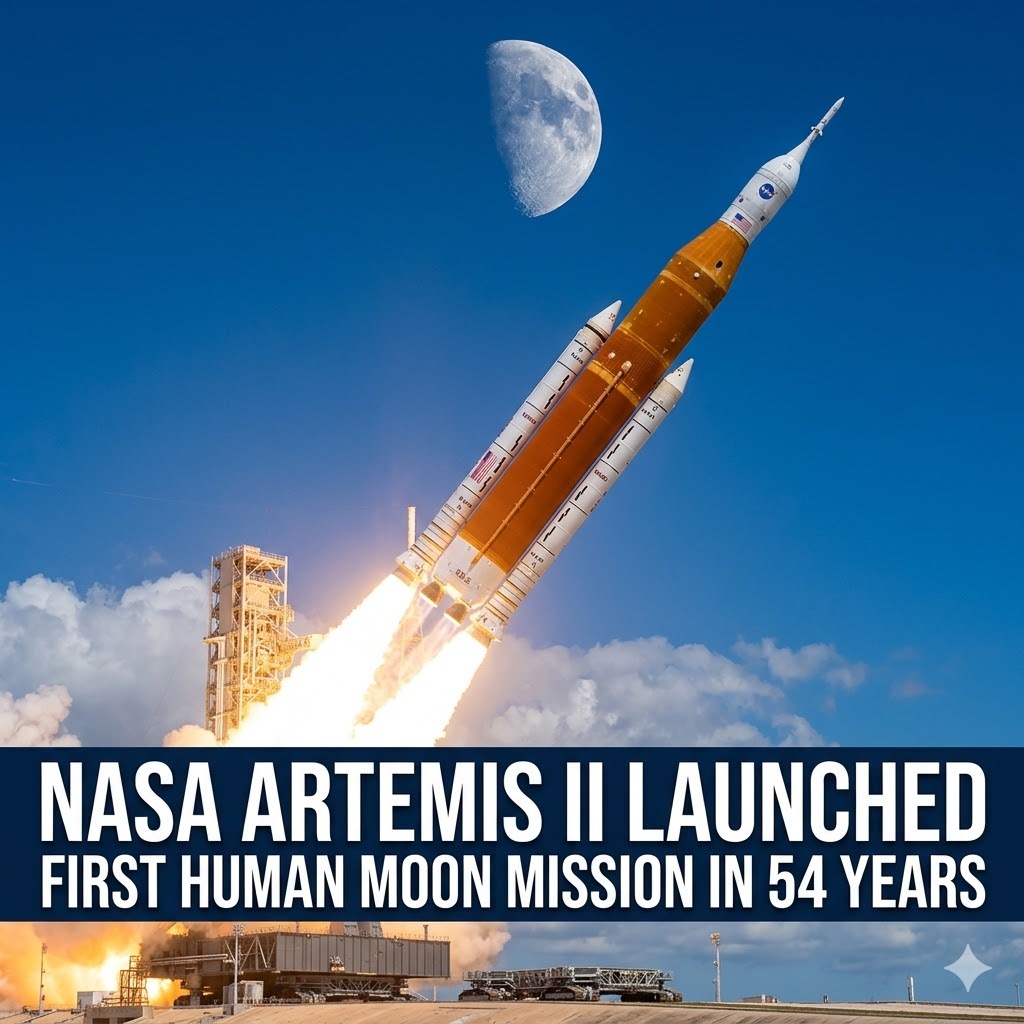
At 6:35 PM ET on April 1, 2026, NASA’s Space Launch System rocket lifted off from Kennedy Space Centre in Cape Canaveral, Florida, carrying 4 astronauts toward the moon for the first time since Apollo 17 in 1972.
The 32-story rocket, generating thrust equivalent to 160,000 Corvettes, accelerated the crew to approximately 18,000 mph in the first 8 minutes of flight, pushing them through forces 3 times Earth’s gravity before breaking free of the atmosphere.
This $4.1 billion mission marks humanity’s return to deep space after a 54-year absence.
What Artemis II Actually Is and What It Is Not
Artemis II is a test flight, not a moon landing. The 4-person crew will fly around the moon and return to Earth, testing Orion’s life support, navigation, and communication systems in deep space for the first time with humans aboard. No landing occurs on this mission. The landing comes later.
Artemis II is the 2nd of 4 planned missions in NASA’s Artemis programme, each building toward a permanent human presence on the lunar surface.
| Mission | Type | Year |
| Artemis I | Uncrewed test flight | 2022 |
| Artemis II | Crewed lunar flyby | 2026 |
| Artemis III | First crewed lunar landing since 1972 | TBD |
| Artemis IV | Extended lunar stay, moon base precursor | 2028 (target) |
The 4 Crew Members and 3 Historic Firsts
The Artemis II crew carries 3 simultaneous historic firsts alongside its technical mission.
- Commander Reid Wiseman leads the mission.
- Pilot Victor Glover becomes the first Black astronaut to travel to the moon.
- Mission Specialist Christina Koch becomes the first woman to travel to the moon.
- Mission Specialist Jeremy Hansen, flying for the Canadian Space Agency, becomes the first non-American assigned to a lunar spaceflight.
Koch and Glover set their personal spaceflight records the moment Orion surpasses the altitude of the International Space Station, approximately 250 miles above Earth, within the first 2 hours of Flight Day 1.
The 10-Day Mission: What Happens and When
Artemis II’s 10-day flight follows a precise sequence determined entirely by orbital physics. Not crew convenience.
Flight Day 1:
After reaching orbit, Wiseman and Glover perform a 1.5-hour manual spacecraft steering demonstration using Orion’s spent upper stage for docking practice. A critical test of whether Orion can dock with lunar landers on future missions. Approximately 8.5 hours into the flight, the crew takes a 4-hour sleep window.
The perigee raises burn. The mission’s most critical moment after liftoff:
Roughly 12.5 hours into the mission, during the crew’s only sleep window, Orion must fire its engine to reshape its temporary Earth orbit into a stable trajectory for the trans-lunar burn the next day. This manoeuvre cannot happen at a convenient time. Orbital physics dictates the exact moment. Missing it ends the mission.
Lead flight director Jeff Radigan stated directly: “Unfortunately, physics cannot be defied. We have to put the burns where they’re necessary for the trajectory.” The crew gets 4.5 hours of sleep after the burn completes.
Flight Day 6 (the far side blackout):
Orion passes behind the moon, blocking all communication with Earth for 45 minutes. During this blackout, the crew will study and photograph the lunar far side. The hemisphere that permanently faces away from Earth and has never been seen directly by human eyes. The crew may become the first humans to visually observe Mare Orientale, a lunar impact basin nearly 600 miles wide that almost completely escapes Earth’s view.
Flight Day 10 (splashdown):
Orion re-enters Earth’s atmosphere and splashes down off the coast of San Diego, California, on April 10, where US Navy teams recover the crew and capsule.
The Distance Record and the Heat Shield Fix
Artemis II targets a maximum distance of 248,700 miles from Earth, 45 miles beyond the current record of 248,655 miles set by Apollo 13 in 1970. Apollo 13 holds this record not because of a successful mission but because of a near-fatal emergency; an oxygen tank explosion forced the crew to loop around the moon on a free-return trajectory to survive.
Artemis II surpassing that distance means humans will voluntarily travel farther from Earth than anyone has gone since a spacecraft nearly killed its crew.
Orion’s heat shield was damaged during Artemis I’s re-entry at approximately 5,000 degrees Fahrenheit, raising direct safety concerns for Artemis II’s crewed return. NASA redesigned the landing trajectory specifically to reduce re-entry temperatures to approximately 3,000 degrees Fahrenheit, lowering heat shield stress by 40% compared to the Artemis I flight profile.
Final Takeaway
Artemis II is not the moon landing. It is the proof of concept that makes every moon landing after it possible. 4 astronauts are currently farther from Earth than any humans have been in over 50 years, testing the spacecraft that future crews will depend on to survive the journey. If Orion’s systems hold, the next crew lands. If they don’t, NASA finds out now rather than on the surface of the moon.
Space exploration, scientific breakthroughs, and the missions pushing the boundaries of what humans can do, our newsletter covers every development worth following. Subscribe and stay informed.