
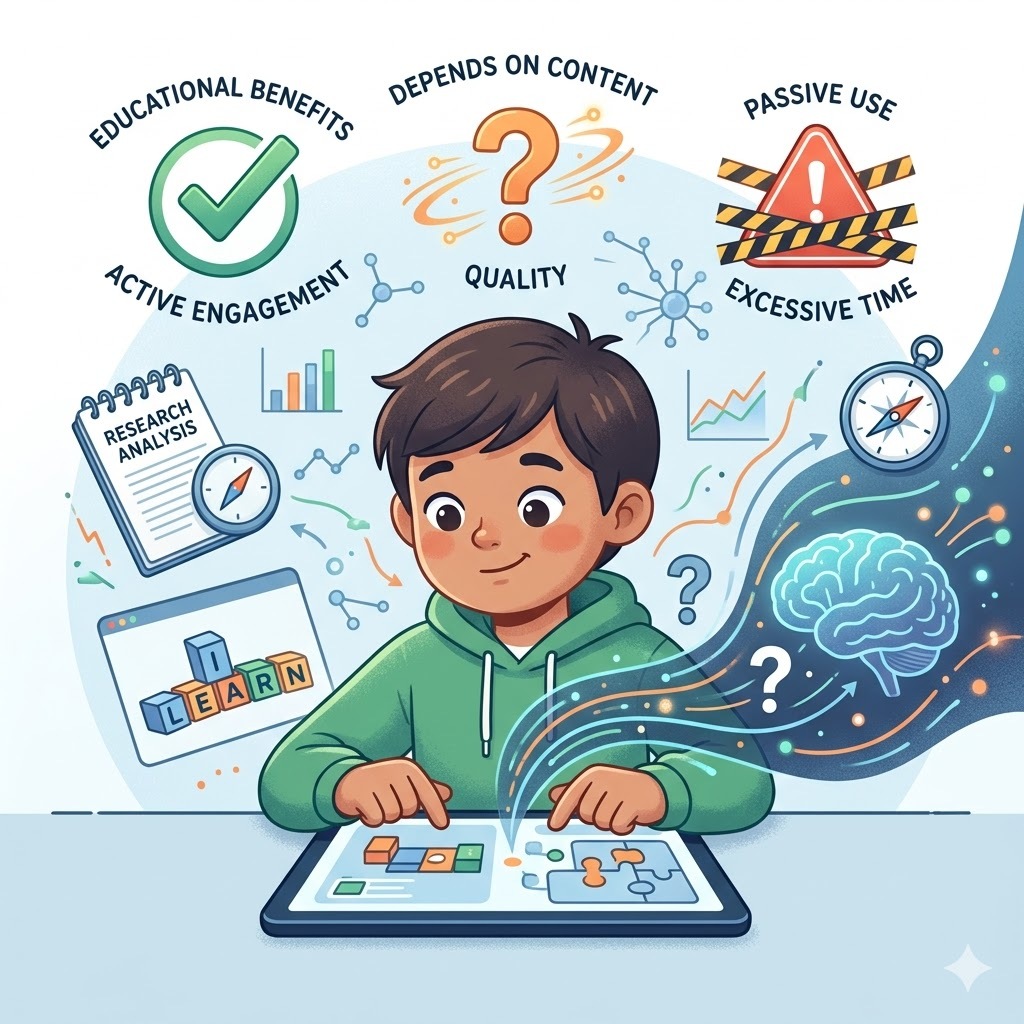
Not in all cases. This is where the research requires careful reading. Professor Pasco Fearon, who helped draft the UK government guidance and led the “Children of the 2020s” research, stated directly that the committee did not want to give the impression that “screens are always terrible.” His position, grounded in the research: “Very small or moderate amounts of screen time, particularly for children over two, doesn’t seem to be harmful.“
The critical variable is not screen time itself. It is the type of content and the presence of an engaged adult.
Watching screens with an engaged adult is linked to better cognitive development than solo viewing, according to the government guidance. Shared, interactive screen use, where a parent watches alongside a child, discusses what is happening, and responds to the child’s reactions, produces measurably different outcomes than passive solo viewing of the same content.
Professor Fearon pointed to Sesame Street as a documented example of screen content with positive developmental outcomes: the programme was “explicitly designed to be educational“, and evidence shows it can “improve children’s early learning and language acquisition.” This finding aligns with broader research showing that slow-paced, age-appropriate, narrative-structured content produces different neurological responses than fast-paced stimulation.
98% of children are watching screens daily by the age of 2, and children with the highest screen exposure, around 5 hours per day, can say significantly fewer words than children watching around 44 minutes daily. Screen time has become one of the most debated topics in modern parenting, and the research behind it is more nuanced than the headlines suggest.
The UK Department of Education’s first evidence-backed practical guidance on screen time, published in 2026, recommends no more than 1 hour of screen time per day for children under 5, and zero screen time for under-2s except for shared, interactive use.
What Screen Time Actually Means
Screen time covers all types of screen use across 4 device categories: computers, tablets, mobile phones, and televisions. The term makes no distinction between a child passively watching fast-paced social media videos alone and a child watching a slow-paced educational programme with an engaged parent sitting beside them. This distinction matters enormously because the research treats them as fundamentally different activities with fundamentally different developmental outcomes.
Why the First 5 Years Are the Most Critical Window
According to the UK government’s “Children of the 2020s” research, 90% of brain growth happens before age 5.
- At birth, the brain weighs approximately 25% of its adult weight.
- By age 1, that figure reaches 70%.
- By age 3, it reaches 85%.
- By age 5, it reaches 92%.
The speed of this growth means that every hour of a young child’s day carries disproportionate developmental weight, and the experiences filling those hours, including screen time, shape neural architecture during the period when it is most plastic and most vulnerable.
Children learn their most crucial social, emotional, and language skills during the first year of life. This makes early childhood the most important window for human interaction, and the window most at risk from passive, solo screen use.
What Excessive Screen Time Does to Children
Excessive screen time, defined in the research as significantly above the 1-hour daily recommendation, is linked to negative effects across 4 developmental areas.
1. Delayed Language Development
According to the UK government’s “Children of the 2020s” research, children with the highest screen time (around 5 hours daily) could say significantly fewer words than children at the lower end of the scale, watching around 44 minutes. Language acquisition depends on back-and-forth human interaction, what researchers call serve-and-return conversation, which screens cannot replicate.
Danielle Matthews, professor of psychology at the University of Sheffield, told the BBC that slowing the conversational pace to allow young children to take their turn is critical: “Responding to them with language that is tuned in to their interests can really help them to learn to talk.“
2. Emotional and Behavioural Issues
A large amount of screen time is linked to emotional dysregulation and behavioural difficulties in early childhood. Speech and language therapist Janet Cooper explains the mechanism through what she calls the brain’s built-in “seeking system,” which is a neurological drive activated by human interaction, not screen stimulation.
Cooper further told the BBC that “If young children are spoken to one-to-one and people show them interesting things, that develops the seeking system to make them explore and make the most of the world around them“.
Passive screen exposure does not activate this system in the same way, leaving the seeking system underdeveloped in children with high solo screen exposure.
3. Slower Thinking and Cognitive Development
Fast-paced screen content, defined in the government guidance as “over-stimulating social media-style videos,” triggers a fight-or-flight stress response in a child’s developing brain.
Professor Sam Wass from the Institute for the Science of Early Years at the University of East London explained the physiological mechanism directly: “If stuff is coming at us too fast, something called the fight-or-flight stress system kicks in, where your heart starts beating faster, and you start to get a lot of energy released to your muscles.”
This stress response is incompatible with the calm, exploratory cognitive state that supports learning and thinking development in young children.
4. Sleep Difficulties
Screen use in the hour before bed disrupts sleep quality in young children by suppressing melatonin production through blue light exposure and maintaining neurological arousal at a point when the brain needs to decelerate toward sleep. The government guidance specifically recommends cutting all screen use for an hour before bed and replacing it with shared reading. A recommendation backed by consistent evidence across multiple independent sleep research studies.
What Good Screen Content Looks Like
The Department for Education recommends that video content for under-5s meets the following 5 characteristics:
- Slow-paced: Content that moves at a speed young children can process without triggering stress responses.
- Simple: Limited narrative complexity that allows comprehension without cognitive overload.
- Repetitive: Repeated elements that reinforce vocabulary and pattern recognition.
- Age-appropriate: Produced specifically for the developmental stage of the target viewer.
- Structured narratively: A clear beginning, middle, and end that teaches story comprehension.
Programmes meeting these 5 criteria, including Hey Duggee, Puffin Rock, Bluey, and Ranger Hamza’s Eco Quest, are cited in the guidance as examples of content.
According to Kate Morton, senior head of commissioning for CBeebies, “intentionally calm, easy to follow and repetitive, with clear storytelling and relatable moments that help children make sense of the world around them“.
Fast-paced social media-style video content meets none of these 5 criteria and represents the highest-risk category of screen exposure for young children.
Screen Time Guidance by Age: What the Research Recommends
| Age Group | Recommended Daily Limit | Exceptions |
| Under 2 years | Avoid screens entirely | Shared, interactive use permitted |
| 2 to 5 years | Maximum 1 hour per day | Slow-paced, age-appropriate, adult-supervised content |
| School age (5+) | No fixed limit, quality and context matter | Educational use, shared viewing preferred |
| Children with SEND | Individual assessment required | Screen-based assistive technology is exempt from limits |
Children with special educational needs and disabilities require a different application of these guidelines. Professor Fearon noted that some children with additional needs benefit specifically from digital interaction, “being able to interact with others through digital devices or as a means of calming down,” and that the general guidance should be interpreted differently for this group.
6 Practical Steps for Managing Screen Time at Home
Managing screen time does not require perfection. It requires 6 consistent, realistic adjustments across daily routines.
- Model the behaviour you want: Children’s brains copy parental screen habits directly, according to the government guidance. Reducing your own visible phone use during family time is the single most influential environmental change available to parents.
- Protect mealtimes from screens: Replace background television with music, conversation, drawing, or simple games during meals.
- Cut screens 1 hour before bed: Replace evening screen time with shared reading to support melatonin production and sleep quality.
- Watch together, not separately: Shared viewing with discussion produces better cognitive outcomes than solo watching of identical content.
- Use built-in device tools: Both Apple and Android devices include screen time management suites with app timers, content filters, and usage tracking accessible in device settings.
- Treat children as conversational partners from infancy: Professor Matthews recommends talking to children during ordinary activities, including bus trips and household chores, as a way to build language development without creating additional time demands on busy parents.
The Benefit Nobody Discusses: Screen Reduction Is Good for Parents Too
Professor Sam Wass at the University of East London presented a finding that rarely appears in screen time coverage: stepping away from connected devices to engage with young children benefits adult mental health, not just children’s development. Evidence shows that slowing down to the pace of a young child, even for 2 minutes, helps adults regulate their own stress responses. The benefit runs in both directions, a finding that reframes screen reduction from a parenting obligation into a mutual well-being practice.
Final Takeaway
Screen time is not the enemy. Passive, solo, fast-paced screen exposure is. The difference between 44 minutes of slow-paced shared viewing and 5 hours of unsupervised social media-style content is not a difference of degree. It is a difference in developmental outcome, neurological response, and language acquisition trajectory.