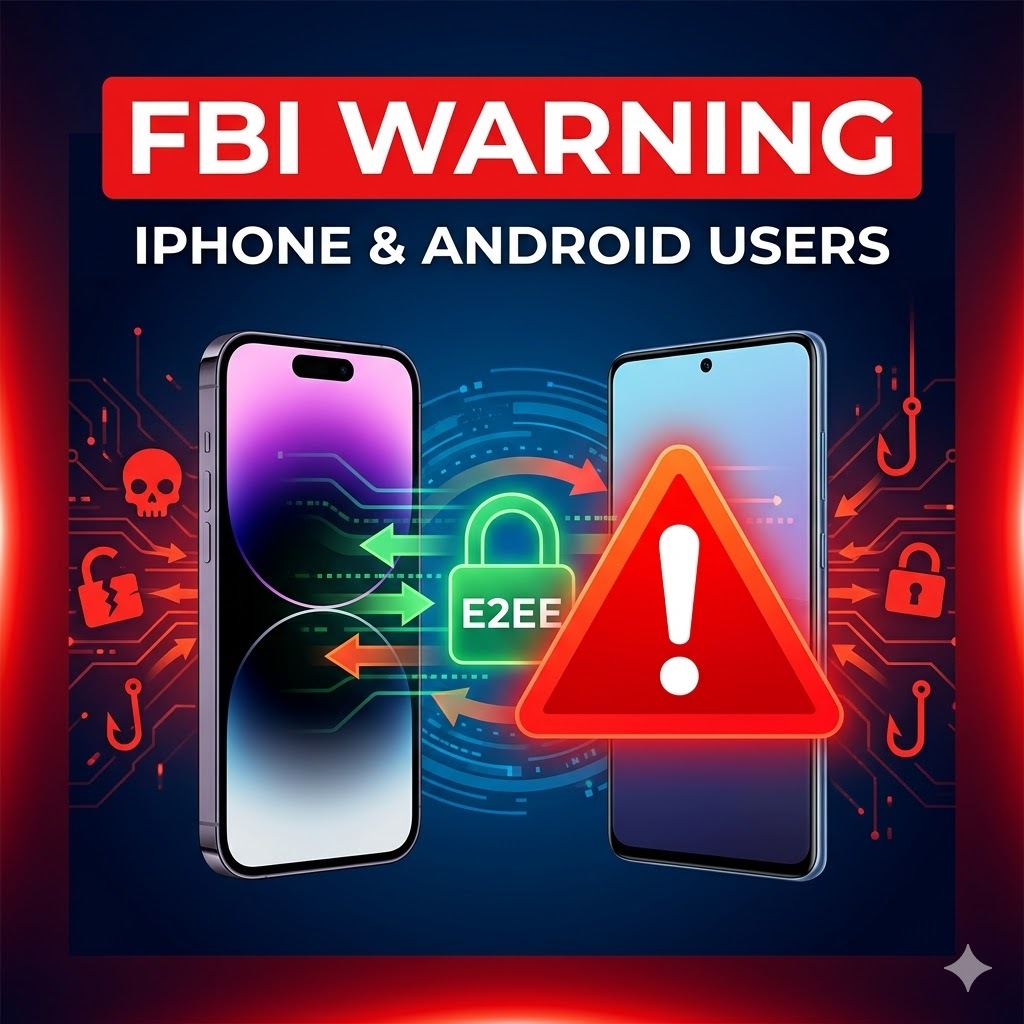
The idea that end-to-end encryption protects your private messages has become one of the strongest beliefs in modern digital security. But a recent warning from the Federal Bureau of Investigation (FBI) is challenging that assumption, and it’s forcing users of both iPhone and Android devices to rethink what “secure messaging” really means.
According to the FBI, encrypted apps like Signal and WhatsApp remain secure in transit, but that security does not extend to the devices, accounts, or notification systems where messages ultimately land. In other words, encryption protects your data while it travels. Not when it is stored, displayed, or accessed.
That distinction is now at the center of a growing cybersecurity concern.
Encryption Is Not the Full Shield Users Think It Is
End-to-end encryption (E2EE) is designed to ensure that only the sender and receiver of a message can read its contents. While that protection remains mathematically strong, the FBI warns that attackers are no longer trying to break encryption itself.
Instead, they are targeting the weak points around it.
The bureau explains that messaging apps are being attacked “without compromising their encryption or the applications themselves.” In practice, this means cybercriminals are shifting focus to devices, user behavior, and account access methods.
Even when encrypted platforms remain secure, users can still be compromised through alternative entry points. The encryption debate is further complicated by platforms’ active choice to remove it. Meta’s decision to strip end-to-end encryption from Instagram direct messages raised immediate concerns about what that policy reversal means for the hundreds of millions of users who assumed their conversations were protected.
How Hackers Are Bypassing “Secure” Messaging Apps
Recent reports show that attackers are using multiple indirect methods to gain access to private conversations. One of the most notable techniques involves extracting message data from smartphone notification systems.
Security researchers found that in some cases, messages from Signal can be accessed through push notification databases on iPhone devices. If message previews are enabled, sensitive content may be temporarily stored locally, making it accessible to malware or anyone with physical access to the device.
Importantly, this does not break encryption. Instead, it exploits how decrypted data is temporarily displayed on the device itself.
The same principle applies across other messaging platforms, including WhatsApp and similar apps. This pattern of security assumptions being exploited at the edges rather than broken at the core is not new. The documented history of significant cyberattacks spanning two decades shows that attackers have consistently found ways around protections that users and organizations believed were definitive.
Account Takeover: The Bigger Threat
Beyond device-level attacks, the FBI also warns about account hijacking as a major risk vector.
Attackers frequently use phishing tactics, fake login links, or malicious QR codes to trick users into linking their messaging accounts to unauthorized devices. Once this happens, the attacker can silently monitor messages, contacts, and conversations in real time.
QR-based credential theft has evolved into a full enterprise attack platform; the Venom phishing-as-a-service campaign deploys exactly this technique against C-suite executives, using QR codes embedded in fake Microsoft SharePoint notifications to harvest session tokens and bypass multi-factor authentication entirely.
In some campaigns, cybercriminals have also exploited multi-device features, which allow messages to sync across multiple endpoints. If one device is compromised, the entire communication chain becomes vulnerable.
The FBI has confirmed that thousands of accounts have been affected in such campaigns, with attackers capable of viewing and sending messages once access is established.
The Real Weak Point: Your Phone, Not the App!
One of the most important takeaways from the FBI’s warning is that messaging apps are not the primary vulnerability. Instead, the real risk lies in the devices themselves.
Modern smartphones are powerful, but they are also complex systems filled with apps, permissions, and background processes. If a device is compromised, encryption becomes irrelevant because attackers can simply read messages after they are decrypted on-screen.
This risk is amplified by the global scale of outdated devices. Security experts estimate that more than one billion smartphones worldwide are no longer receiving operating system updates. These devices are especially vulnerable because known security flaws remain unpatched.
Once malware gains access to an outdated phone, it can potentially:
- Read notifications
- Access stored files
- Monitor app activity
- Extract login credentials
Malicious Apps and Permission Abuse
The FBI also highlights risks from seemingly harmless mobile applications, especially those developed or hosted in jurisdictions with weaker data protection rules.
Some apps request excessive permissions, including access to contacts, location data, the microphone, and the camera. While these permissions may appear necessary, they can be abused to collect far more information than users realize.
In some cases, apps continue collecting data in the background even when not actively in use.
The bureau advises users to be especially cautious about third-party app stores and unknown developers, as these are common entry points for malware.
Why Encryption Still Matters But Isn’t Enough
Despite the concerns, experts stress that end-to-end encryption is still an essential layer of protection. It prevents attackers from intercepting messages during transmission and remains one of the strongest cryptographic systems in use today.
However, encryption alone cannot protect against:
- Compromised devices
- Stolen authentication tokens
- Social engineering attacks
- Malicious app permissions
As cybersecurity analysts often point out, the strength of encryption is only as effective as the weakest link in the system, and that weak link is usually the user’s device or behavior.
How Users Can Protect Themselves
The FBI recommends several practical steps to reduce exposure to these threats:
Start by disabling message previews on lock screens. This prevents sensitive content from appearing in notifications where it could be extracted by malware.
Next, regularly review linked devices in apps like WhatsApp and Signal to ensure no unauthorized sessions are active.
Users should also:
- Keep their operating system updated
- Avoid installing apps from unofficial sources
- Review and limit app permissions
- Remove apps that show unusual behavior or excessive battery usage
These steps do not eliminate risk, but they significantly reduce exposure to common attack methods.
Final Takeaway
The FBI’s warning is not about broken encryption. It’s about misunderstood security. Messaging platforms like Signal and WhatsApp remain technically secure, but attackers have shifted focus to the environments around them.
In today’s threat landscape, your privacy is no longer determined by encryption alone. It depends on your device security, your app behavior, and how carefully you manage access to your digital identity.
Stay ahead of evolving cyber threats, mobile security risks, and real-world FBI alerts with The IT Horizon. Subscribe to our newsletter for clear, practical insights that help you understand, not just react to, the changing world of digital security.