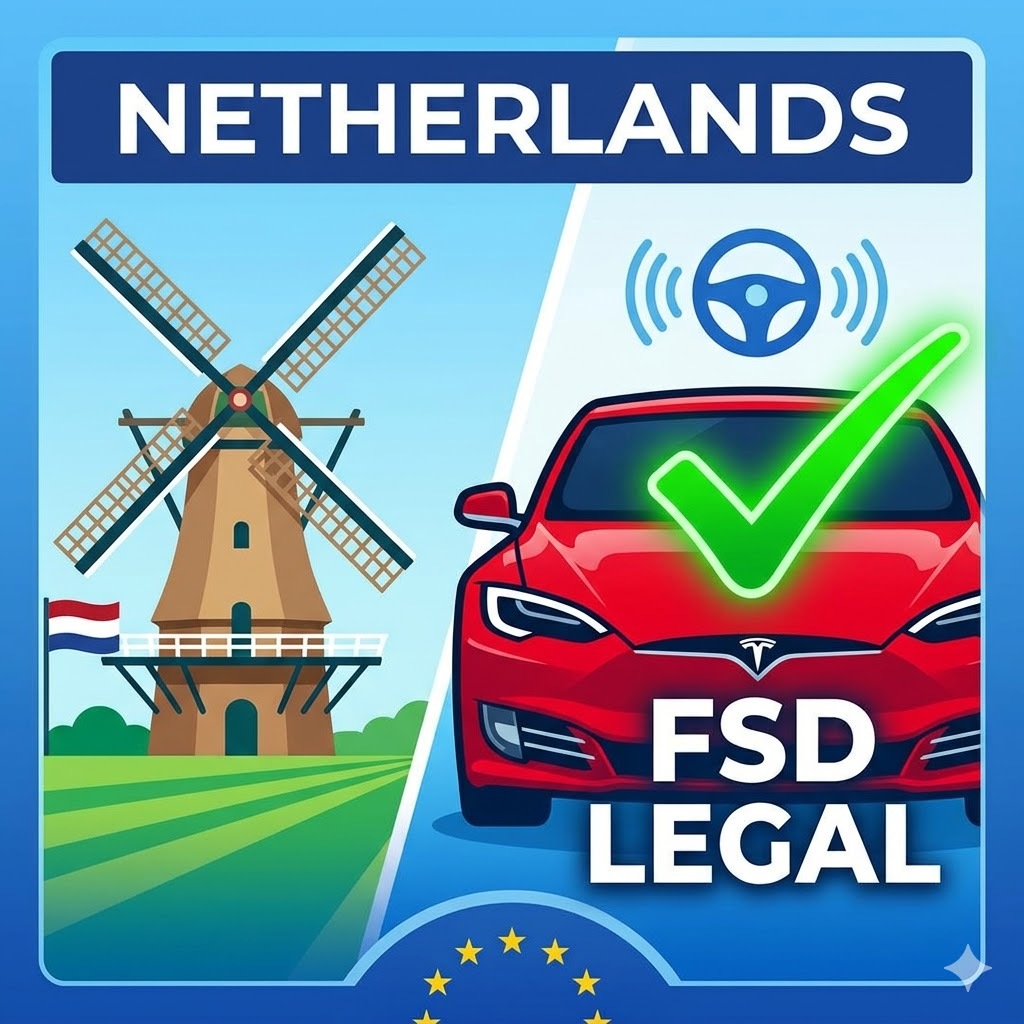
Tesla Full Self-Driving (FSD) Supervised received its first European regulatory approval on April 10, 2026, when the Dutch vehicle authority RDW authorized its use on Netherlands roads after more than 18 months of testing and analysis. The Netherlands becomes the first European country to approve any self-driving software for use in a wider range of real-world driving conditions, including both highways and city streets. RDW has simultaneously submitted the application to the European Commission for EU-wide authorization, opening a pathway to continental adoption as early as summer 2026.
Tesla’s response on X was unambiguous: “No other vehicle can do this.”
What FSD Supervised Actually Does and Doesn’t Do
Tesla Full Self-Driving Supervised is an AI-powered driver assistance system that handles steering, braking, acceleration, route navigation, and parking using a camera-based computer vision architecture. The key distinction embedded in its name is legally and operationally critical: FSD Supervised is not autonomous driving. The driver remains in the vehicle, at the controls, legally responsible for every action the car takes, and required to intervene at any moment.
RDW stated this unambiguously in its approval announcement: “A vehicle with FSD Supervised is not self-driving. It is a driver assistance system, and the driver remains responsible and must always maintain control.“
Driver accountability frameworks for AI-assisted systems represent one layer of a much broader governance gap. Organizations deploying AI across every sector face security and liability risks that most governance frameworks have not yet formally categorized, making the Dutch regulatory model one of the few documented examples of a structured accountability requirement being applied to AI behavior in a high-stakes physical environment.
Before activating the feature, Dutch drivers must complete a mandatory tutorial and pass a quiz confirming they understand that FSD Supervised “does not make your vehicle autonomous. Do not become complacent.” The software rollout begins with version 2026.3.6, deploying initially to a limited user group before broader availability.
This differs from hands-free driving systems offered by Mercedes, Ford, and BMW, which operate on select highways at limited speeds, primarily in Germany. Tesla’s FSD Supervised approval covers a wider range of driving situations, making it structurally distinct from every competing driver assistance product currently authorized in Europe.
Why the Dutch Approval Carries EU-Wide Consequences
RDW’s approval carries significance beyond the Netherlands’ approximately 100,000 eligible Tesla Model 3 and Model Y owners. The Dutch regulator has submitted the FSD Supervised authorization to the European Commission for validation across all EU member states. Under the EU vehicle approval architecture, a majority vote within the responsible committee converts the Dutch national certification into a valid EU-wide authorization. If the majority threshold is not reached, individual member states retain the right to adopt it independently.
Tesla anticipated possible EU-wide approval during the summer of 2026. RDW’s submission to the European Commission formally initiates that process.
One critical detail RDW explicitly flagged: the EU version of FSD Supervised is not equivalent to the US version. EU vehicle approval standards are stricter than US requirements, meaning the system approved for Dutch roads has passed a higher technical bar than the version currently operating in America, where FSD is available as a subscription service but simultaneously faces consumer lawsuits, federal investigations by the National Highway Traffic Safety Administration, and crash-related recall inquiries.
What This Means for Tesla’s Business
FSD adoption in Europe is central to Tesla’s growth strategy in a market where sales have faced sustained headwinds. Tesla’s European sales declined across most of 2025 before recovering in February 2026. The first year-over-year increase in more than a year. Contributing factors include an aging EV lineup and reputational damage from CEO Elon Musk’s political positioning in European markets.
Much of Tesla’s $1 trillion valuation rests on the commercial potential of AI-driven self-driving software and robotaxi services as a revenue stream beyond vehicle sales. The commercial model Tesla is betting on, AI capability generating recurring software revenue from an installed hardware base, is the same structural shift reshaping enterprise software broadly, where Anthropic’s launch of Claude Cowork as a subscription desktop automation platform signals that AI-as-recurring-revenue has moved from theory to deployed product across multiple industries simultaneously.
FSD, supervised as a subscription product, generating recurring revenue from an existing installed base of vehicles, represents the immediate commercial model. The robotaxi network represents the longer-term bet.
Morningstar analyst Seth Goldstein assessed the approval’s direct commercial impact: “I expect FSD approval by the Dutch authority and subsequent European regulators will lead to improved sales in Europe over the coming months as consumers are excited to try FSD.” Tesla shares rose 0.7% in aftermarket trading following the announcement, modest movement against a year-to-date decline of 23%.
The Road to EU-Wide Approval
The pathway from Dutch national approval to EU-wide authorization requires the European Commission process to reach a majority committee vote, a timeline Tesla publicly projected for summer 2026. If the Commission vote fails, country-by-country adoption becomes the fallback strategy, which would produce a fragmented European deployment map rather than a unified market entry.
The distinction RDW drew between US and EU FSD versions matters for this process. A stricter EU-certified version of FSD, tested over 18 months against European road standards, enters the Commission review with a more robust safety record than the American version’s regulatory history would suggest. Whether European regulators weigh that distinction favorably or focus on the US incident record remains the central unknown in the approval timeline.
Tesla’s European headquarters in Amsterdam made the Netherlands a symbolically fitting first approval. Whether it becomes the foundation of a continental rollout or a single-country authorization depends on a committee vote expected before the summer ends.
The Final Opinion
The Netherlands’ FSD approval represents a genuine regulatory milestone, 18 months of rigorous testing, stricter EU standards than the US version, and a mandatory driver accountability framework. The safety case is structured and defensible.
The contradictory position is equally legitimate. Tesla’s US FSD record includes active federal investigations, consumer lawsuits, and crash-related recall inquiries, all running simultaneously with this European approval. The absence of a formal, standardized framework for investigating AI system failures in transportation mirrors a gap that exists across every high-stakes AI deployment category. The same structural deficit that allows aviation to learn systematically from every incident, while AI systems accumulate incident records without equivalent accountability mechanisms.
RDW acknowledged the EU version differs from the US version without specifying how. Approving a system while declining to publicly detail what separates the approved version from the investigated one leaves drivers, regulators, and the public navigating a gap that a safety argument alone cannot close.
Autonomous vehicle regulation, AI deployment on public infrastructure, and the technology decisions reshaping transportation are covered at The IT Horizon. Subscribe to our newsletter. We track every regulatory approval, product launch, and policy shift affecting how AI moves through the physical world.