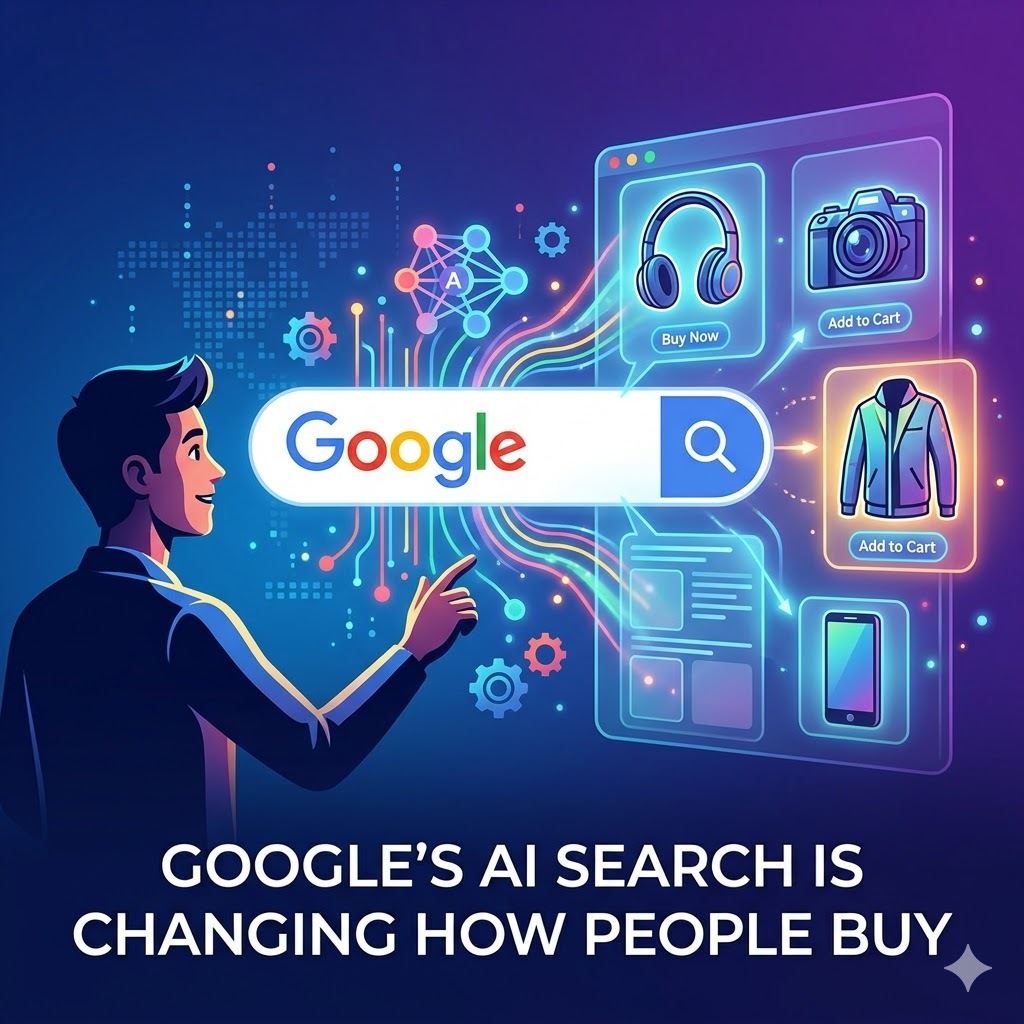
Google’s AI-powered search behaviors are fundamentally restructuring the consumer journey from a linear funnel into a faster, more fragmented decision cycle. The Think with Google editorial team identified 5 distinct behavioral shifts, already active across Google’s search ecosystem as of January 2026, that are collapsing the traditional awareness-to-purchase timeline marketers have built strategies around for decades.
The classic marketing funnel is not evolving. Google’s own data confirms it has been replaced.
The 5 AI Search Behaviors Reshaping Consumer Decisions
Google’s AI search ecosystem now operates across 5 consumer moment categories, each representing a structural change in how users discover, evaluate, and act on purchase decisions.
1. Visual Discovery as High-Intent Commerce:
Google Lens and Circle to Search transform physical environments into instant shopping interfaces. 1 in every 5 Google Lens searches carries direct commercial intent, meaning users photographing real-world objects are not casually browsing. They are actively initiating purchase journeys from a single image capture.
2. Complex Query Handling Through AI Mode:
AI Mode processes natural language queries with layered specificity that traditional keyword search structurally is not able to handle. As of Q3 2025, AI Mode operates across 40 languages and serves 75 million daily active users. Users submit detailed, conversational queries, replacing vague keywords with fully contextualised requests, and receive synthesized answers, replacing the entire consideration phase.
3. Higher-Quality Traffic Replacing Higher-Volume Traffic:
AI Overviews filter out low-intent users before a single click reaches a publisher’s website. Users clicking through from AI-generated results arrive informed, qualified, and closer to conversion. The traffic volume drops, the lead quality rises. Publishers absorbing raw click losses without measuring conversion quality changes are misreading the actual impact on their business.
4. Trust Validation Through Search and YouTube:
70% of social media users return to Google Search to verify and evaluate products discovered on social platforms. YouTube ranks as the primary product review destination across all consumer age groups according to a 2024 Traackr survey. The purchase journey now moves: social discovery > Google Search validation > conversion. AI Overviews intercept this validation moment directly.
5. Agentic Search Replacing Passive Queries:
Search is transitioning from question-and-answer to command-and-execute. Users now instruct Google’s AI agents to book reservations, check store inventory, and trigger purchase alerts autonomously. Structured, accessible business data determines whether a brand participates in this agentic layer or gets bypassed entirely.
What Marketers Must Change Immediately
| Behavior Shift | Old Approach | Required Adaptation |
| Visual search intent | Text-optimized product listings | Multimodal-ready visual assets |
| Complex query handling | Keyword density targeting | Natural language content depth |
| Agentic task execution | Static website listings | Structured data integration with Google’s Shopping Graph |
| AI Overview placement | Organic ranking optimization | GEO-aligned content with E-E-A-T signals |
Google’s internal data shows advertisers activating AI Max in Search campaigns see 14% more conversions at equivalent cost per acquisition. A direct performance gap between brands adapting to AI search behaviors and those still optimizing for the traditional results page.
The Final Opinion
Google’s data makes the efficiency argument convincing. Shorter journeys, higher-intent clicks, faster conversions. The numbers support the transition. Marketers following Google’s recommendations will likely see measurable gains in lead quality and conversion rates.
The contradictory position deserves equal weight. A search experience that answers every question before a user visits a single independent source is not just changing consumer behavior. It is concentrating information authority inside one AI system. When Google’s Gemini model synthesizes the answer, selects the cited sources, places the ads, and executes the purchase through its own agent layer, the open web’s role in the consumer journey shrinks to whatever Google’s algorithm decides to surface.
The marketing funnel has changed. Whether it has improved or simply been absorbed depends entirely on which side of Google’s ecosystem your business sits on.
AI search is rewriting the rules of digital marketing in real time. Subscribe to The IT Horizon newsletter; we track every behavioral shift, GEO update, and platform change so your strategy stays ahead of the algorithm.