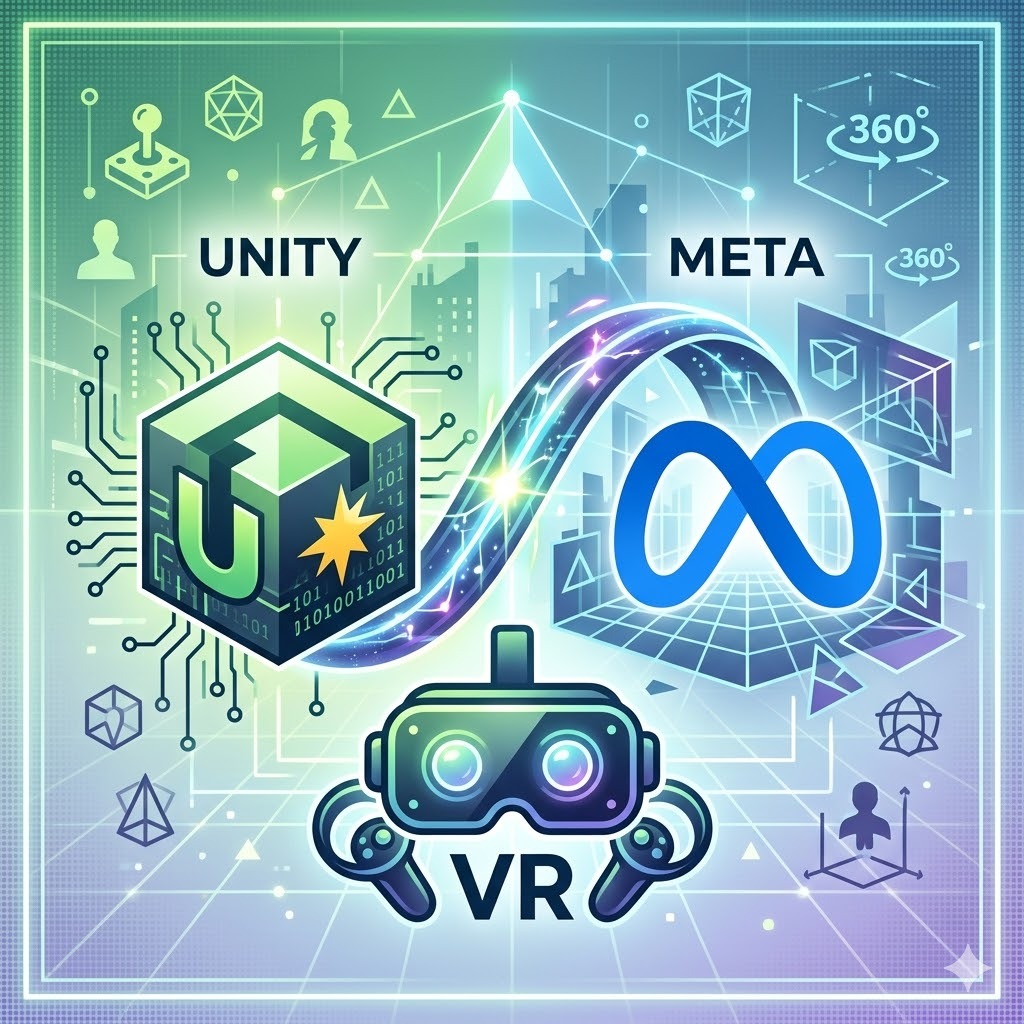
On April 8, 2026, Unity and Meta announced an extended multi-year platform support and enterprise agreement. A formal deepening of one of the most consequential partnerships in virtual reality. Unity, the world’s leading game engine, and Meta announced an extended multi-year platform support and enterprise agreement that deepens their long-standing collaboration in virtual reality. Under the extended partnership, Unity will continue to provide support for Meta’s VR platform.
The announcement is significant on its own terms. But understanding why it matters requires knowing how these 2 companies got here in the first place.
How This Partnership Started
The Unity-Meta relationship began nearly a decade ago on August 18, 2016, when they announced a deal to help game developers reach Facebook’s audience of about 650 million gamers. The first collaboration focused on integrating Unity’s game engines with Facebook’s platform. At the time, consumer VR was in its earliest phase, the original Oculus Rift had just launched, and the idea of a mainstream VR ecosystem was more aspiration than reality.
The companies’ collaboration dates back to the early Oculus Rift era of the mid-2010s, when Unity became one of the first engines to support consumer VR alongside Epic Games’ Unreal Engine. Meta has clearly encouraged Unity in the past to develop tools so developers could more easily create VR games.
Over the following decade, Unity became embedded in Meta’s VR ecosystem at a foundational level, not as a peripheral tool but as the engine powering the majority of what users actually play and experience on Meta hardware.
What the New Agreement Does
The agreement maintains Unity’s support for Meta’s VR platform. Unity’s game engine powers the majority of top-selling VR games on Meta’s platform. The extension makes that support formal, multi-year, and enterprise-grade, meaning the infrastructure developers rely on to build for Meta’s devices has now been committed to for the foreseeable future.
Unity COO Alex Blum framed the value of the partnership in terms of the developer ecosystem: “By pairing Meta’s hardware and OS leadership with Unity’s role as the assembly point for interactive content creation, we’re making VR accessible to more developers so they can develop, deploy, and grow their games and business applications on Meta’s VR devices.”
Ryan Cairns, VP of Virtual Reality at Meta, made the developer investment angle explicit: “Unity is a critical partner for Meta across multiple initiatives, including our investment in the VR developer community. By extending our long-standing partnership, we’re making it easier for developers to bring high-quality, performant experiences to the millions of people who use Meta’s VR devices.”
Why the Market Noticed Immediately
The announcement did not pass quietly. Shares of Unity Software jumped nearly 7% premarket on Wednesday after the company extended its partnership with Meta. For a company that has been working toward profitability through a period of restructuring, the signal from a multi-year enterprise commitment with the world’s leading VR platform was meaningful to investors.
Unity comes into this partnership with a market capitalisation of $9.6 billion and preliminary Q1 2026 revenue between $505 million and $508 million, surpassing its guidance of $480 million to $490 million. The company also projected adjusted EBITDA of $130 million to $135 million, representing 58% year-over-year growth. The Meta extension reinforces the longer-term growth case for Unity’s Create business at exactly the moment those numbers needed validation.
What It Means for VR Developers
This partnership might prove to be very beneficial for VR even beyond Meta’s commitment to more support for their own Quest platform. Unity has already tried to cover VR incompatibilities between different vendors by adding its own XR layer, and would be a great partner for Meta to not only support VR developers but also push VR forward faster by integrating interesting VR software coming out of Meta Reality Labs directly into the most popular XR game engine.
For developers building on Meta’s devices, the extended agreement provides continuity — the tools, SDKs, and platform support they depend on will remain stable and supported across the multi-year window. That stability is not trivial. In a hardware ecosystem where platform priorities shift, and developer tools can be deprecated without warning, a formal multi-year commitment from both sides is directly relevant to every studio deciding where to invest development resources.
Final Words
A decade after Unity first integrated with the Oculus Rift to help developers build for consumer VR, the partnership has grown from a developer convenience into a structural pillar of the world’s leading VR platform. The April 2026 extension does not change what Unity and Meta have already built together; it commits both companies to continuing to build it, at scale, for the next generation of VR hardware and experiences.
Tech partnerships, platform developments, and the industry decisions shaping digital experiences, The IT Horizon covers every story worth knowing about. Subscribe and stay ahead.