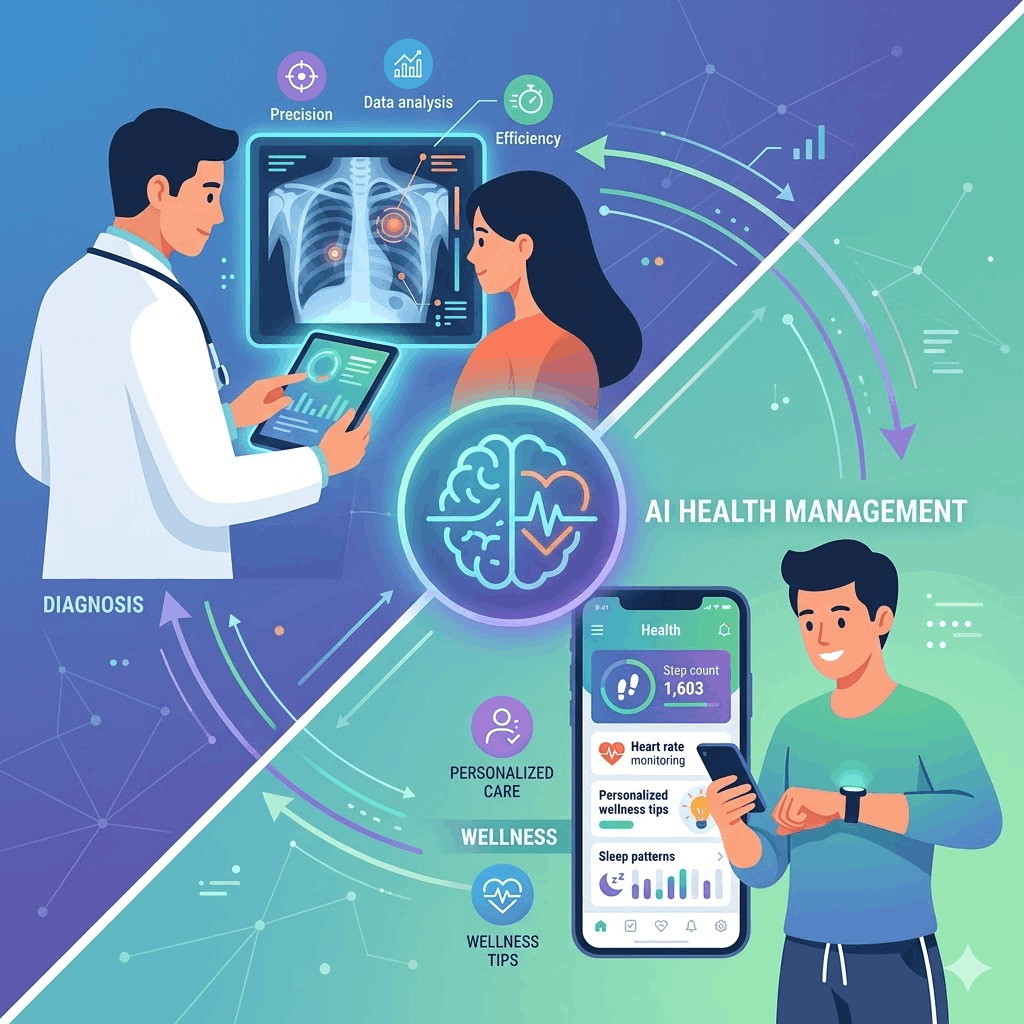
For most of human history, healthcare has been reactive. Something goes wrong, you see a doctor, the doctor diagnoses the problem, and treatment begins. The system was built around the moment of crisis. Not the years leading up to it.
Artificial intelligence is dismantling that model, replacing it with something fundamentally different: a proactive, continuous, personalised system that monitors your health before symptoms appear, identifies risks months or years in advance, and tailors recommendations to your specific biology rather than population averages.
By 2026, AI in healthcare is no longer be experimental. It is embedded in clinical workflows, consumer wearables, drug discovery pipelines, surgical theatres, and mental health platforms. The World Economic Forum’s white paper, The Future of AI-Enabled Health: Leading the Way, notes that despite its rapid development, healthcare is still “below average” in its adoption of AI compared to other industries, which means the transformation already underway is only at its beginning.
With 4.5 billion people currently lacking access to essential healthcare services and a health worker shortage of 11 million expected globally by 2030, the case for AI in health is not just about improving convenience for those who already have access. It is about making quality healthcare available to people who currently have none.
What AI in Healthcare Actually Means
Before examining specific applications, it helps to understand what AI in healthcare actually involves. AI in healthcare refers to the use of machine learning, natural language processing, deep learning, and computer vision technologies to enhance the capabilities of health professionals, improve patient outcomes, and automate tasks that were previously bottlenecks in the system.
The key distinction is data. Human physicians are extraordinarily skilled, but they are limited by what they can hold in memory, how fast they can read an image, how many patients they can see in a day, and how much fatigue affects their judgment. AI systems are not subject to those limitations. They process millions of data points in seconds, detect patterns invisible to the human eye, and apply consistent attention regardless of time of day or patient volume.
The result is not the replacement of doctors. It is an augmentation. AI handles the data-intensive, pattern-recognition-dependent parts of healthcare. Physicians handle the empathy, ethical reasoning, and complex contextual judgment that no current AI replicates.
1. Diagnosis: Speed, Accuracy, and Early Detection
The most immediately visible impact of AI in healthcare is in medical imaging and early disease detection, areas where the difference between catching something early and catching it late is the difference between life and death.
Medical imaging: faster and more accurate than manual review
AI systems analyse MRIs, CT scans, and X-rays in seconds, reducing diagnosis times in some contexts by 90% compared to manual review. This is not a marginal improvement. Tt represents the difference between a radiologist reviewing 50 scans a day and an AI system reviewing thousands, with consistent accuracy throughout.
A study from 2 UK universities trained an AI software system on a dataset of 800 brain scans of stroke patients and then trialled it on 2,000 patients. The result: the AI was twice as accurate as human professionals at examining the scans. Crucially, it could also identify the timeframe within which the stroke occurred, information essential for treatment decisions.
As Dr Paul Bentley, consultant neurologist, explained: “For the majority of strokes caused by a blood clot, if a patient is within 4.5 hours of the stroke happening, he or she is eligible for both medical and surgical treatments.” The AI’s ability to pinpoint this window directly changes which treatments are available.
On fractures, AI is addressing a sobering gap in human performance. Urgent care doctors miss broken bones in up to 10% of cases. AI systems are now approved by the UK’s National Institute for Health and Care Excellence (NICE) for initial fracture scanning. NICE describes the technology as safe, reliable, and capable of reducing follow-up appointments.
Detecting disease before symptoms appear
AstraZeneca developed a machine learning model trained on medical data from 500,000 people in a UK health data repository. The model could “predict with high confidence a disease diagnosis many years later,” identifying signatures in a patient’s data that are highly predictive of developing Alzheimer’s disease, chronic obstructive pulmonary disease, and kidney disease years before any clinical symptoms appear.
A separate study published in research covered by PMC found that an AI tool could successfully detect 64% of epilepsy brain lesions previously missed by radiologists. Trained on MRI scans from over 1,100 adults and children globally, the tool spotted lesions more quickly than a doctor and discovered tiny or obscured ones that had evaded human examination.
Lead researcher Dr Konrad Wagstyl described the challenge: “It’s like finding one character on five pages of solid black text. AI finds about two-thirds that doctors miss, but a third are still really difficult to find.” The combination of AI detection and human oversight produced results neither could achieve alone.
Specialized screening
AI tools designed specifically for diabetic retinopathy detection have achieved 97.5% sensitivity, a level that makes high-quality screening accessible in underserved areas where specialist ophthalmologists are unavailable. For skin cancer detection, AI systems have matched dermatologist-level accuracy in controlled studies, creating a pathway for population-scale screening at a fraction of the current cost.
Every year, approximately 400,000 hospitalised patients suffer preventable harm, with 100,000 deaths. AI acting as a consistent “second pair of eyes” in emergency departments, particularly for complex imaging under high-volume conditions, represents one of the most direct applications for reducing that number.
Real-world tools: Viz.ai deploys AI to detect issues and notify care teams in real time, enabling faster treatment decisions in time-critical situations. Enlitic’s deep learning platform analyses unstructured medical data, radiology images, blood tests, EKGs, genomics, and patient history, to give doctors better insight into a patient’s immediate needs. Subtle Medical’s SubtlePET and SubtleMR products speed up MRI and PET scans while reducing image noise, shrinking wait times by enabling more patients to be scanned per day.
2. Daily Wellness and Personalisation: From Generic Advice to Individual Biology
The second major transformation AI is driving in health is personal, moving daily health management from generic population-level recommendations to advice tailored to individual biology, behaviour, and goals.
Personalized nutrition and metabolism
AI apps now analyse real-time metabolic data, genetic profiles, and gut microbiome composition to create personalised meal plans. This goes far beyond “eat more vegetables,” it means understanding how a specific individual’s body processes carbohydrates, which foods trigger inflammation in their specific microbiome, and what combination of nutrients optimises their energy and cognitive performance given their genetics.
Tools like PlanEat and Samsung Food generate weekly menus and grocery lists tailored to specific health goals, high protein for muscle development, low glycaemic index for blood sugar stability, caloric targets for weight management, while accounting for individual food preferences, dietary restrictions, and time constraints.
Smart wearables evolving into health coaches
The wearable device market has moved well beyond step counting. Current AI-powered wearables analyse heart rate variability (HRV), sleep quality, blood oxygen levels, skin temperature, and stress indicators to provide actionable daily insights.
OpenAI’s ChatGPT Health, a dedicated and encrypted platform built in collaboration with physicians, allows users to securely sync their electronic medical records and wearable data from platforms including Apple Health and MyFitnessPal. The system analyses irregularities in sleeping patterns, provides nutrition recommendations, suggests personalised workouts, and identifies subtle trends, such as sleep or heart rate anomalies, weeks before symptoms appear.
Anthropic’s Claude for Life Sciences, powered by the Claude Opus 4.5 model, connects to clinical databases and patient records through integrations with HealthEx. Users query their medical history and wearable data, receive explanations of complex lab results in plain language, summarise years of medical history, and identify trends across fitness metrics to prepare for doctor appointments. On the enterprise side, the platform automates high-stakes research tasks, including drafting clinical trial protocols.
Both platforms represent a new category of health technology: AI that sits between the patient and the physician, making sense of data continuously rather than only at the point of a clinical appointment.
3. Chronic Condition Management: Continuous Monitoring Instead of Periodic Check-Ins
For the approximately 60% of American adults living with at least 1 chronic condition, the traditional model of quarterly check-ups and annual blood tests is structurally inadequate. Conditions change daily. Complications develop between appointments. Hospitalisation often represents a failure of monitoring that could have caught a problem earlier.
AI is providing proactive management for chronic illnesses that reduces hospitalisation rates and improves daily quality of life through continuous monitoring.
Diabetes management
AI systems now automatically adjust insulin delivery in real time, monitoring glucose levels continuously and modulating the insulin dose response in a way that mimics a functioning pancreas. This shifts diabetes management from a burden of constant manual monitoring and calculation to a background automated process, reducing both the cognitive load on patients and the risk of dangerous glucose excursions.
Twin Health’s Whole Body Digital Twin creates a digital representation of human metabolic function built around thousands of health data points, daily activities, and personal preferences. The company’s holistic approach seeks to address and potentially reverse chronic conditions like Type 2 diabetes through a combination of IoT technology, AI, data science, and medical guidance.
Cardiovascular monitoring
Prolaio integrates with smartwatches and ECG patches to collect a continuous stream of real-world patient data. Its AI analyses this data to identify patterns and early warning signs, allowing care teams to track patient progress and adjust treatment in real time rather than waiting for the next clinic visit. Cleerly’s AI-enabled platform measures and analyses atherosclerosis, plaque buildup in the heart’s arteries, to determine an individual’s specific risk of heart attack and recommend a personalized treatment plan.
Mental health support
AI-powered chatbots and virtual therapeutic platforms now provide 24/7 conversational support for stress, anxiety, and depression management. Spring Health offers a mental health benefit platform that collects a comprehensive dataset from each individual and uses a machine learning model to match people with the right specialist, either in-person care or telehealth, based on their specific profile. Sailor Health focuses specifically on senior mental health, a population that has the highest rates of suicide and loneliness while receiving the least mental healthcare. Its AI-native platform provides real-time clinical insights and care coordination.
Ambulance triage and emergency care
A study in Yorkshire, England, found that in 80% of cases, an AI model could correctly predict which patients needed hospital transfer. The model was trained on factors including patient mobility, pulse, blood oxygen levels, and chest pain, and it also proved to respond without demographic bias. In an emergency system where 350,000 people are taken by ambulance to the hospital each month, 80% predictive accuracy for transfer necessity has direct implications for resource allocation and patient outcomes.
4. Drug Discovery: Compressing Decades Into Years
Drug development is one of the most expensive and failure-prone processes in human enterprise. Putting each drug through clinical trials costs an estimated average of $1.3 billion, and only 10% of those drugs are successfully brought to market. The process from initial discovery to patient availability typically takes 10 to 15 years.
AI is compressing this timeline significantly, helping design drug molecules, predicting side effects before clinical trials, identifying the best candidate patients for trials, and potentially reducing development costs by up to 50%.
Pfizer used AI and machine learning to support the development of PAXLOVID, its COVID-19 treatment, using modelling and simulation to identify compounds with the highest likelihood of effectiveness and narrow research focus accordingly.
Recursion, in partnership with NVIDIA, generates and analyses large amounts of biological and chemical data using generative AI. During experiments, the company uses hardware systems, microscopes, and continuous video feeds to collect data for its AI operating system to review, accelerating the biological experimentation cycle dramatically.
GRAIL’s Galleri test uses AI to screen over 100,000 DNA regions for cancer signals from a single blood sample. If cancer signals are detected, the test predicts the tissue or organ associated with the cancer, creating a pathway for multi-cancer early detection as a routine screening tool.
Freenome uses AI in screenings, diagnostic tests, and blood work to detect cancer in its earliest stages, when treatment is most effective. Deep Genomics applies AI to find candidates for developmental drugs related to neuromuscular and neurodegenerative disorders, improving the statistical probability of passing clinical trials while decreasing time and cost to market.
Atomwise’s neural network, AtomNet, predicts bioactivity and identifies patient characteristics for clinical trials, screening between 10 and 20 million genetic compounds per day and delivering results reportedly 100 times faster than traditional pharmaceutical methods.
5. Healthcare Operations: Reducing Administrative Burden
One of the largest hidden drains on healthcare quality is administrative burden. Physicians spend an estimated 30 to 50% of their working time on documentation, scheduling, and administrative tasks rather than direct patient care. AI is systematically targeting this drain.
AI scribes and clinical documentation
Microsoft’s Dragon Copilot listens to patient-doctor conversations and creates notes on clinical consultations. Nuance DAX, another AI scribe tool, performs the same function, drafting clinical notes from doctor-patient conversations, reducing physician burnout and freeing up time for additional patient care. Freed provides tools that listen to doctor-patient conversations, transcribe the audio, and analyse the dialogue so clinicians easily review and add to electronic health records.
Augmedix uses natural language processing and automated speech recognition for medical documentation across hospitals, health systems, and individual practices. Doximity’s AI Scribe claims users save over 10 hours per week through support for notes, letters, and patient instructions.
In Germany, AI platform Elea has cut testing and diagnosis times from weeks to hours, according to its co-founder Dr Sebastian Casu, who told EU-Startups: “No one joins the healthcare sector to spend hours on admin.”
Digital patient platforms
The World Economic Forum’s Digital Healthcare Transformation Initiative’s 2024 insight report included a case study on digital patient platform Huma, which found it reduced readmission rates by 30% and time spent reviewing patients by up to 40%, while alleviating healthcare provider workload.
Johns Hopkins Hospital partnered with GE Healthcare to use predictive AI techniques to improve patient flow. The result: the facility assigned patients admitted to the emergency department to beds 38% faster.
Digital twins and precision medicine
Researchers are developing “digital twins,” virtual replicas of a person’s physiology, to simulate how an individual will respond to specific treatments before they are administered. Rather than prescribing a treatment and observing the outcome, digital twin technology allows physicians to test multiple treatment approaches virtually and select the one most likely to succeed for a specific patient’s biology. Twin Health’s Whole Body Digital Twin represents the current leading commercial implementation of this concept.
6. AI in Robotic Surgery: Precision Beyond Human Capability
Robotic surgery augmented by AI is enabling procedures with a level of precision that exceeds what human hands achieve unassisted. Intuitive’s da Vinci platform, the first robotic surgery assistant approved by the FDA, uses cameras, robotic arms, and surgical tools to assist minimally invasive procedures, providing surgeons with a three-dimensional, magnified view of the surgical site. The da Vinci system has assisted in over 10 million operations, with a 94 to 100% success rate reported by the Cleveland Clinic.
Carnegie Mellon University’s Robotics Institute developed HeartLander. A miniature mobile robot that enters the chest through a small incision, navigates to specific locations on the heart’s surface by itself, and administers therapy under physician control. Vicarious Surgical combines virtual reality with AI-enabled robots, allowing surgeons to virtually explore the inside of a patient’s body in detail before performing minimally invasive operations.
7. The Unignorable Challenges
Data privacy and security
AI tools require access to large volumes of sensitive patient information, making healthcare organisations prime targets for cyberattacks. HIPAA compliance, data anonymisation techniques, and strict encryption standards are essential but not sufficient, particularly as AI systems become more integrated with wearable devices, consumer apps, and cloud platforms that fall outside traditional hospital security perimeters.
Bias in training data
AI algorithms trained on non-representative data reproduce the biases in that data. Historically, clinical datasets have underrepresented women, patients of colour, and lower-income populations. Algorithms trained on these datasets produce less accurate diagnoses and suboptimal care recommendations for the very groups most underserved by the existing healthcare system. PathAI has specifically partnered with organisations, including the Bill & Melinda Gates Foundation, to expand its AI technology into broader healthcare contexts, explicitly addressing the equity dimension of AI diagnostic tools.
Hallucination and accuracy
A recent study found that OpenAI’s Whisper, used by many hospitals to summarise patient meetings, was hallucinating portions of transcriptions. A US study found that standard large language models, including ChatGPT, Claude, and Gemini, were unable to provide clinicians with sufficiently relevant or evidence-based answers to medical questions when used without retrieval augmentation. ChatRWD, a retrieval-augmented generation system that combines LLMs with retrieval systems, produced useful answers to 58% of clinical questions, compared to 2 to 10% for standard LLMs.
Public trust
A recent UK study found that just 29% of people would trust AI to provide basic health advice. However, over two-thirds reported comfort with AI being used to free up professionals’ time. The gap between these 2 figures, comfort with AI as a support tool versus discomfort with AI as a primary advisor, is where responsible implementation of health AI must operate.
Regulation
In the UK, AI-powered medical devices are strictly regulated by the Medicines and Healthcare products Regulatory Agency. In the US, the FDA concluded that while it will “continue to play a central role in ensuring safe, effective, and trustworthy AI tools,” it is also essential that all involved entities attend to AI with the rigour the technology requires. Dr Caroline Green of the Institute for Ethics in AI at the University of Oxford summarised the practitioner-level challenge: “People using these tools must be properly trained in doing so, meaning they understand and know how to mitigate risks from technological limitations.”
Conclusion
AI is not replacing the doctor-patient relationship. It is expanding what that relationship detects, predicts, and personalizes. A physician with access to AI tools reviews imaging in seconds instead of minutes, catches diseases years before symptoms appear, adjusts chronic condition management continuously instead of quarterly, and spends more time in direct conversation with patients because administrative tasks are automated. A patient with access to AI tools understands their lab results, tracks subtle changes in their biometrics, and arrives at appointments with a clearer picture of their own health than was previously possible for anyone outside a clinical setting.
The transformation is not uniform; access to AI health tools remains heavily skewed toward those who afford premium wearables and subscription platforms. Closing that gap is the most important work ahead of the healthcare AI sector. The technology to detect cancer from a blood test, predict Alzheimer’s years before symptoms, and monitor heart health continuously already exists. Making it available to the 4.5 billion people currently without access to essential healthcare is the challenge that will define whether AI in health becomes one of the most equitable developments in medical history, or one more tool that widens the gap between those who have access to excellent care and those who do not.
AI research, health technology, and the scientific developments reshaping medicine and human wellbeing, our newsletter covers every story worth following. Subscribe and stay informed.