
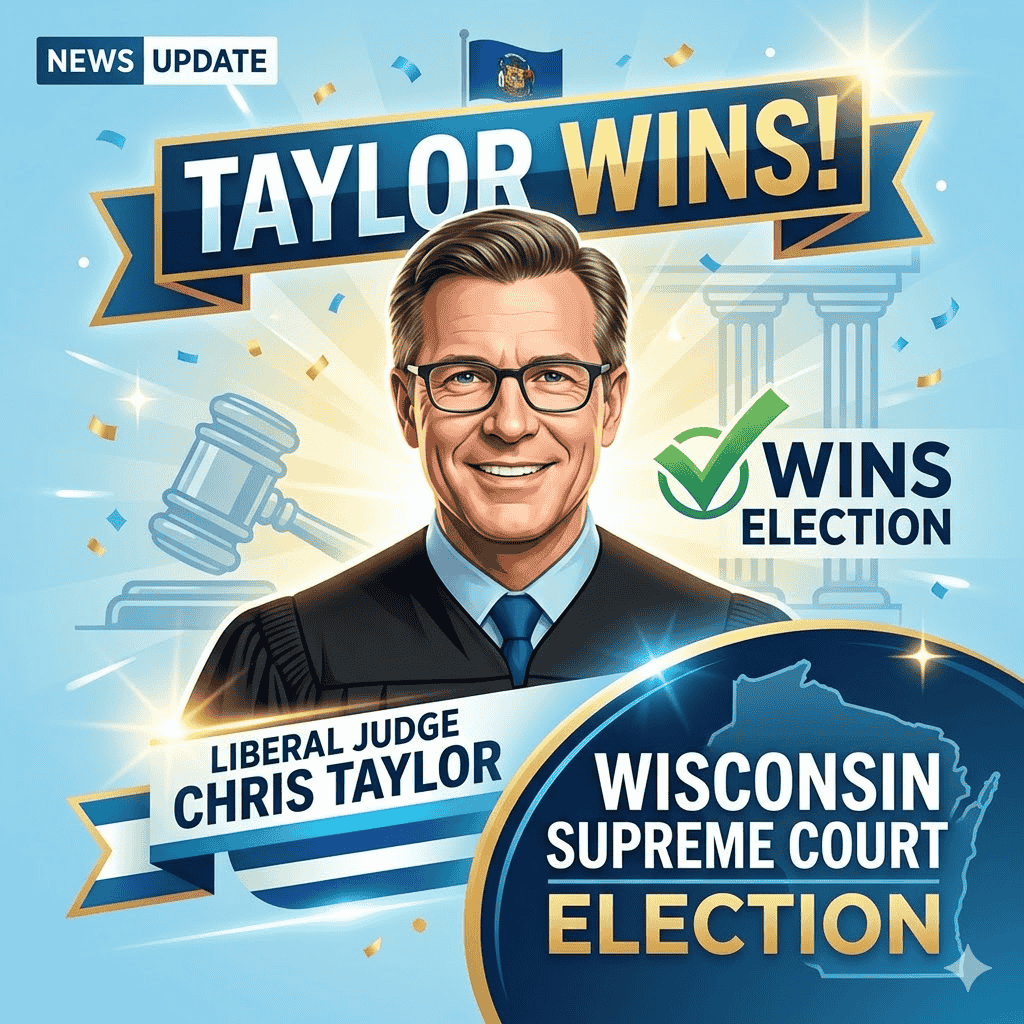
Democratic-backed Judge Chris Taylor won a seat on the Wisconsin Supreme Court on April 7, 2026, defeating Republican-backed Judge Maria Lazar by a margin of 60.1% to 39.8%. A gap of more than 300,000 votes.
The win extends the liberal majority on Wisconsin’s highest court to 5-2, guarantees liberal control through at least 2030, and carries significant consequences for abortion rights, redistricting, union law, and the 2028 presidential election in one of America’s most competitive battleground states.
Who Won and Who Lost
Chris Taylor (Winner)
Taylor is a state Appeals Court judge from Dane County who has served as a judge since 2020. Before that, she spent 10 years as a Democrat representing Madison in the Wisconsin State Assembly and worked as an attorney and policy director for Planned Parenthood of Wisconsin. Abortion rights sat at the centre of her campaign.
1 of her TV ads stated directly that “abortion is on the ballot.” Taylor raised more than $5.6 million for the race and outspent Lazar approximately 9 to 1 on television advertising, according to a tally by the Brennan Center for Justice.
Maria Lazar (Defeated)
Lazar is a state Appeals Court judge from Waukesha County who has served as a judge since 2015. Before joining the bench, she worked 4 years as an assistant state attorney general under a Republican attorney general, where she defended former Republican Governor Scott Walker’s Act 10, legislation that effectively ended collective bargaining rights for most public-sector workers, as well as Republican redistricting efforts and laws implementing voter ID requirements and restricting abortion access. Lazar raised approximately $900,000 for the race. She conceded on election night at the Ingleside Hotel in Pewaukee.
The Final Numbers
99% of votes counted. Taylor’s margin: 305,145 votes.
| Candidate | Votes | Percentage |
| Chris Taylor (Liberal) | 903,411 | 60.1% |
| Maria Lazar (Conservative) | 598,266 | 39.8% |
What Does This Change on the Wisconsin Supreme Court
The new court composition
With Taylor’s win, liberals now hold a 5-2 majority on the Wisconsin Supreme Court. Their strongest position since liberals reclaimed the majority in 2023, ending 15 years of conservative control.
How the majority was built: 4 consecutive liberal wins
The current liberal dominance on the court was built through 4 straight victories in statewide judicial elections dating back to 2020:
- 2020: The Liberals’ win begins the winning streak
- 2023: Liberals reclaim the majority, ending 15 years of conservative control
- 2025: Liberals hold their majority despite massive national spending, Trump involvement, and Elon Musk personally handing out $1 million checks to Wisconsin voters in support of the conservative candidate
- 2026: Taylor’s win extends and deepens the majority to 5-2
How long will liberals hold the court?
Taylor’s victory guarantees liberal control of the Wisconsin Supreme Court until at least 2030. Another conservative justice (Annette Ziegler) announced her retirement earlier in 2026, meaning another seat will be up in 2027. If liberals win that race as well, the court becomes 6-1, the most lopsided majority in either direction in recent Wisconsin history.
Who the 2 Candidates Are: Backgrounds
Taylor’s background in detail
Taylor entered the race with a distinctly political background for a judicial candidate. A fact her opponent used against her. She spent 10 years in the Wisconsin State Assembly as a Democrat from Madison, one of the state’s most liberal cities. She worked for Planned Parenthood before her legislative career. She was elected to the Appeals Court in 2020. Her campaign placed abortion at the centre of its message, and she attracted support from prominent national Democrats, including former President Barack Obama, former Transportation Secretary Pete Buttigieg, Arizona Senator Mark Kelly, Connecticut Senator Chris Murphy, and former US Ambassador to Japan Rahm Emanuel.
Lazar’s background in detail
Lazar entered the race with a more traditionally judicial profile. A judge since 2015 with prior experience as an assistant state attorney general. Lazar’s opponents focused on her record defending conservative legislation during her time at the Department of Justice, including Act 10 and laws restricting abortion access. Lazar was supported by anti-abortion groups and backed by Wisconsin Republican Party Chair Brian Schimming. Former Governor Scott Walker attended her election night event. The conservative side argued that Lazar fit the profile of successful conservative judicial candidates, prior prosecutorial experience and strong law enforcement backing, but acknowledged the challenge of winning back suburban voters in southeast Wisconsin.
The Issues That Defined the Race
Abortion rights
Taylor made abortion the centrepiece of her campaign. The liberal-controlled court already struck down a state abortion ban law after gaining the majority in 2023. Taylor’s ads directly tied her candidacy to protecting abortion access, and she criticized Lazar for previously calling the US Supreme Court’s overturning of Roe v. Wade “very wise.”
Act 10 and union rights
Lazar’s defence of Act 10, the Scott Walker legislation that ended collective bargaining for most public-sector workers, became a major issue. A circuit court judge ruled in December 2024 that Act 10 is unconstitutional. That ruling is expected to reach the Wisconsin Supreme Court, where Lazar would have been positioned to help defend the law she previously argued for as a government attorney.
Redistricting
The liberal-controlled court has already ordered new legislative maps in Wisconsin, a state where Republicans have held the legislative majority since 2011. Taylor’s win keeps the liberal majority in place as Democrats pursue further redistricting challenges ahead of the November 2026 elections for the state legislature.
Partisanship on the bench
The race’s sole debate saw both candidates accuse each other of bringing partisan agendas to the court. Lazar called Taylor a “radical, extreme legislator” and a “judicial activist.” Taylor said Lazar would bring “an extreme, right-wing political agenda to the bench.” Though Wisconsin Supreme Court races are officially nonpartisan, support for both candidates broke almost entirely along partisan lines.
Why This Race Mattered Less Nationally and Still Matters Enormously Locally
Lower national profile than 2025
The 2026 race drew significantly less national spending and attention than the previous 2 Wisconsin Supreme Court elections, where national spending records were set in battles over majority control. The difference: in 2025, the entire court majority was at stake. In 2026, liberals already held the majority, meaning conservatives were competing to narrow the gap. Not flip control. That lower-stakes framing reduced outside money and national media coverage dramatically.
High local stakes
Locally, the implications are significant and immediate. The liberal-controlled court is directly relevant to at least 4 active or anticipated legal disputes: the ongoing Act 10 constitutionality ruling, legislative redistricting ahead of the 2026 November elections, abortion access litigation, and any election-related challenges tied to the 2028 presidential race in a state that has voted for different parties in consecutive presidential elections.
Wisconsin Republican Party Chair Brian Schimming’s post-result statement acknowledged the scale of the challenge: “Stay united and continue fighting for our conservative values.” Conservative strategist Mark Graul, who has run Wisconsin Supreme Court campaigns before, pointed to the need to win back suburban voters, particularly in the southeast portion of the state, as the core structural challenge the conservative movement faces in future court races.
Final Words
Taylor’s victory speech framed the result in terms that went beyond Wisconsin: “Once again, Wisconsin showed the entire nation that we believe that the people should be at the center of government and the priority of our judiciary, not the billionaires, not the most powerful and privileged, but the people.” Whether Wisconsin’s liberal court winning streak, now at 4 consecutive races, continues in 2027 will determine whether that majority deepens to 6-1 or stabilizes at 5-2. Either way, the court that will be hearing cases about abortion, redistricting, union rights, and the 2028 presidential election is now solidly, durably liberal for the foreseeable future.
Election results, political developments, and the decisions shaping American governance, our newsletter covers every story worth knowing about. Subscribe and stay informed.