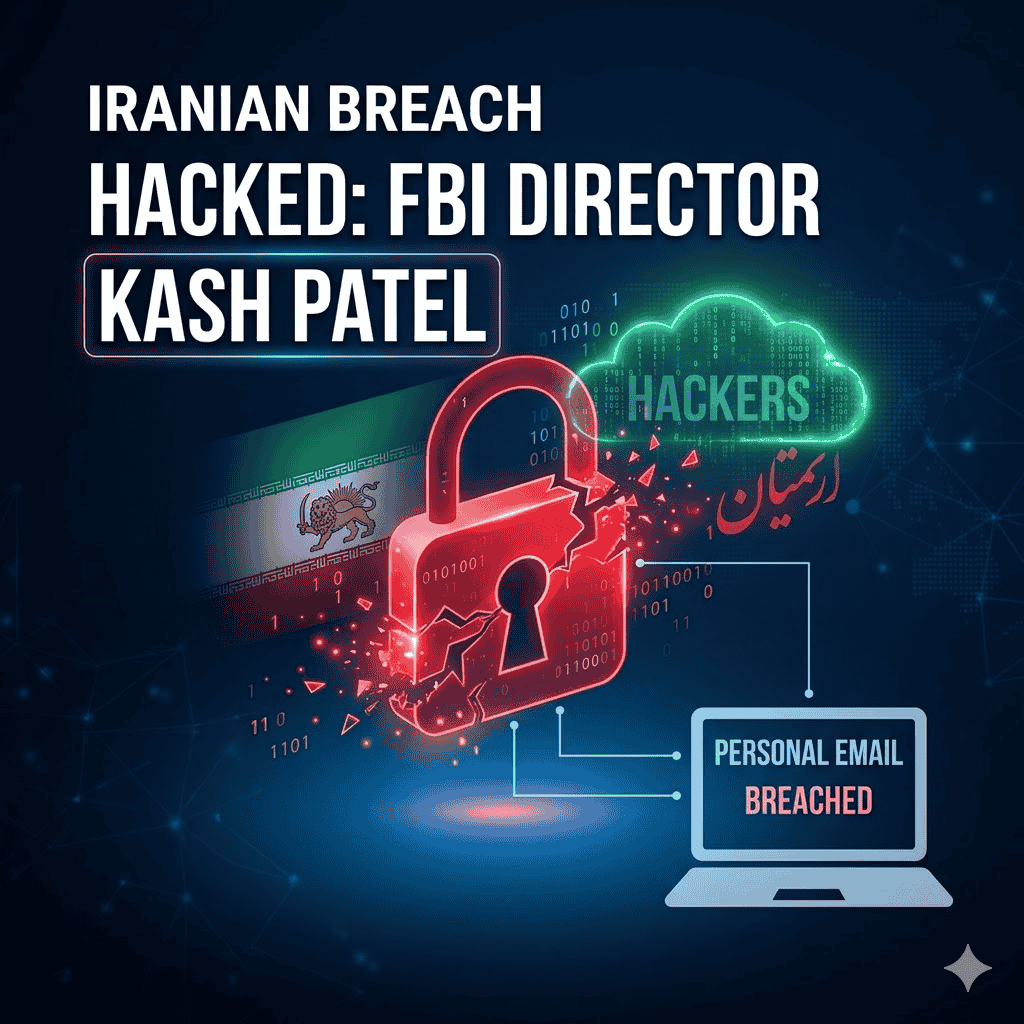
An Iranian-linked hacking group called Handala publicly claimed it had breached the personal Gmail account of FBI Director Kash Patel on March 27, 2026, publishing hundreds of his personal emails and photographs online.
The FBI confirmed the breach. The group called it the beginning of a wider campaign.
Security experts called it something more specific: an embarrassment operation designed for maximum propaganda value.
Experts further added that it was built on a relatively unsophisticated attack against a personal account with far weaker protection than any government system.
Who Is Kash Patel
Kash Patel is the current Director of the Federal Bureau of Investigation, appointed by President Donald Trump. Before leading the FBI, he served in senior national security roles in the Trump administration’s first term and was a vocal critic of the FBI’s leadership during that period, which made his eventual appointment as its director one of the most politically charged law enforcement appointments in recent US history. Patel is a prominent public figure and a high-value symbolic target for any group seeking to embarrass the US government.
What Was Breached and What Was Not
What Handala claims to have accessed
The Handala Hack Team published the following material on its website on March 27:
- More than 300 emails from what appears to be Patel’s personal Gmail account.
- Personal photographs showing Patel at various locations, smoking and sniffing cigars, riding in a vintage convertible, taking a selfie with a bottle of rum, and posing at restaurants and hotels.
- What is described as a resume and personal documents.
What the FBI confirmed
The FBI confirmed that Patel’s personal email had been targeted. Bureau spokesman Ben Williamson stated the data involved was “historical in nature and involves no government information” and that the bureau had “taken all necessary steps to mitigate potential risks associated with this activity.“
What was not breached
Handala’s statement claimed to have brought the “impenetrable systems of the FBI to their knees within hours.” That claim is false. All evidence reviewed by security researchers and journalists points to Handala having accessed Patel’s older, personal Gmail account, not any FBI system, not any government network, and not any classified infrastructure. The FBI’s own systems were not compromised.
The email content
The emails that appeared in the published sample are dated primarily between 2010 and 2019, years before Patel held any FBI role. Reuters confirmed that the personal Gmail address Handala claims to have accessed matches an address linked to Patel in previous data breaches preserved by the dark web intelligence firm District 4 Labs. TechCrunch found that Patel appears to have forwarded some emails from his Justice Department account to the same Gmail address in 2014, a security practice that is strongly discouraged but not uncommon among officials.
Who Is the Handala Hack Team
Background
Handala presents itself publicly as a group of pro-Palestinian vigilante hackers. Western cybersecurity researchers widely consider it to be one of several personas used by Iranian government cyberintelligence units, specifically Iran’s Ministry of Intelligence and Security (MOIS). The group is described by experts as “opportunistic.” Its attacks are calculated more for their propaganda and psychological impact than for tactical intelligence value.
Recent operations
Handala has been escalating its public operations since the US-Israel military campaign against Iran began. The following are its 4 most notable recent actions:
- Stryker cyberattack (March 11, 2026): Handala claimed to have wiped over 200,000 systems at Michigan-based medical technology company Stryker, claiming to have extracted 50 terabytes of critical data and erased employee login systems
- Lockheed Martin data leak (March 26, 2026): Handala claimed to have published personal data of dozens of Lockheed Martin employees stationed in the Middle East and threatened them with personal harm if they did not leave within 48 hours. When journalists called the phone numbers in the leaked data, most did not work
- Kash Patel email breach (March 27, 2026): the current incident
- $50 million bounty on Trump and Netanyahu: Handala posted a statement offering $50 million to anyone who could “eliminate” President Donald Trump and Israeli Prime Minister Benjamin Netanyahu, framing the offer as a direct response to the US Department of Justice’s $10 million reward for information leading to the identification of Handala members
Why the FBI is offering $10 million for Handala information
The US Justice Department had previously seized several Handala domain names linked to hacking schemes, describing the group as using its websites to spread terrorist propaganda, conduct psychological operations, claim credit for hacking activity, and call for the killing of journalists and dissidents. The $10 million reward is offered for information that helps identify Handala members. The domain Handala used to publish the Patel breach material was registered the same day the DOJ announced the domain seizures, March 19, 2026.
Why This Breach Was Not Technically Sophisticated
Security experts emphasised that breaching a personal Gmail account is not the same as breaching a government system, and the gap between the 2 in terms of security is vast.
Dave Schroeder, Director of National Security Initiatives at the University of Wisconsin-Madison, explained: “Personal accounts don’t have the same level of protection and alerting as government systems, so these are often an attractive target for hackers.”
Cynthia Kaiser, Senior Vice-President at Halcyon Ransomware Research Center and a former FBI cybersecurity analyst, assessed the published emails as likely coming from a historical breach: “The emails look very old, and that makes me believe that this is likely a compromise that occurred from other groups in another time period, and is recycled today.”
This pattern has precedent. Russian hackers breached Hillary Clinton campaign chairman John Podesta’s personal Gmail in 2016. Teenage hackers broke into then-CIA Director John Brennan’s personal AOL account in 2015.
In both cases, the breach was technically simple but politically significant. The target was not the institution. It was the individual’s personal account, with weaker security and older data.
Why Iran Is Doing This Now
The breach fits a specific strategic pattern that Israeli cybersecurity firm Check Point identified explicitly. Chief of staff Gil Messing described the Patel hack-and-leak operation as part of Iran’s broader strategy to embarrass US officials and “make them feel vulnerable” as the US-Israel military conflict against Iran drags into its second month.
A US intelligence assessment reviewed by Reuters on March 2 noted that Iran and its proxies could respond to the conflict with low-level hacks against US digital networks, exactly the category this operation falls into. The assessment did not predict sophisticated infrastructure attacks. It predicted embarrassing operations: visible, humiliating, and designed for public consumption rather than strategic intelligence value.
Handala confirmed this intent in its own statement: “The so-called ‘impenetrable’ systems of the FBI were brought to their knees within hours by our team. This is the security that the US government boasts about?“
The statement is designed for propaganda, not accuracy. The FBI’s systems were not compromised. But the statement generated global headlines regardless.
What This Means for Senior Officials Using Personal Email
The Patel breach is the latest in a long pattern that security professionals have been warning about for years: senior government officials who use personal email accounts for any work-adjacent communication create a persistent vulnerability that has nothing to do with government system security.
Personal accounts, regardless of how secure the government systems around them are, operate with consumer-level protection. They do not have the same monitoring, alerting, or incident response infrastructure as classified or government-managed systems. They are accessible from any device, anywhere, and are subject to the same credential stuffing, phishing, and historical breach exposure as any other personal account.
The fact that Patel’s Gmail address appeared in previous data breach databases, preserved by dark web intelligence firms, indicates the account had been exposed in prior incidents. Recycling data from historical breaches is among the most common and least technically demanding operations in the hacking world.
Conclusion
Handala breached a personal Gmail account containing personal photographs and decade-old emails. The FBI’s systems were not touched. The breach is not operationally significant as an intelligence operation. It is, however, exactly what it was designed to be, a public humiliation of the United States’ top law enforcement official, timed to coincide with an active military conflict, published for maximum visibility. Iran is not demonstrating technical capability. It is demonstrating willingness to keep attacking, and willingness to embarrass, and in that narrow objective, the operation succeeded completely.
Cybersecurity threats, state-sponsored hacking, and the security developments shaping global politics – our newsletter covers every story worth knowing about. Subscribe and stay informed.