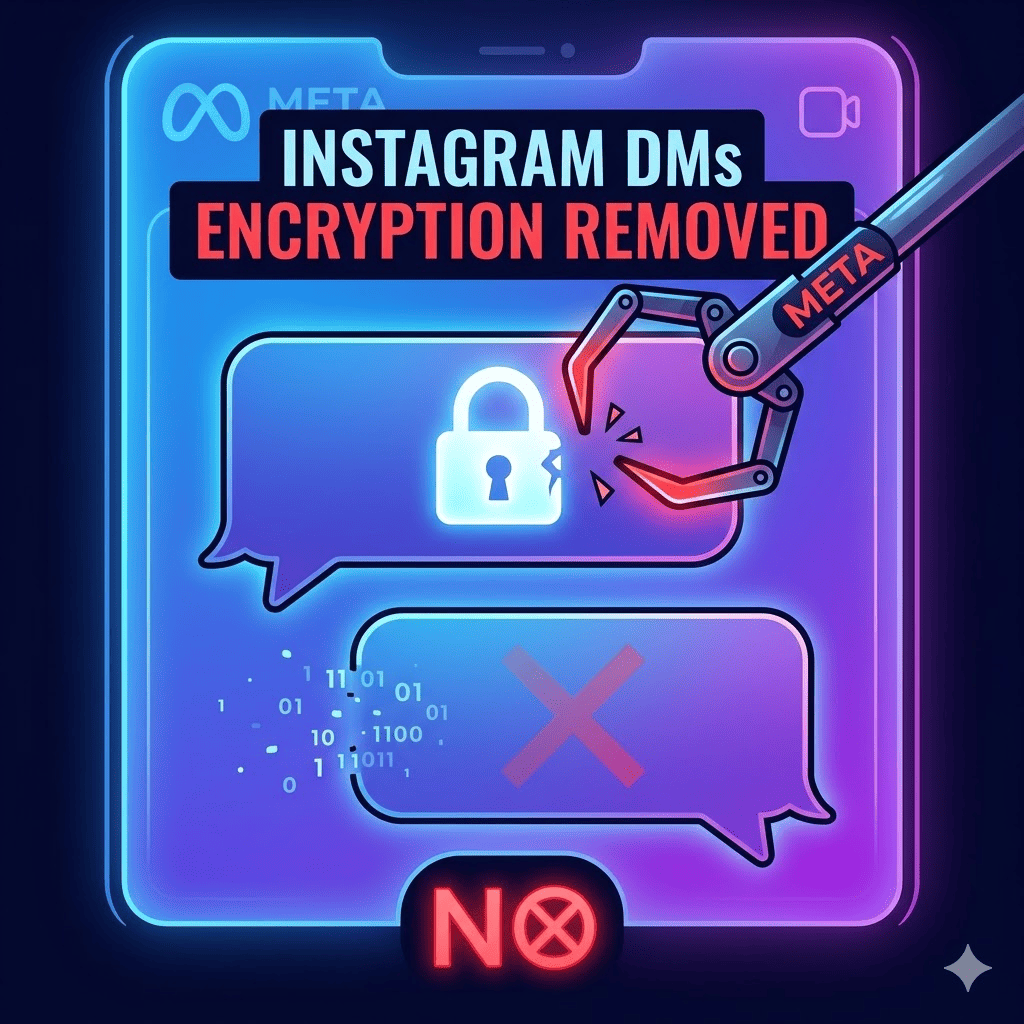
Meta has quietly announced that end-to-end encryption for Instagram direct messages will be discontinued on May 8, 2026. After that date, Meta will technically be able to read the contents of every private conversation on Instagram. The company says the reason is low adoption. Experts say the real reasons are more complicated, and more consequential.
What Is End-to-End Encryption and Why Does It Matter
What is End-to-End Encryption?
End-to-end encryption (E2EE) is a system where only the 2 people in a conversation can read what is being sent. The messages are scrambled at the sender’s device and can only be unscrambled at the recipient’s device. No one in between, not Meta, not a hacker who intercepts the data in transit, not a government agency with a warrant, can read the content.
What changes without it?
Without end-to-end encryption, Meta’s servers can access the content of every Instagram DM. This means:
- Meta can scan messages for moderation purposes
- Meta can be legally compelled to hand over chat histories to law enforcement
- Meta can technically use message content for advertising targeting or AI training
- A data breach of Meta’s servers exposes message content, not just metadata
What stays the same
WhatsApp, which is also owned by Meta, will keep its end-to-end encryption. Facebook Messenger’s encryption status is separate. Only Instagram DMs are losing the feature.
What Meta Says and What It Is Not Saying
The official reason
Meta’s spokesperson stated the decision was due to low uptake: “Very few people were opting in to end-to-end encrypted messaging in DMs, so we’re removing this option from Instagram in the coming months.“
Why does that explanation have problems
The low adoption argument does not hold up to scrutiny for 3 specific reasons:
- The feature was deliberately hard to find: Enabling E2EE on Instagram required 4 to 5 separate steps and was not explained clearly to users. It created a separate conversation thread rather than upgrading an existing one, and some conversations disappeared from devices after being initiated. Low adoption under those conditions reflects poor product design, not low user demand for privacy.
- The feature was opt-in, not opt-out: Meta chose to make encryption something users had to actively turn on rather than something active by default. A feature that requires effort to enable will always show lower adoption than one enabled by default. This was a design choice, not a user preference.
- WhatsApp is staying encrypted: If Meta’s concern were genuinely operational simplicity, removing encryption from WhatsApp would make more logical sense, since WhatsApp is primarily a messaging app. Instagram being singled out suggests the decision is platform-specific and likely commercially motivated.
Who Has Been Pressuring Meta to Remove Encryption
Law enforcement agencies
For years, an international coalition of law enforcement agencies argued publicly and formally that Meta’s encryption plans would harm their ability to investigate crimes. The agencies that pushed back against encryption included:
- The FBI (United States)
- Interpol (international)
- The UK’s National Crime Agency
- The Australian Federal Police
Their argument: end-to-end encryption prevents platforms from detecting and reporting child sexual exploitation, terrorism, and human trafficking occurring through private messages.
Child safety groups
Multiple child safety organisations raised similar concerns, arguing that encrypted messaging creates a protected channel for abuse.
The counter-argument from privacy experts
Tom Sulston, head of policy at Digital Rights Watch, noted that the move is more likely commercially motivated than law-enforcement-driven, pointing to the fact that WhatsApp, which faces the same law enforcement pressure, is keeping its encryption. Sulston also noted that unencrypted message content gives Meta the ability to use conversations for advertising targeting and AI model training, creating a direct commercial incentive for the removal that has nothing to do with child safety.
The Australian eSafety Commissioner’s office offered a measured position: strong encryption protects privacy and security, but platforms also have obligations to prevent harm regardless of whether encryption is in place. Neither position rules out encryption. They simply require platforms to build additional safety tools alongside it.
What the Experts Think Is Actually Going On
Privacy researchers and digital rights experts point to 3 explanations for the removal that Meta has not addressed publicly:
1. Advertising and AI training
Unencrypted message content is significantly more valuable commercially than encrypted content. Meta already knows who you talk to on Instagram, how frequently, and for how long, but without encryption removal, it cannot know what you say. Message content could improve ad targeting precision and provide training data for Meta’s AI models. As Tom Sulston stated: “The commercial pressure to use it is huge, so it feels inevitable that they will if they’re not already.“
2. Platform strategy: Separating social media from messaging
Sulston also suggested Meta may be deliberately segregating its platforms by function: Instagram as a social discovery platform where users find new people, and WhatsApp as a private messaging platform between people who already know each other. Keeping encryption on WhatsApp while removing it from Instagram fits this distinction, social discovery platforms benefit from content visibility in ways that private messaging apps do not.
3. Infrastructure simplification
Merging messaging across WhatsApp, Facebook, and Instagram into a unified infrastructure, a goal Meta has previously pursued, is significantly more complex when encryption protocols differ across platforms. Removing Instagram’s encryption may simplify a planned future integration.
What Happens to Your Existing Encrypted Messages
Meta has stated that users with existing encrypted Instagram conversations will see instructions for downloading their messages before May 8. After that date, those conversations will no longer be protected by end-to-end encryption going forward. Users on older versions of Instagram will need to update the app to access the download functionality.
Messages sent before May 8 in encrypted conversations will not automatically become readable by Meta, but messages sent after May 8 will not be encrypted at the sending stage.
What This Means for the Broader Encryption Debate
Security researchers and privacy advocates are treating this as a significant precedent rather than a product decision. The concern is not just about Instagram DMs. It is about what happens next.
Meta is one of the largest technology companies in the world. Its retreat from encryption on a major platform signals to governments, regulators, and other tech companies that law enforcement pressure combined with commercial incentives can override privacy commitments even for a company that publicly championed encryption just 3 years earlier.
Zuckerberg first announced plans to roll out end-to-end encryption across Meta’s platforms in 2019. Implementation did not begin until 2023. By May 2026 (7 years after the commitment) Instagram’s encryption is being reversed entirely.
Security researchers warned directly: “Meta’s retreat from its commitments to protect user privacy with end-to-end encryption on Instagram chat could create a problematic precedent in big tech,” particularly as repressive governments worldwide look to expand surveillance capabilities and law enforcement agencies continue pressuring platforms to weaken privacy protections.
What You Can Do
The following are 3 practical actions for Instagram users who want to maintain private messaging:
- Download your existing encrypted conversations before May 8: Follow the instructions Meta will display in the app for affected chats
- Move sensitive conversations to WhatsApp: Meta itself recommends this, and WhatsApp’s encryption is remaining in place
- Use a dedicated encrypted messaging app: Signal remains the gold standard for end-to-end encrypted messaging with no commercial incentive to remove it
Final Takeaway
Meta is removing Instagram DM encryption because very few people used it, which is true, but incomplete. Very few people used it partly because Meta made it difficult to use, did not enable it by default, and built it in a way that created friction rather than seamlessness.
The feature is being removed 3 years after it arrived and 7 years after it was promised, in a decision that serves law enforcement pressure, advertising strategy, and AI training data acquisition simultaneously. Whether users notice or care enough to act is the question that will determine how significant a precedent this actually becomes.
Digital privacy, security policy, and the platform decisions affecting billions of users, our newsletter covers every development worth knowing about. Subscribe and stay informed.