
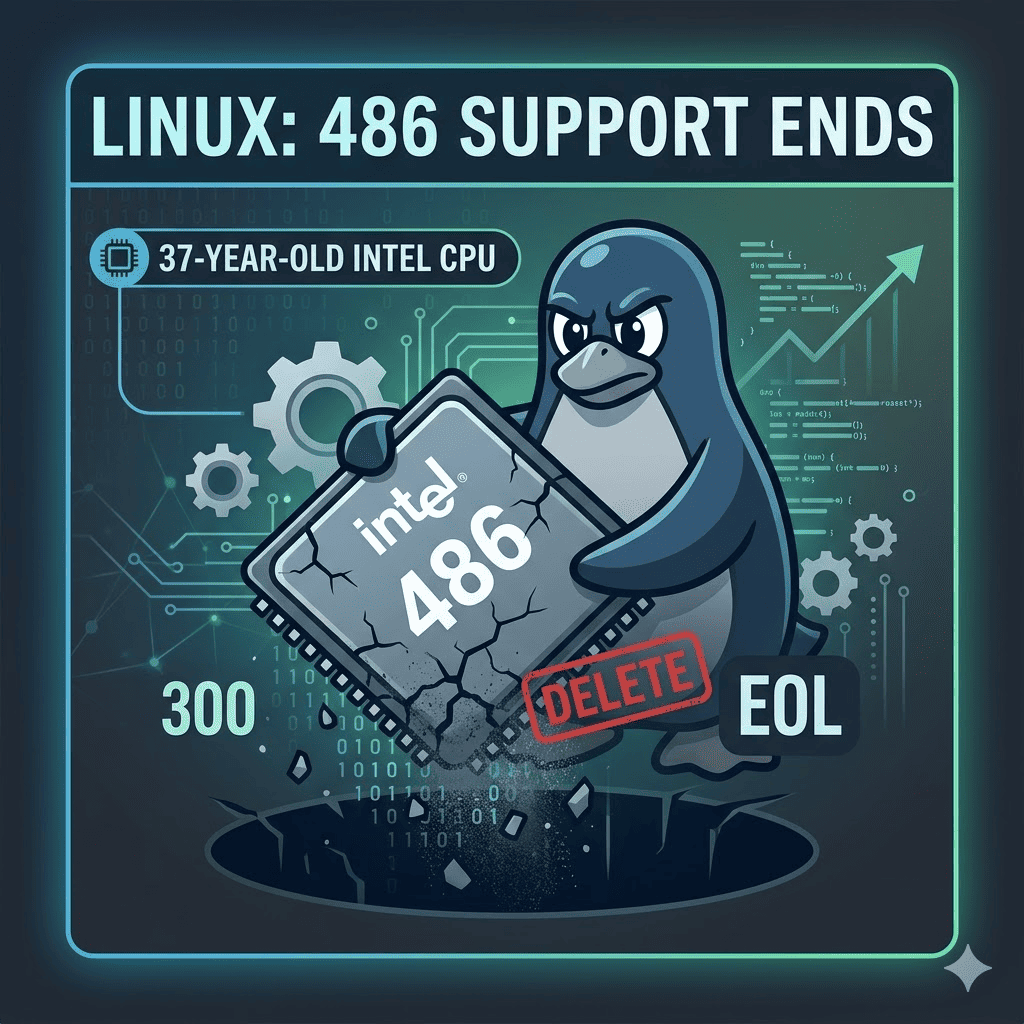
Linux 7.1 is set to begin removing support for Intel’s i486 processor, a chip that first launched in 1989 and has somehow maintained kernel-level support for 37 years. A patch authored by kernel developer Ingo Molnar is already queued into the Linux kernel’s tip/tip.git development branch ahead of the Linux 7.1 merge window, removes the 3 Kconfig build options that allow an i486 kernel image to be compiled.
Linus Torvalds himself stated there is “zero real reason” to keep it around, and for the first time in nearly 4 decades, he appears to be right.
What Is Actually Being Removed and Why It Took This Long
The 3 Kconfig options being dropped in Linux 7.1:
- CONFIG_M486SX: Covers 486-class CPUs without a floating point unit, including AMD, Cyrix, IBM, Intel SL/SLC/SLC2/SLC3/SX/SX2 and UMC U5S variants.
- CONFIG_M486: Covers 486-class CPUs with a built-in FPU, including AMD, Cyrix, IBM, Intel 486DX/DX2/DX4, and UMC U5D variants.
- CONFIG_MELAN: Covers the AMD Elan processor, a low-power 486-derived chip used in embedded applications.
Removing these options means users can no longer compile a Linux kernel image targeting an i486 processor. The actual i486 support code buried deeper in the kernel will be removed in a subsequent kernel series. Linux 7.1 is the first step. Not the last.
Why it took 37 years: The i486 was kept alive not because it was actively used, but because removing it required effort, and nobody had a strong enough reason to prioritise the work. Molnar’s patch notes that maintaining “ancient” 32-bit CPU support requires “various complicated hardware emulation facilities on x86-32,” a technical debt that adds an ongoing maintenance burden for every kernel update without benefiting any practical user base.
What Is the Intel 486 and Why Does It Matter Historically
The Intel 486 launched in 1989 as the dominant consumer processor of the early 1990s. It was the chip that brought personal computing to mainstream households, ran DOS, Windows 3.1, early Linux distributions, and games like Doom, X-COM, and Warcraft. It introduced 3 hardware advancements that modern processors still build on:
- Built-in L1 cache: The first x86 processor to integrate a cache directly on the chip, dramatically reducing memory access latency
- Integrated FPU on DX variants: The 486DX included a floating point unit directly on the die, whereas previous chips required a separate math coprocessor
- VL-Bus (VESA Local Bus): A high-speed bus standard that bridged the 486 directly to expansion cards, enabling far faster graphics and storage performance than the ISA bus it replaced
The 486 came in several variants that are still referenced with surprising familiarity in community discussions: the DX (full chip with FPU), the SX (FPU removed or disabled, sold at a lower price), the DX2 (clock-doubled variants running at 50 or 66MHz), and the DX4 (clock-tripled variant reaching 100MHz, which competed directly with early Pentium processors in many workloads).
Linux itself has a specific connection to the 486. Linus Torvalds began developing the Linux kernel in 1991 on a 386-based machine, not a 486, as is sometimes misremembered, but the 486 was the dominant hardware Linux ran on as it grew from a personal project into a serious operating system through the mid-1990s.
Who Actually Still Uses a 486 in 2026
The honest answer is: almost nobody running a modern kernel. No known Linux distribution still ships with i486 support. Anyone still running a 486 with Linux is almost certainly running a kernel version that is years or decades behind the current release, meaning Linux 7.1’s removal has no practical effect on them whatsoever.
The 3 scenarios where 486-class hardware genuinely remains in active use are:
- Industrial and embedded control systems: 486-derived processors were manufactured well into the 2000s for embedded applications. Intel’s embedded 486 variants were produced until 2007. Equipment using these chips for real-time control, motion systems, or legacy industrial automation has no reason to upgrade to a modern kernel and almost certainly never will
- Aerospace and radiation-hardened computing: The F-22 Raptor famously runs on radiation-hardened 486 processors, which tolerate cosmic radiation far better than modern silicon. These systems do not run Linux, and do not run consumer Intel chips, but illustrate that 486-class architecture has legitimate longevity in specialised environments
- Retrocomputing hobbyists: A small community actively builds and maintains 486 systems, including new FPGA-based 486 clones available today. These users are overwhelmingly running legacy software on legacy kernels and are not affected by Linux 7.1
What Happens If You Still Need i486 Linux Support
Linux 7.1 removes the ability to build a new kernel for i486. It does not delete existing kernels. The following 3 options remain available for anyone with a genuine i486 requirement:
- Continue running an existing Linux LTS kernel: Multiple long-term support versions remain available and supported, covering any realistic i486 use case
- Fork the patch: Linux is open source. Anyone with the technical capability to maintain i486 support can fork the relevant code and maintain it independently. Industrial users with the resources to still be running 486 hardware in 2026 almost certainly have the resources to do this
- Run FreeDOS or an alternative OS: For retrocomputing and legacy software use cases, FreeDOS and NetBSD remain viable alternatives that have no plans to drop 486 support
What Comes After Linux 7.1
The Kconfig removal in Linux 7.1 is the first of 2 planned steps. Once those build options are gone and no significant complaints emerge, which kernel maintainers fully expect, the underlying i486 support code will be removed entirely in a subsequent kernel series, completing the cleanup.
The 386 processor, which preceded the 486, had its Linux support dropped in 2012, meaning the 386 received 21 years of Linux support and the 486 received approximately 32 years. By any measure, both chips outlasted their support obligations by decades.
Final Takeaway
The Intel 486 ran Doom, built careers, and powered the early internet. It shipped in millions of machines across the early 1990s and earned genuine affection from an entire generation of computer users. Linux supported it for 37 years. Longer than most of those users have been employed in the industry it helped build. The kernel moving on is not a slight. It is the most honest possible acknowledgment that the chip did exactly what it was supposed to do, for far longer than anyone had any right to expect.
Tech history, open-source software, and the hardware decisions shaping modern computing, our newsletter covers every development worth knowing about. Subscribe and stay informed always.